How to Build a Passive Income Stream with Aged Domains
May 26, 2026 · 16 min read

How to Build a Passive Income Stream with Aged Domains
Aged domains are previously registered web addresses with built-in SEO advantages like backlinks, indexed content, and trust signals. Unlike new domains, aged ones bypass Google's "sandbox" period, allowing you to attract organic traffic faster. Here's a quick breakdown of how to turn aged domains into passive income:
- Find the Right Domain: Ensure its history matches your niche. Use tools like the Wayback Machine to check past content and backlinks for quality.
- Monetize It: Options include display ads, affiliate marketing, lead generation, or flipping the domain for profit.
- Rebuild and Optimize: Restore valuable pages or redirect them strategically. Focus on content updates and SEO improvements.
- Leverage AI Tools: Automate content creation, marketing, and site maintenance to save time and scale efficiently.
- Track Performance: Monitor revenue, traffic, and ROI to decide whether to hold, grow, or sell the domain.
Aged domains are a shortcut to building profitable websites. With the right strategies, you can generate steady income with minimal effort.
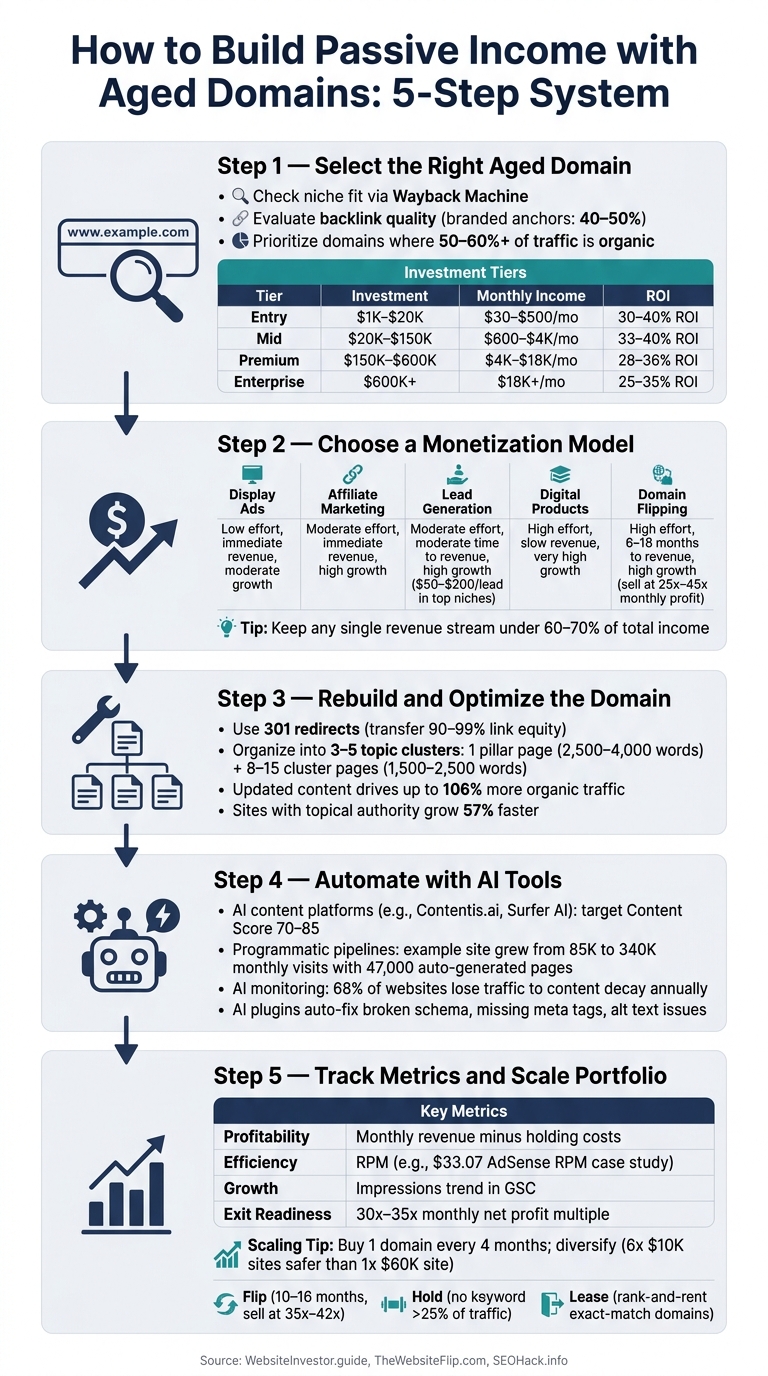
How to Build Passive Income with Aged Domains: 5-Step System
How to Buy, Flip, and Build Six-Figure Sites With Expired Domains: Interview with Sean Markey
sbb-itb-96552b7
Step 1: Selecting the Right Aged Domain
Not all aged domains are worth your time or money. To make sure you're investing wisely, start by setting clear criteria to weed out unsuitable options quickly.
How to Evaluate Domain Relevance and Niche Fit
The first step is to determine if the domain’s history aligns with the project you’re planning. Use tools like the Wayback Machine (web.archive.org) to review its historical content. For example, if the domain was previously a sports statistics site, it makes sense to repurpose it into a sports-focused content hub. Trying to shift it into an unrelated niche like cryptocurrency could weaken its authority and confuse search engines.
"The decisive factor is content continuity and qualitative enhancement." - Deerscores
To make the most of the domain’s existing authority, conduct a content gap analysis. This process helps you identify target keywords and structure your site in a way that builds on its past. This approach preserves the domain’s trust signals and gives you a clear roadmap for creating content from the start.
Once you’ve confirmed the domain’s relevance, move on to evaluating its authority and organic performance.
How to Check Backlink Quality and Search Visibility
A domain’s backlink profile is a key indicator of its authority. Focus on the quality of unique referring domains rather than sheer volume. Links from reputable, relevant sites - especially editorial, in-content links - are far more valuable than a high quantity of low-quality links. Be cautious of domains with patterns like PBN footprints, comment spam, or sudden spikes in backlinks. A healthy backlink profile shows steady growth and relies heavily on branded anchor text (about 40: 50% of the total anchors). If exact-match anchors exceed 10%, the domain may carry a higher risk of penalties.
Next, check the domain’s organic traffic history. Strong authority with little to no traffic can signal penalties or de-indexing. For domains intended to generate passive income, prioritize those where at least 50: 60% of historical traffic came from organic search. This indicates a diverse keyword base rather than reliance on one traffic source.
Once you’ve verified the domain’s authority and traffic, the next step is to assess its financial potential.
How to Budget for Domain Acquisition
After confirming the domain’s relevance and quality, it’s time to evaluate its cost against potential returns. Here’s a breakdown of typical investment tiers to help guide your decision:
| Investment Tier | Price Range | Typical Monthly Earnings | Expected Annual ROI |
|---|---|---|---|
| Entry Level | $1,000: $20,000 | $30: $500 | 30: 40% |
| Mid-Range | $20,000: $150,000 | $600: $4,000 | 33: 40% |
| Premium | $150,000: $600,000 | $4,000: $18,000 | 28: 36% |
| Enterprise | $600,000+ | $18,000+ | 25: 35% |
(Source: WebsiteInvestor.guide, 2026)
For beginners or solo entrepreneurs, the entry-level tier is the most practical starting point. For instance, one investor purchased a pet care content site for $40,000 through Empire Flippers at a 33x monthly profit multiple. At the time, the site earned $1,200/month. After 18 months of work - adding 40 articles and switching from AdSense to Mediavine - the site’s revenue grew to $2,800/month. It later sold for $84,000, resulting in a total return of $120,000.
Before finalizing any deal, always insist on live, read-only access to tools like Google Analytics, Search Console, and payment platforms like Stripe or PayPal. Screenshots can be faked, and any seller unwilling to provide this access should be a red flag.
Step 2: Choosing a Monetization Model
After securing the right aged domain, the next step is deciding how to monetize it. The authority of an aged domain can significantly amplify the results of your chosen strategy. Picking the right monetization model is crucial for maximizing your return on investment.
Monetization Models Side by Side
Here’s a quick comparison of common monetization strategies:
| Model | Initial Effort | Time to Revenue | Maintenance | Growth Potential |
|---|---|---|---|---|
| Display Ads | Low | Immediate (if traffic exists) | Very Low | Moderate |
| Affiliate Marketing | Moderate | Immediate | Low: Medium | High |
| Digital Products | High | Slow | High | Very High |
| Lead Generation | Moderate | Moderate | Low | High |
| Domain Flipping | High | 6: 18 months | High | High |
Display ads are all about traffic volume. For example, networks like Mediavine require a minimum of 50,000 sessions per month, offering RPMs between $25 and $50 depending on your niche. Topics like finance and legal tend to command the highest rates. On the other hand, affiliate marketing can yield higher earnings per visitor, but it does require ongoing upkeep. Product links can expire, and commission structures may change unexpectedly - Amazon Associates, for instance, slashed commission rates by up to 75% in April 2020.
Lead generation strikes a balance between effort and reward. In lucrative niches like insurance or home services, a single lead can be worth $50: $200. Once you’ve established solid partnerships, daily maintenance is relatively minimal. Meanwhile, digital products - such as guides, templates, or niche-specific tools - can generate the highest earnings per visitor. However, they require significant upfront effort to create. Lastly, domain flipping is more about long-term capital gains than passive income. The process typically involves acquiring a domain, improving its value over 6, 18 months, and selling it for 25x, 45x its monthly profit.
A blended approach can be a smart move, combining strategies to diversify income streams and make the domain more appealing to potential buyers.
Which Models Work Best for Solo Founders
For solo founders, simplicity and efficiency are key. Strategies like display ads and affiliate marketing are ideal because they’re relatively easy to set up and maintain. With just 5: 10 hours of effort per month, these methods can start generating revenue quickly, even for those with limited technical knowledge or resources.
One critical piece of advice: don’t let your revenue rely too heavily on one source. Aim to keep any single stream under 60: 70% of your total income. As your traffic grows beyond 50,000 monthly sessions, switching from Google AdSense to Mediavine can be a game-changer. This one move alone can double or even triple your ad revenue without increasing your traffic.
"A niche authority website is not just a content project. It is a long-term asset - one that can generate cash flow, support other ventures, or eventually be sold." - Casey Botticello, Founder, Bank
If your niche has strong commercial intent - like personal finance, health, or home services - consider adding lead generation as a secondary revenue stream once your traffic stabilizes. Save more complex strategies, like creating digital products or SaaS, for later. These are best tackled when you have a deeper understanding of your audience’s needs and willingness to pay.
Step 3: Turning an Aged Domain into a Revenue-Generating Asset
Once you've chosen your monetization model, it's time to get to work.
How to Rebuild or Repurpose the Domain
Start by using the Wayback Machine to uncover the domain's historical content and create an inventory of its URLs. Focus on the pages with the strongest backlinks - these are the ones you'll want to either restore or redirect. If the original site structure fits your niche, rebuilding it can help retain much of the domain's existing authority. However, if you're shifting to a new focus, use intent-based 301 redirects to align the old content with your new direction, rather than simply redirecting everything to the homepage.
Why does this matter? A 301 redirect transfers 90: 99% of the link equity to the target page, which means it directly influences how quickly your site regains visibility in search results. Once you've implemented the redirects, verify the domain in Google Search Console and clean up any outdated tokens or settings.
"Redirects are content-driven, maintaining topical integrity rather than mere metrics or structure." - Metehan Yesilyurt, AI Search & SEO Researcher
After securing the site's structural foundation, you can shift your attention to content creation and revenue generation.
How to Create Content and Set Up Revenue Flows
Refreshing old content can often outperform creating brand-new posts. In fact, updated blog posts can drive up to 106% more organic traffic compared to their original versions. Use Google Search Console to identify underperforming pages - look for those with declining impressions over the last six months, rankings between positions 5: 20, or outdated information. These are your best opportunities for improvement.
Organize your content into 3: 5 tightly focused topic clusters. Start with one comprehensive pillar page (2,500, 4,000 words) and support it with 8, 15 cluster pages (1,500, 2,500 words each). Sites with strong topical authority tend to grow their organic traffic 57% faster than others. As traffic builds, integrate revenue streams such as ad placements, affiliate links, and email capture forms on your most-visited pages.
"Your best SEO ROI in the next 30 days probably isn't a new post - it's a post you wrote 18 months ago that used to rank fifth and now shows up on page three." - SiteUp.ai
By laying this groundwork, you're setting up a foundation that supports both traffic growth and revenue generation.
How to Set Up Conversion Paths
Once your content and revenue flows are in place, focus on optimizing the user experience to drive conversions. Start by ensuring every high-traffic page includes a clear and compelling call-to-action. In the first 90 days after acquiring the domain, two quick wins can make a big difference: fine-tune your ad placements to maximize RPM and add email capture forms to all pages that are already attracting visitors.
For affiliate-driven pages, craft introductions that immediately address a specific problem and promise a clear solution - this helps reduce bounce rates and encourages users to engage further. On lead generation pages, consider adding a detailed FAQ section based on Google's "People Also Ask" data. This not only improves user experience but also increases your chances of capturing featured snippets, creating a natural entry point into your sales funnel.
After making any updates to a page's conversion elements, update the dateModified schema and manually request reindexing in Google Search Console. This can give your page a "freshness boost" within 48: 96 hours, rather than waiting for Google's next crawl. Repeating this process across your top-performing pages can significantly amplify the results of your optimization efforts over time.
Step 4: Automating Operations with AI Tools
Once your content structure and conversion paths are set, the next hurdle is managing everything without it eating up all your time. This is where AI tools change the game, turning what used to be a team effort into something a solo founder can handle. The result? You save time and create a system that supports scalable growth, connecting past successes with a future of steady revenue.
Using AI to Create and Publish Content
Keeping content fresh is one of the most time-consuming parts of running a content site. But with AI, you can streamline this process while boosting engagement and revenue. Platforms like Contentis.ai take care of the entire publishing workflow, using real-time SERP data to guide content creation. For example, Martin K., an SEO specialist, used the platform to connect 12 domains and create over 2,000 articles in just three months:
"Connected 12 domains - 2,000+ articles in 3 months without lifting a finger. The system runs and I watch impressions grow in GSC." - Martin K., SEO Specialist
For individual article quality, tools like Surfer AI (powered by GPT-4o) can generate SEO-friendly drafts from a single keyword. These drafts come with a Content Score that measures how well your content stacks up against top-ranking pages. Aim for a score between 70 and 85 - anything higher risks over-optimization, which can make your content less appealing to readers. Even with these tools, a quick 30: 60 minute human review is crucial to add personal insights and verify facts. This is especially important after Google's March 2025 helpful content update, which targets AI-generated content that lacks clear expertise.
Automating Marketing and Lead Generation
Once your content publishing is automated, the next step is scaling traffic and capturing leads. Speeder.ai is a tool designed for this purpose. It creates professional landing pages with targeted copy and runs personalized cold email campaigns to engage decision-makers:
"Our AI researches each domain and generates a professional landing page with buyer analysis, suggested companies, and conversion copy." - Speeder.ai
For domains you want to monetize through direct sales or leasing, this eliminates the need for manual negotiation. On the SEO front, programmatic content pipelines can dramatically scale organic traffic. In one case, a site grew from 85,000 to 340,000 monthly visits by deploying an automated pipeline that produced 47,000 product comparison pages in three months - without any manual content creation. If you choose this route, publish pages in batches of 100 to 500 to keep things manageable and ensure each page has at least 70% unique content to avoid duplicate content penalties.
Monitoring and Maintaining Site Performance
As automated campaigns increase traffic and generate leads, keeping an eye on performance is key to maintaining growth. One major challenge is content decay - 68% of websites lose organic traffic to it annually, and 66% of pages older than two years already experience declining traffic. AI monitoring tools can connect directly to Google Search Console to track clicks, impressions, and keyword cannibalization across your portfolio. These tools flag drops in traffic before they snowball into bigger issues.
For technical upkeep, AI-powered WordPress plugins like SEOWorkerAI continuously check for problems like broken schema, missing meta tags, or image alt text issues. They can either fix these automatically or queue them for your review. A smart approach for high-value domains is to start in "review-then-fix" mode - this lets you approve updates before they go live. Once you're confident in the tool's performance, you can switch to auto-fix mode. Regular monitoring and maintenance ensure that aged domains remain profitable, giving you control without requiring constant manual audits.
Step 5: Tracking Results and Growing Your Domain Portfolio
Once you've set up your AI-powered systems (see Step 4), the next step is to evaluate your metrics and decide which domains to keep, expand, or sell. This stage is critical - some founders use it to amplify their success, while others unintentionally let underperforming sites drain their resources.
Key Metrics to Track
Start by understanding your true cost basis: this includes not just the purchase price but also the 10, 15% in escrow and transaction fees that are often overlooked. Knowing your actual acquisition cost helps you evaluate whether the monthly cash flow is worth the investment.
In addition to acquisition costs, keep an eye on these four key areas:
| Metric Category | What to Track | Why It Matters |
|---|---|---|
| Profitability | Monthly revenue minus all holding costs | Measures net cash flow |
| Efficiency | RPM (Revenue Per Mille) | Reflects how well your traffic is being monetized |
| Growth | Impressions trend in Google Search Console | Highlights early signs of content decay |
| Exit Readiness | Market multiple (e.g., 30x: 35x monthly net profit) | Provides a snapshot of current sale value |
Take Tom Morgan's example from SEOHack.info. He built a niche site focused on "profession-specific budgeting" and achieved a $33.07 AdSense RPM by targeting low-competition keywords where Reddit previously dominated. With just 48 articles, the site reached 127,000 monthly sessions and generated $4,200 in monthly revenue over 14 months.
To further evaluate your efforts, compare your domain's annual ROI to a passive benchmark, like the S&P 500's average return of about 10%. This "alpha" calculation helps you determine whether your operational efforts are delivering extra value.
How to Scale with More Domains
The best time to expand your portfolio is when your first site enters its "Compounding Phase" - usually around Year 2. By this point, the site has likely established topical authority, making it easier for new content to rank. Reinvesting profits into new acquisitions at this stage can often yield better results than doubling down on a single site.
Diversification is another smart move. Instead of putting all your eggs in one basket, consider spreading your investment across multiple sites. For instance, owning six $10,000 sites is generally safer than one $60,000 site. If one domain is hit by an algorithm update, the others can still generate income. Mushfiq Sarker from TheWebsiteFlip.com has flipped over 200 sites using a structured approach - buying at 30x, 35x multiples, making technical and ad optimizations, and selling at 35x, 42x multiples. This method offers a scalable and predictable model.
To manage multiple sites effectively without increasing your workload, space out your acquisitions. Buying a new domain every four months allows you to focus on each site's critical first 90 days while minimizing exposure to market fluctuations.
When to Flip, Lease, or Hold a Domain
Deciding whether to flip, lease, or hold a domain depends on its potential for long-term value versus short-term gains.
"Flipping prioritizes capital velocity over income generation - the opposite of buy-and-hold strategies that emphasize passive income and long-term compounding." - Victor Valentine Romo, Founder, Scale With Search
Here’s how to approach each option:
- Flip: Consider selling when market multiples rise significantly (e.g., from 28x to 34x) or when rising costs and labor reduce your cash-on-cash return. The ideal flip window is typically 10: 16 months, balancing the time needed for improvements with carrying costs. Listing in November or December can also fetch a 5: 10% premium due to increased buyer activity before the year's end.
- Hold: Retain a domain if no single keyword or page drives more than 25% of its total traffic. This indicates a diversified and stable asset. Another advantage of holding is tax-related: in the U.S., keeping a domain for over 12 months can lower the federal tax rate on gains from up to 37% (short-term) to between 15, 20% (long-term capital gains).
- Lease: If you own a local exact-match domain (like "plumbernewyork.com"), leasing it under a rank-and-rent model can be a great option. Leasing generates recurring income while allowing you to keep the asset and avoid transaction costs.
Conclusion: Building a Passive Income Portfolio with Aged Domains
Building passive income through aged domains offers a more efficient alternative to starting from scratch. By following a structured five-step system, you can create a repeatable process: identify a domain with real SEO value, pick a monetization model that aligns with your goals, turn the domain into a revenue-generating asset, use AI to handle time-consuming tasks, and monitor key metrics to decide whether to hold, grow, or sell. Each step works together to ensure your domains actively contribute to your income objectives.
This system - from selecting the right domain to scaling your efforts - gives solo entrepreneurs the tools to create passive income streams. By tapping into existing SEO equity and incorporating an AI marketing agent, you can boost your profits while minimizing the time and effort required.
"Unlike social platforms, where attention is rented, search-driven websites allow you to own the asset." - Casey Botticello, Founder, Bank
The results speak for themselves. Casey Botticello has built a portfolio of over 50 niche websites over the past decade, with some earning more than $10,000 per month before selling for mid-six figures. That kind of success begins with a single domain, a focused niche, and a clear system - just like the one outlined in this guide.
Speeder.ai simplifies the entire process by automating strategy, content creation, marketing, and outreach. Its autonomous AI agents work tirelessly, running nightly cycles to keep your domains active and profitable 24/7. Paired with the step-by-step approach detailed above, Speeder.ai makes managing multiple domains a smooth and scalable endeavor.
FAQs
How can I tell if an aged domain is safe to buy?
When considering buying an aged domain, it's crucial to dig into its past to ensure you're making a safe investment. Start by using tools like the Wayback Machine to see how the domain was used in the past. Was it tied to a legitimate website, or does it have a sketchy history? This can give you a solid idea of its credibility.
Next, analyze its backlinks. Use reliable SEO tools to check the quality of links pointing to the domain. Steer clear of domains with spammy or low-quality backlinks, as these can harm your SEO efforts. Also, confirm the domain hasn’t been penalized by Google - penalties can severely impact its value and performance.
Lastly, ensure there are no trademark conflicts associated with the domain name. A legal issue can quickly turn your purchase into a headache. By reviewing its content history, backlink profile, and legal standing, you can confidently decide whether the domain is worth buying.
Should I rebuild old pages or use 301 redirects?
When rebuilding old pages, using 301 redirects is often the smartest approach. They help maintain your SEO efforts by transferring most of the link equity from the old page to the new one. Skipping redirects can lead to a drop in rankings and traffic, particularly if those old pages still attract backlinks or visitors. Redirects should always be considered unless the content is entirely outdated or no longer relevant.
How much traffic do I need before monetizing with ads?
To start making a noticeable income from ads, you'll want to aim for around 10,000 monthly visitors. With an RPM (revenue per thousand impressions) of $10, this could bring in approximately $100 per month. That said, if you're aiming for more substantial passive income, you'll usually need much higher traffic numbers.