
Which is better for building a startup from scratch - AI agents or offshore engineers? If you’re aiming to hit $1,000 in monthly recurring revenue (MRR) within 90 days, the choice comes down to cost, speed, and how much time you can invest. Here’s the breakdown:
- AI agents (like Speeder.ai): Automate SaaS product development, marketing, and support tasks for $300: $500/month. They’re fast, efficient, and can secure your first paying customers within 48 hours. You’ll only need to spend about 10 hours per week on strategy.
- Offshore engineers: Skilled human developers cost $40/hour or more, with total expenses reaching $63,950, $70,300 over 90 days. They’re better for complex systems but require 20: 30 hours of weekly management and take 60+ days to secure customers.
Quick Comparison:
| Metric | AI Agents | Offshore Engineers |
|---|---|---|
| Cost (90 days) | ~$597 | $63,950: $70,300 |
| Founder Time Weekly | ~10 hours | 20: 30 hours |
| Time to First Customer | 48 hours | 60: 75 days |
| Strengths | Fast, low-cost | Handles complexity |
| Challenges | Limited for legacy | High cost, delays |
If you need speed and cost-efficiency, AI agents are ideal for early-stage startups. For complex projects, offshore engineers may be necessary. The choice depends on your goals and resources.
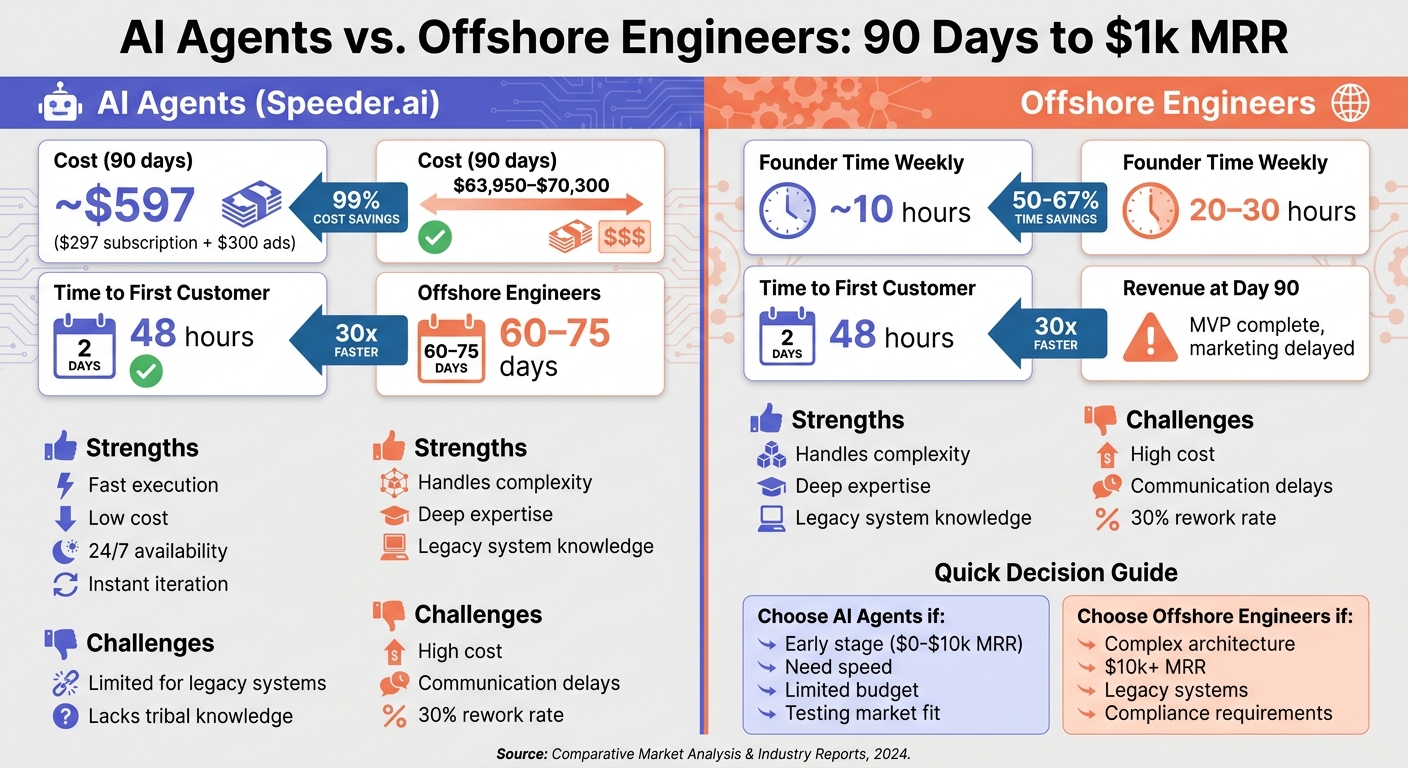
AI Agents vs Offshore Engineers: 90-Day Startup Cost and Performance Comparison
How This Solo AI Founder Bootstrapped 5 Products to 1M+ / Month | Tibo Louis-Lucas
sbb-itb-96552b7
The Business Blueprint
To fairly compare the AI-driven and offshore engineer approaches, let’s start with a clear business concept that aligns with typical startup constraints in 2026. This shared foundation ensures both paths face the same requirements, timelines, and success metrics.
Business Idea and Milestones
The idea? A SaaS platform tailored for freelancers. It combines client management, project tracking, invoicing, and time tracking - think of it as a blend of Notion, Harvest, and FreshBooks. With a pre-validated market and well-defined requirements, it’s an ideal scenario to test how each approach handles speed and cost. Plus, it aligns perfectly with the earlier 90-day $1k MRR challenge.
The technical scope revolves around standard SaaS essentials: CRUD operations, user authentication, and a dashboard interface. These are areas where AI agents tend to shine.
The 90-day timeline is broken into three key phases:
- Week 1: Launch a landing page with signup and payment integration.
- Week 4: Release the MVP, focusing on core workflows like client onboarding and invoice generation.
- Day 90: Achieve $1,000 MRR by securing 10, 20 customers paying $50, $100/month. This sets the stage for scaling toward a $10,000 MRR goal.
Metrics and Evaluation Criteria
To measure success, track these four metrics:
- Total cost: Includes all expenses incurred.
- Founder time: Weekly hours the founder dedicates to the project.
- Features shipped: How much functionality is delivered.
- Revenue growth: Progress from $0 to $1,000 MRR.
These metrics highlight the trade-offs. For example, an AI-first approach might deliver features more quickly but could demand more active involvement from the founder. On the other hand, offshore engineers might require less daily oversight but could lead to higher overall costs.
The AI Agents Approach with Speeder.ai
Workflow and Automation
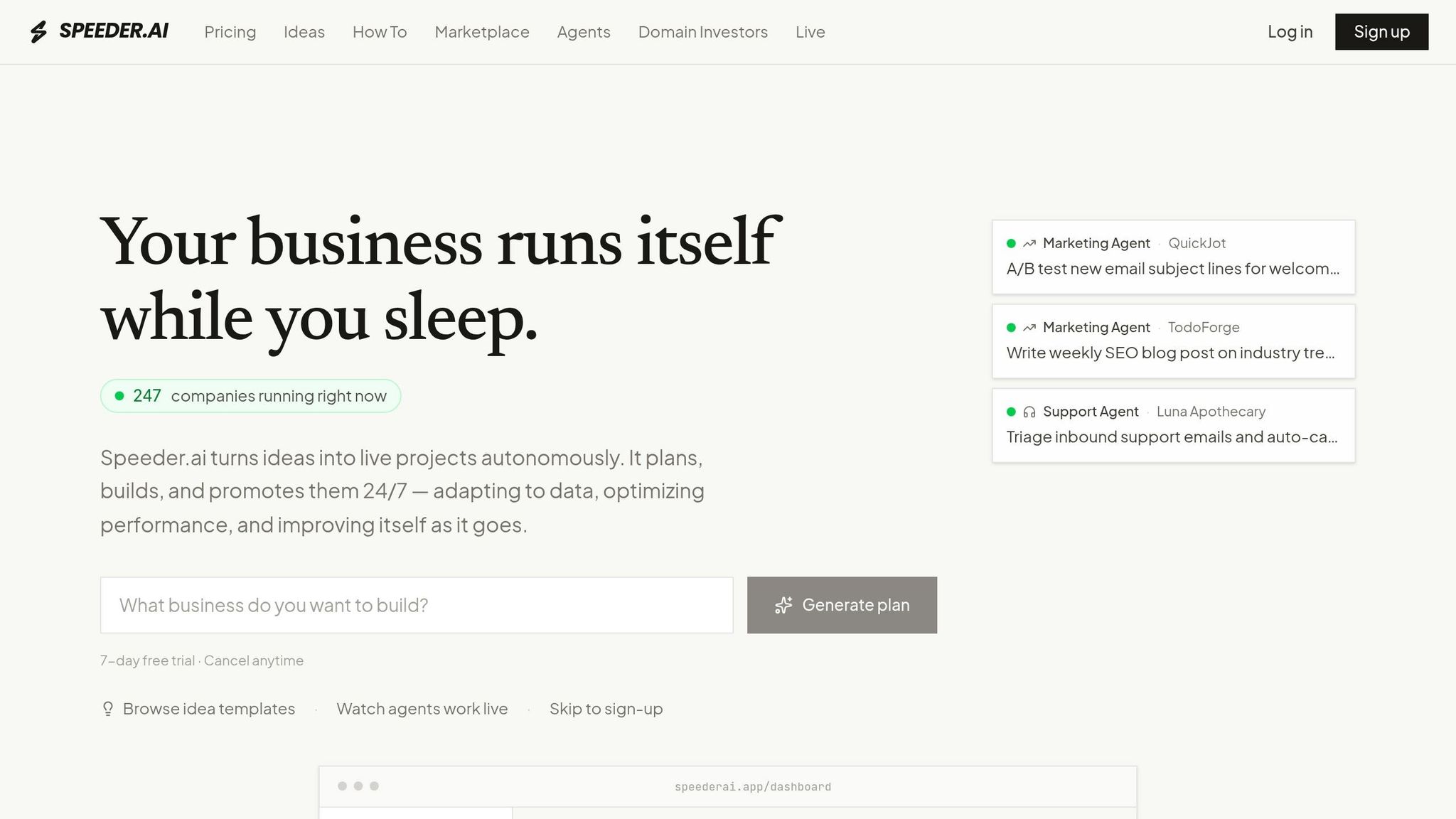
Speeder.ai starts with a streamlined process: you describe your company’s vision and target audience, and an onboarding agent takes it from there. Within a minute, the agent analyzes the market, drafts a business plan, and sets up the essential infrastructure - server, database, GitHub repository, and even email accounts.
Once onboarding is complete, six specialized agents step into their roles. Here’s how they work together:
- The CEO Agent: Evaluates progress and prioritizes tasks every night at 2:00 AM.
- The Engineer Agent: Writes production-ready code and commits it directly to GitHub.
- The Growth Manager Agent: Launches ad campaigns on Meta and Google, posts on LinkedIn and X, and handles cold outreach.
- The Support Agent: Manages customer emails, addressing routine inquiries and escalating urgent issues.
- The Research Agent: Keeps an eye on competitors and gathers market insights.
- The QA Agent: Reviews code to catch bugs before deployment.
Each morning, you’ll receive a detailed email summarizing the overnight progress, such as deployed code, launched ad campaigns, and new leads. Need something specific, like a launch blog post? Simply chat with the CEO agent to kick off the task.
One user highlighted the efficiency of this system:
"We plugged Speeder into Monefy and within a week the growth agent had launched three ad campaigns we hadn't gotten around to. It just does the work." Verified User, Speeder.ai
With the workflow explained, let’s move on to the tools and costs that power this system.
Tools and Costs
For a 90-day sprint to achieve $1k in monthly recurring revenue (MRR), Speeder.ai’s Pro plan offers a solid foundation at $99 per month. This plan supports up to three companies and includes:
- Managed Meta and Google ad campaigns
- AI-driven image generation
- A/B testing capabilities
- 25 on-demand task credits per month
Over the 90-day period, the cost breakdown looks like this:
- Subscription Fees: $297 ($99/month for three months)
- Ad Spend: Approximately $300
In total, the investment is around $597. What’s notable is that this approach eliminates extra costs for salaries, contractors, or project management tools - everything runs seamlessly within Speeder.ai’s ecosystem.
Now, let’s examine how these tools and costs translate into results within 90 days.
90-Day Breakdown and Results
Speeder.ai’s autonomous agents enable rapid progress, often turning an idea into a functional MVP by the end of the first weekend. Here’s what the timeline typically looks like:
- Day 1-2: Coding, marketing, and customer support tasks are underway, with the first paying customer secured within 48 hours.
- Day 3-87: Founders spend about 10 hours per week focusing on strategy while the agents handle execution.
- Day 87: The business reaches ~$1k MRR, validating the model.
This breakdown highlights how Speeder.ai’s AI agents can deliver results quickly and efficiently, which is especially valuable for solo founders running lean startups.
| Metric | Result |
|---|---|
| Total Cost | ~$597 ($297 subscription + ~$300 ads) |
| Founder Time | ~10 hours per week |
| Revenue (Day 87) | ~$1k MRR |
| Time to First Customer | 48 hours |
One user shared how the platform’s speed made a difference:
"The CEO agent caught a churn spike before we did and had the support agent drafting win-back emails the same night. That kind of speed matters." Verified User, Speeder.ai
With AI agents handling the heavy lifting - coding, ad management, and customer support - founders can shift their focus to strategic decisions and refining product-market fit. This model offers a practical path for building a business without being bogged down by daily operations.
The Offshore Engineers Approach
Workflow and Management
The offshore engineering approach leans on traditional team structures and management practices, contrasting sharply with AI-driven automation. Here's how it typically unfolds: you start with a small team - just three people - a tech lead, a backend engineer, and a frontend engineer. By the second week, part-time QA and DevOps roles are added to keep the project on track.
Managing such a team isn't simple. It requires a 4-hour daily overlap for communication, daily updates, and weekly demos. Misaligned product visions can cause delays, with feedback loops stretching 12: 24 hours just to clarify basic issues. This inefficiency can lead to as much as 30% of the team's work needing rework.
"The savings from cheaper hourly rates get overwhelmed by the productivity multiplier that AI gives to engineers who can use it well." Irfan Suleman, Engineering Leader
Communication tools like Slack (for daily check-ins) and Trello or Jira (for task tracking) are critical. To avoid scope creep, the team locks story points for each sprint and moves any change requests to a separate backlog with a set budget. Quality control is rigorous: 80% unit test coverage, mandatory code reviews, and nightly end-to-end smoke tests are enforced.
Expect the team’s productivity to dip by 15: 25% between weeks 4 and 8 as they get used to changes in your product’s requirements. These management hurdles directly impact the overall cost structure, as detailed in the next section.
Tools and Costs
The offshore engineering process relies on a straightforward tool stack:
- GitHub for version control
- Figma for design
- Platform-as-a-Service (like Render or Supabase)
- Stripe for payment handling
- Basic observability tools for logs and metrics
Here’s a cost breakdown for a 90-day period (roughly 12 weeks):
| Expense Category | Cost |
|---|---|
| Engineering Labor (1,470 hours at $40/hr) | $58,800 |
| Cloud Infrastructure (PaaS, DB, CDN) | $1,200: $3,600 |
| Observability Tools (Logs, metrics) | $450: $1,500 |
| Auth/Payments | $0: $900 |
| Stripe Atlas (Incorporation) | $500 |
| Design/Brand Polish | $2,000: $5,000 |
| Total | $63,950: $70,300 |
The average offshore rate is $40/hour, though individual rates range from $35 to $45 depending on experience and location. On top of that, management and coordination add another 15: 25% to developer costs.
90-Day Breakdown and Results
The project typically unfolds over three phases:
- Discovery Phase (2 weeks): $5,600
- Build Phase (8 weeks): $40,800
- Hardening Phase (2 weeks): $12,400
At the end of this structured 90-day timeline, you’ll have a functional MVP. However, additional work is usually needed to reach $1k Monthly Recurring Revenue (MRR).
A real-world example from March 2026 illustrates the cost-effectiveness of this approach. A US-based team of 12 senior engineers (each earning about $280,000 annually) was replaced by offshore engineers in Bangalore using AI tools like Cursor and Claude Code. Each offshore engineer cost $51,000 annually, saving the company $2.75 million per year while still delivering 90% of the previous team’s output.
| Metric | Result |
|---|---|
| Total Cost | $63,950: $70,300 |
| Founder Time | 20: 30 hours per week (management) |
| Revenue (Day 90) | MVP complete, marketing delayed |
| Time to First Customer | 60: 75 days (post-MVP) |
One of the biggest hurdles with this model is that marketing and customer acquisition often get delayed until after the MVP is complete. Founders typically spend 20: 30 hours weekly managing the team, reviewing code, and clarifying requirements - time that could otherwise go toward strategic planning or sales. While the MVP is ready by day 90, hitting $1k MRR requires additional efforts in growth and customer acquisition. Ultimately, you're paying for hours worked, not guaranteed outcomes.
Head-to-Head Comparison
Comparison Table
Here's a side-by-side look at how AI agents stack up against offshore engineers across key metrics:
| Metric | AI Agents (Speeder.ai) | Offshore Engineers |
|---|---|---|
| Monthly Cost | $300: $500 | $3,200: $8,000 per developer |
| Founder Time Required | 5: 10 hours/week (orchestration) | 20: 30 hours/week (management) |
| Time to First Customer | 8: 24 hours | 60: 75 days |
| Availability | 24/7, no timezone delays | 12: 24 hour feedback loops |
| Iteration Speed | 20+ sessions/day | 1: 2 pull requests/day |
| Rework Rate | Low (consistent execution) | 30% due to context debt |
| Scalability | Instant, usage-based | Linear, hiring-dependent |
| Risk Factor | High (lacks tribal knowledge) | Moderate (communication gaps) |
AI agents offer a significant cost advantage, with expenses ranging from $300 to $500 per month compared to the $3,200: $8,000 per developer cost of offshore engineers. This translates to potential monthly savings of up to 97%. Even when factoring in occasional API cost spikes during heavy use, the savings remain substantial. For example, a solo founder relying on AI agents spends a fraction of the $80,000: $120,000 monthly payroll often required to maintain a traditional offshore team.
Key Differences and Insights
The comparison highlights some important trade-offs. Offshore engineers can deliver a polished MVP within 90 days, but this extended timeline often delays marketing efforts, increasing costs before seeing any revenue. AI agents, on the other hand, flip this process. With Speeder.ai, you can launch a landing page, payment system, and initial marketing campaigns in under 24 hours. This approach allows you to test market demand while continuing to refine the product.
Timezone delays are another challenge for offshore teams, with feedback loops stretching to 12: 24 hours. This often results in rework - up to 30% due to miscommunication or lack of context. As Irfan Suleman points out:
"The savings from cheaper hourly rates get overwhelmed by the productivity multiplier that AI gives to engineers who can use it well".
AI agents thrive in tasks that are structured and repeatable, such as documentation, test coverage, boilerplate code, and security audits. In fact, AI-assisted engineers can complete code generation and testing tasks 20: 45% faster. However, AI agents can struggle with legacy systems or "scar tissue" - those nuanced, hard-earned insights about why certain systems or workarounds exist. A notable example from October 2025 involved Luca Moretti’s team replacing five backend engineers with AI agents. While the agents handled 80% of tickets in their first week, they inadvertently removed a critical legacy delay in the payment system during their second week, resulting in a 94% drop in payment volume.
The most effective approach often combines the strengths of both AI and human expertise. A hybrid model - where a small senior-led team or solo founder leverages AI agents for repetitive tasks - can outperform larger offshore teams. For example, Moretti’s hybrid setup of two engineers and AI agents completed 52 tickets in one week, significantly surpassing the output of the original five-person team.
While offshore teams remain better suited for complex architecture and situations requiring deep contextual knowledge, AI agents excel in scenarios demanding rapid iteration and cost efficiency. For a solo founder aiming to hit $1k MRR in a 90-day window, AI agents provide faster execution, reduced costs, and the flexibility to adapt in real-time without being constrained by timezone differences or lengthy standup meetings. These insights can guide your decision on the best approach for your specific goals.
Choosing the Right Approach
When to Use AI Agents
AI agents like Speeder.ai are a great choice for quickly testing ideas and reaching your first $1,000 in monthly recurring revenue (MRR) without hefty payroll costs. If your business is in the early stages - somewhere in the $0 to $10k MRR range - where speed and affordability are more important than perfect architecture, AI agents can efficiently handle structured, repetitive tasks. These include things like creating landing pages, setting up payment systems, writing documentation, improving test coverage, and generating boilerplate code.
A reliable AI stack typically costs between $300 and $500 per month, which is a fraction of what traditional development might cost. For example, in March 2026, the team at Agentfounder.ai built their entire platform - including a landing page, desktop app, payment system, and SEO-optimized blog - in just 24 hours for under $50. Compare that to the estimated $200,000 annual salary of a senior developer, and the savings are staggering. For solo founders, this approach can delay the need to hire a developer for up to a year, saving anywhere from $15,000 to $50,000 and providing more flexibility for strategic decisions.
AI agents also offer round-the-clock availability and almost instant iteration. Unlike offshore teams, which can have feedback delays of 12: 24 hours, AI agents work continuously. Running three to five agents simultaneously - each focused on specific tasks like features, bug fixes, or documentation - can deliver three to four times the output of a single developer. In fact, by 2026, 34% of new micro-SaaS products launched in the first quarter were created by founders with no programming experience, thanks to AI agent stacks.
While AI agents excel in speed and cost-effectiveness, they may not be the best option for projects involving complex systems. That’s where offshore engineers come in.
When to Hire Offshore Engineers
Offshore engineers bring critical technical expertise to the table, making them ideal for tackling more complicated challenges. Their value becomes clear when working on complex systems that require a deep understanding of context and technical nuances. For instance, AI agents can sometimes lack the memory and awareness to avoid costly errors in legacy systems. One notable example involved agents accidentally removing critical payment system logic, which led to significant revenue losses.
When your business reaches $10k: $15k MRR and the complexity of your product starts to exceed what you can personally manage, it might be time to hire offshore engineers. A hybrid approach often works best: pairing one or two senior engineers with AI agents. The engineers can focus on strategic tasks while the agents handle repetitive work. This setup can outperform larger, traditional teams while maintaining the level of contextual understanding needed for high-stakes decisions.
Offshore teams are also a good fit for industries that require human interaction or compliance, such as enterprise sales or regulated sectors. They can support "follow-the-sun" models, ensuring around-the-clock coverage for global operations.
Final Thoughts
As startups grow, the shift from simple validation tasks to managing complex, legacy systems becomes a turning point. The competitive edge now lies in "context engineering" - the ability to give AI agents clear, high-quality instructions and domain-specific guidance. Armando Gonzalez, founder of Agentfounder.ai, sums it up well:
"The question isn't 'Should I use an AI co-founder or hire a developer?' The question is: 'Can I afford to spend 6 months hiring, onboarding, and managing a developer when I could be live in 24 hours?'"
For founders aiming to go from $0 to $1k MRR, the data is clear: AI agents dominate in speed, cost, and iteration. As of 2026, solo-founded startups account for 36.3% of all new ventures, and the micro-SaaS market is expected to grow from $15.7 billion in 2024 to $59.6 billion by 2030. The era of relying solely on offshore hiring for cost savings is fading, as AI-augmented founders now achieve lower costs per unit of output. The real question isn’t whether AI will transform how businesses are built - it’s whether you’ll be one of those leveraging its power.
FAQs
What should I do each week if AI agents build most of the product?
If AI agents are managing the bulk of your product development, your role shifts to providing weekly strategic oversight. This means reviewing key performance metrics, fine-tuning priorities to match your business objectives, and keeping an eye out for any unexpected results. It’s also important to regularly assess operational costs and productivity to make sure everything is running efficiently. Think of it as managing a remote team - your job is to guide their efforts and ensure their tasks are optimized for success.
How do I prevent AI agents from breaking payments or other critical flows?
To keep AI agents from interfering with payments or essential processes, it's crucial to have layered security and continuous monitoring in place. Implement ongoing identity verification to spot anomalies and block potential coordinated attacks.
Be prepared with robust error handling protocols. For instance, monitor HTTP status codes like 401 (Unauthorized) or 402 (Payment Required), along with signature mismatches, to quickly identify and resolve issues.
Additionally, conduct regular security audits and apply risk-based defenses to maintain stability without compromising the user experience. These steps help create a secure and seamless environment for both users and systems.
When does it make sense to switch from AI agents to offshore engineers?
Switching from AI agents to offshore engineers is a smart move when tasks demand human judgment, specialized expertise, or intricate decision-making that AI simply can't handle. This shift becomes even more logical once AI-driven productivity has already streamlined efficiency, narrowing the cost benefits of offshore hiring. Offshore engineers excel in areas like nuanced decision-making, strategic planning, or quality assurance - tasks that require a level of insight and adaptability beyond what AI can currently offer.