
Most domain appraisal tools are wrong in the same way: they give you one number for a price that depends on the buyer.
If I were sizing up a domain today, I’d treat any AI appraisal as a range finder, not a price tag. In this article, I’d boil it down like this:
- GoDaddy is a solid baseline for fast-sale pricing
- EstiBot works best for keyword-heavy domains and bulk reviews
- Traffic-based tools can price undeveloped domains absurdly low
- Brandability-focused tools make more sense for short, startup-friendly names
- The best price check is still buyer interest, comps, and live offers
A few numbers make the point fast:
- An investor may look at a short
.comat $199 to $999 - An end user may pay $2,500 to $25,000 for that same name
- A traffic-based tool put
speeder.aiat $10.00 in July 2026 - Yet
.ainames in the same market have been listed from $14,000 to $55,000
So if you want the short answer: don’t trust one tool. I’d cross-check at least 2 to 3 appraisers, look at recent comps, and set three prices before making a move: your floor, your target, and your walk-away number.
The Truth About Domain Appraisals, AI Domains & LTO Deals | Snippets
sbb-itb-96552b7
Quick Comparison
| Tool | Best Use | Main Inputs | Common Blind Spot | General Read |
|---|---|---|---|---|
| GoDaddy | Baseline pricing | Sales comps, TLD, length | Brandables, newer extensions | Lower-end |
| EstiBot | Portfolio scans | Keywords, CPC, search volume, sales data | Short brand names | Keyword-heavy bias |
| StatShow | Live sites with traffic | Visitors, pageviews, ad revenue | Parked or low-traffic names | Very low on undeveloped domains |
| Atom-style tools | Startup-friendly brandables | Memorability, sound, industry fit | Exact-match SEO value | Better for coined names |
If I had to sum up the whole article in one line, it would be this: appraisals help set the range, but the market decides the price.
How AI domain valuation works and where it goes wrong
The main problem isn't the inputs. It's how each tool scores them.
The main signals behind automated appraisals
Automated appraisers look at many of the same data points, but they don't treat them the same way. Common inputs include domain length, TLD, commercial keywords, comparable sales, industry vertical, site age, and traffic data.
Category can change a domain's price by multiples. So the vertical tied to a name can matter just as much as its traffic.
Brandable names work a little differently. They're often priced based on memorability, spelling, and pronounceability, not keyword volume. And that's where things start to split. Some tools lean toward keyword-heavy domains. Others give more weight to startup-ready brandables. That's a big reason the same domain can get very different numbers depending on which appraiser you check.
Why appraisals miss unique buyer demand
AI models are trained on past sales data. That's their edge, and it's also where they fall short.
When the market moves fast, the data trails behind. .ai demand climbed quickly, and many automated tools were slow to catch up.
But the bigger issue is demand that doesn't show up in the data. An appraisal can't see recent trademark filings, funding rounds, or a company's push to move up from a weaker extension. Any of those signals can make a domain worth far more to one buyer than a tool suggests.
A domain hits its real price only when the right buyer shows up. That's why the next section looks at how GoDaddy, EstiBot, and other tools can land on very different numbers for the same name.
GoDaddy vs. EstiBot vs. other automated appraisers
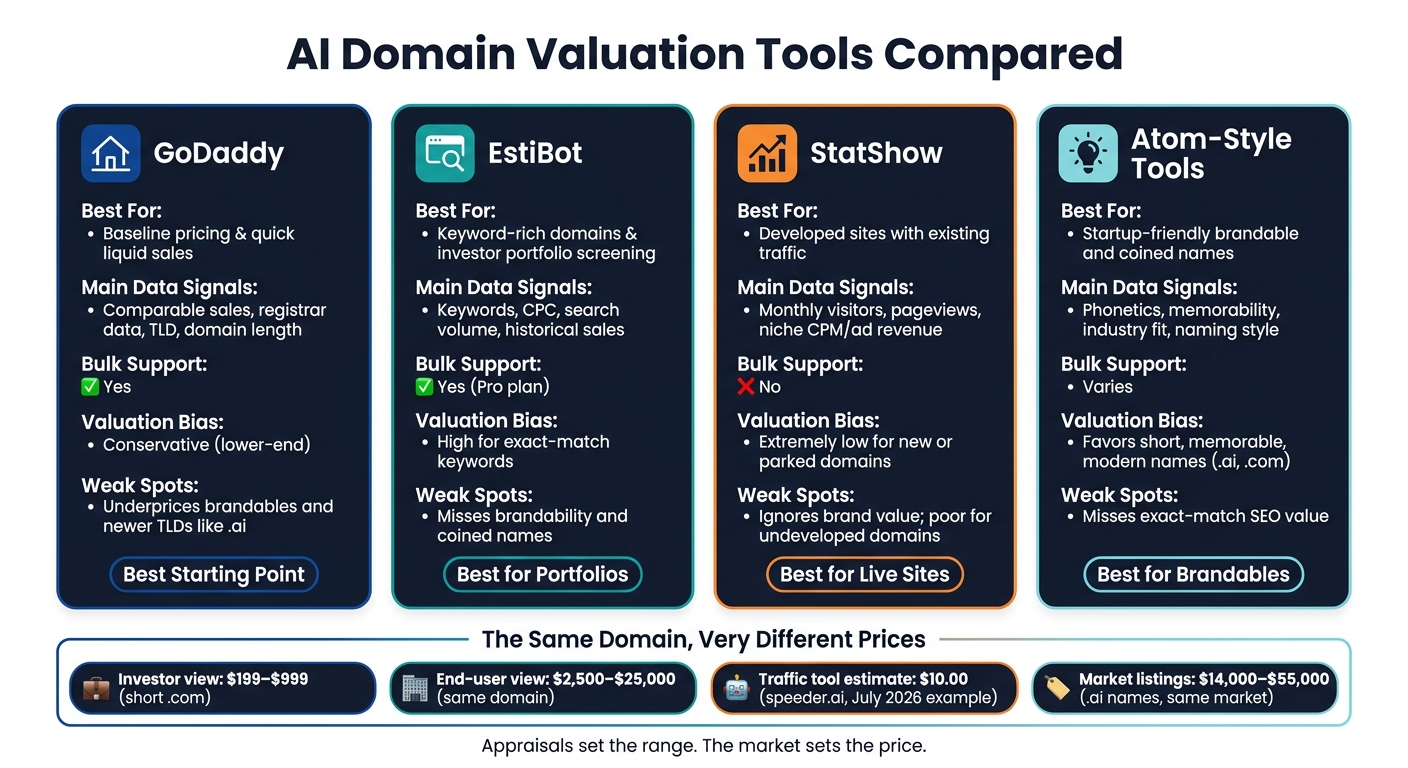
AI Domain Valuation Tools Compared: Which Tool Is Right for You?
Each appraiser is built around a different question. And that question shapes every number you get back.
GoDaddy Appraisal as the starting point
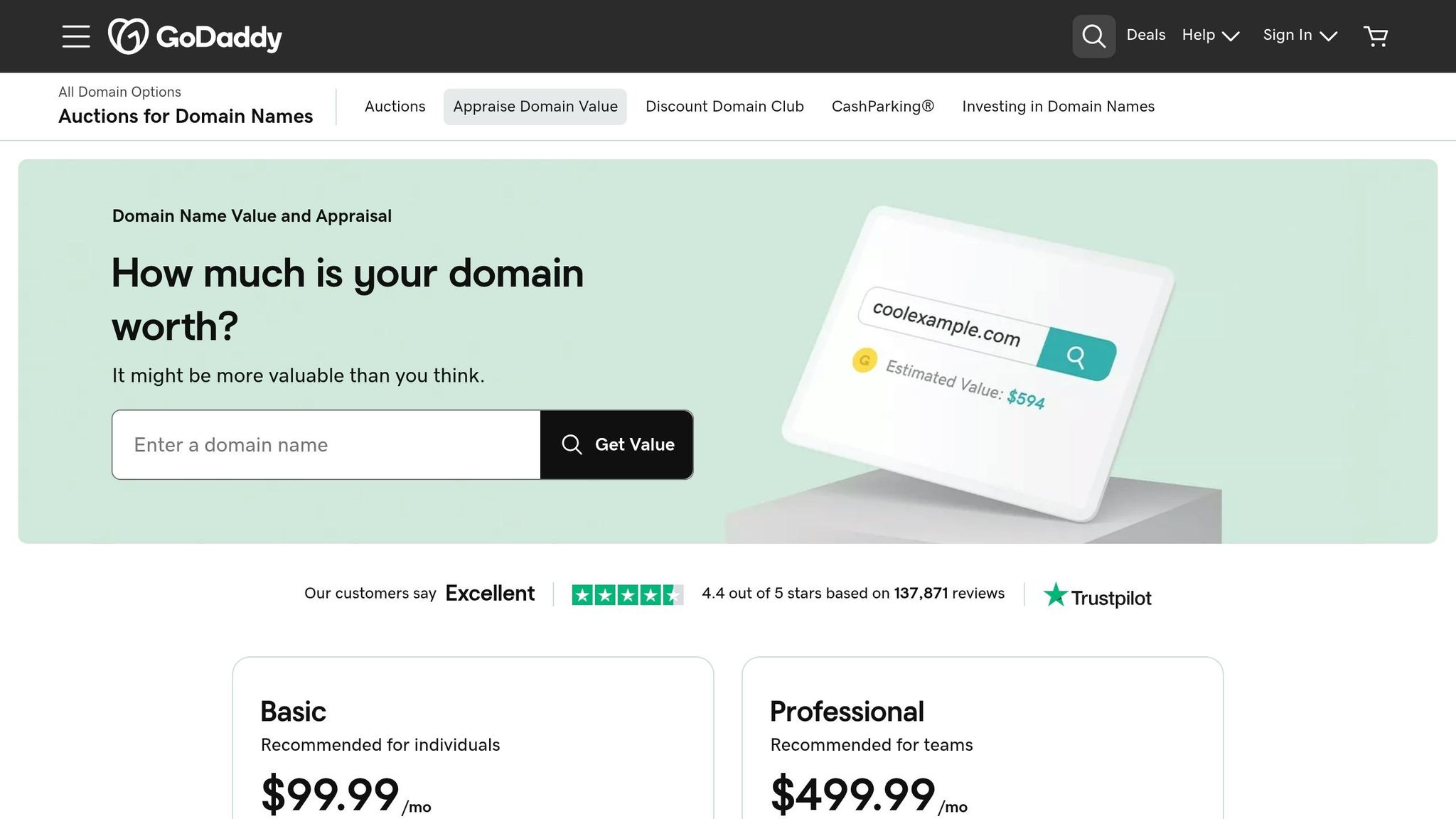
GoDaddy Appraisal is free for single searches and gives you a quick USD estimate right inside the registrar. It leans on comparable sales from registrar and public records, so it often reflects what a domain might fetch in a fast sale.
That’s why it works well as a rough floor for quick-sale pricing. Think of it as a starting point for sell decisions, not the top end of the range.
Where it can fall short is with brandable names and newer TLD categories. The same issue shows up with .ai domains, where premiums have moved up fast and older sales data can lag behind the market. So it’s best used as a first pass, not the final word.
EstiBot for portfolio screening
EstiBot pulls in keyword search volume, CPC data, past sales records, domain length, and TLD to build its estimate. It’s most useful for screening portfolios of keyword-heavy .com domains. In plain English, it’s a buy-side tool for investors who want to review a lot of names at once.
The catch? Its model tends to reward exact-match keyword domains. That means it can miss the brand appeal that pushes some names into a premium range. Once brand value matters more than keyword match, its read becomes less helpful.
Other automated appraisers worth cross-checking
Traffic-based tools like StatShow come at the problem from a different angle. Instead of leaning on market comps, they use traffic data. Their estimates are based on monthly visitors, pageviews, and niche ad revenue, such as CPM.
That can help when a domain already has a live site with measurable activity. But for domains with little or no traffic, the numbers can come in VERY low. So this type of tool matters mostly when usage already exists.
For a fast side-by-side view, here’s how the main options stack up:
| Tool | Main Data Signals | Best For | Weak Spots | Bulk Support | Typical Valuation Bias |
|---|---|---|---|---|---|
| GoDaddy | Comparable sales, registrar data, TLD, length | Baseline pricing; quick liquid sales | Underprices brandables and newer TLDs like .ai |
Yes | Conservative |
| EstiBot | Keywords, CPC, search volume, historical sales | Keyword-rich domains; investor screening | Misses brandability | Yes (Pro) | High for exact-match keywords |
| StatShow | Monthly visitors, pageviews, niche CPM | Developed sites with existing traffic | Ignores brand value; undervalues parked or low-traffic domains | No | Extremely low for new or parked domains |
When a domain falls outside standard keyword .com patterns, compare at least two tools. The gap between estimates tells you something useful. A wide gap usually means pause and check more data. A tight gap gives you an easier pricing range to work with.
Use that spread to help decide whether to buy, sell, or hold.
Brandable names need a different lens, which is where Atom-style outputs matter more.
Atom and AI tools that value brandability differently
When keyword appraisals miss buyer fit, switch to a brandability lens.
When brandability matters more than keyword volume
Some domains are priced for memorability and buyer fit, not search volume. A short coined name like uglyduck.ai may show little search demand, yet it’s listed at $9,900. Why? It’s short, easy to remember, and has a clear metaphor baked into it. That kind of value often slips past keyword-based appraisers.
The same logic shows up with brandable names aimed at founders who want something people won’t forget. knitly.com is listed at $32,000, which is far above what a traffic-based tool would likely suggest from keyword data alone.
Rising demand around AI has also pushed .ai prices up, even when search data is thin.
How Atom-style outputs help price startup-friendly names
Atom and similar platforms look at naming from a different angle. They score things like phonetic feel, memorability, naming style, and industry fit. In plain English, they ask whether a name sounds right for SaaS, AI, or FinTech, instead of asking only whether people type it into Google.
Here’s the cleanest side-by-side view:
| Factor | Keyword-Driven Tools (GoDaddy/EstiBot) | Brandability Tools (Atom-style) |
|---|---|---|
| Primary signal | Search volume, CPC, historical sales | Phonetics, memorability, industry fit |
| Name types valued | Exact-match keyword domains | Invented names, metaphors, short coined words |
| TLD weighting | Heavily favors .com |
Values .ai and .com for modern tech use cases |
| Target buyer | SEO-focused businesses | Startups and venture-backed companies |
Use brandability tools when keyword models price the name too low. If your domain is short, easy to say, and tied to a fast-growth category like AI or SaaS, a weak score from a keyword tool isn’t always a bad sign. It may just mean you’re measuring it with the wrong ruler.
That gap between the two models can help you set a buy, sell, or hold range.
How to turn tool outputs into a realistic price range
Once you've compared the tools, turn those outputs into a price range, not one fixed number. That's the big shift. A domain's actual price usually lands somewhere between what the tools say and what buyers are willing to pay.
A simple pricing workflow for buy, sell, and hold
Start by running two or three appraisals and writing down the spread. If the tools don't line up, that's a signal in itself. It usually means the domain has mixed signals, which gives you a broader negotiation range.
Next, set three numbers before you take any other step:
- Floor: the lowest price you'd accept
- Target: your realistic asking price
- Walk-away number: the point where you'd rather keep the domain than sell it
If you're a solo founder buying one domain, treat the appraisal range as your negotiation ceiling. In plain English, don't let the numbers pull you past what the range can support. Start from the low end and work up only if the seller has a strong case.
If you're pricing a portfolio, use the average across tools as your baseline. Then push the ceiling up only when outreach, inbound interest, or buyer replies show that demand is there.
The table below shows what matters most in each case:
| Situation | What Tool Output Matters Most | What to Ignore | Action |
|---|---|---|---|
| Solo founder buying | GoDaddy/EstiBot baseline | Very high outliers | Use the appraisal range as your ceiling and negotiate from the low end |
| Investor selling .com | Comparable sales (comps) | Old traffic-based estimates | Use the highest appraisal as a ceiling, then raise it only if comps and demand support it |
| Selling a brandable .ai | Atom-style brandability scores | Keyword-driven scores | Use a "Make an Offer" page to capture serious buyer interest |
| Portfolio review | Average of several tools | One-off spikes or dips | Identify the floor, then use outreach to find the ceiling |
Using Speeder.ai to test valuation in live demand
After you set a range, test it against actual buyer interest. Appraisals are just the first signal. Speeder.ai turns live buyer activity into pricing feedback through landing pages, inquiries, and offers.
That matters because static appraisals can go stale fast. Buyer behavior doesn't. Use that live data to adjust prices monthly instead of leaning too hard on old tool outputs.
Speeder.ai also tracks external signals like funding rounds and trademark filings to spot potential buyers before they start searching. If that sounds like an edge, it is. When demand signals show up early, they can support a higher asking price than automated appraisals alone.
Conclusion: Which AI valuation tools fit each situation
Your price range should come from three inputs working together: appraisals, comps, and buyer behavior. Use GoDaddy and EstiBot as baselines. Use brandability tools for startup-ready names. Then use live buyer activity as the final check.
Appraisals set the range. The market sets the price.
FAQs
How accurate are AI domain appraisals?
AI domain appraisals are automated estimates, not final market prices.
They’re useful as a starting point because they look at things like keyword commercial intent, past sales comps, and market trends.
That said, they can miss the hard-to-measure parts of a domain’s price, especially with premium names or sudden shifts in demand. If you’re a solo founder, use these tools as a rough pricing baseline and then sanity-check the number with manual research.
Which tool should I trust for a brandable .ai domain?
For a brandable .ai domain, don't lean on one automated score. Use a mix of market comps and platform-specific data instead.
Compare your domain with similar high-quality sales and current premium listings to set a realistic pricing range. That gives you a price point that reflects both brand potential and actual market demand.
How do I set a realistic asking price from mixed appraisals?
Treat each appraisal as one data point, not the final word. Start by looking at the spread between your lowest and highest estimates. That range gives you a practical baseline instead of locking you into a single number too early.
From there, tighten your asking price by checking recent comparable sales and weighing factors like brandability, commercial keywords, and market demand. The goal is simple: set a price that reflects both what the tools say and what buyers are actually willing to pay.