The City + Niche Playbook: How Names Like londonlaw.ai and dubailaw.ai Become $10k/Month Portfolios
August 1, 2026 · 12 min read

The City + Niche Playbook: How Names Like londonlaw.ai and dubailaw.ai Become $10k/Month Portfolios
Most city + niche .ai domains are dead weight. The few that work can turn into lease income, lead-gen cash flow, and the occasional five-figure sale.
If I boil this article down, the model is simple: I only want names tied to a clear buyer, a high-value local service, and a city with enough active businesses to pay for the name fast. Then I pick one path - sell, lease, build lead gen, or run AI intake for SaaS - based on how fast I want cash and how much work I want to do.
Here’s the full takeaway in plain English:
- Buy only names with clear buyer demand
- Stick to high-ticket niches like law, tax, medical, insurance, and home repair
- Use major cities for bigger upside and smaller cities for cheaper entry
- Monetize in 4 ways: direct sale, lease, lead gen, or AI-assisted intake
- Use outbound, because parked domains rarely sell on their own
- Cut weak names fast, since renewals and outreach costs add up
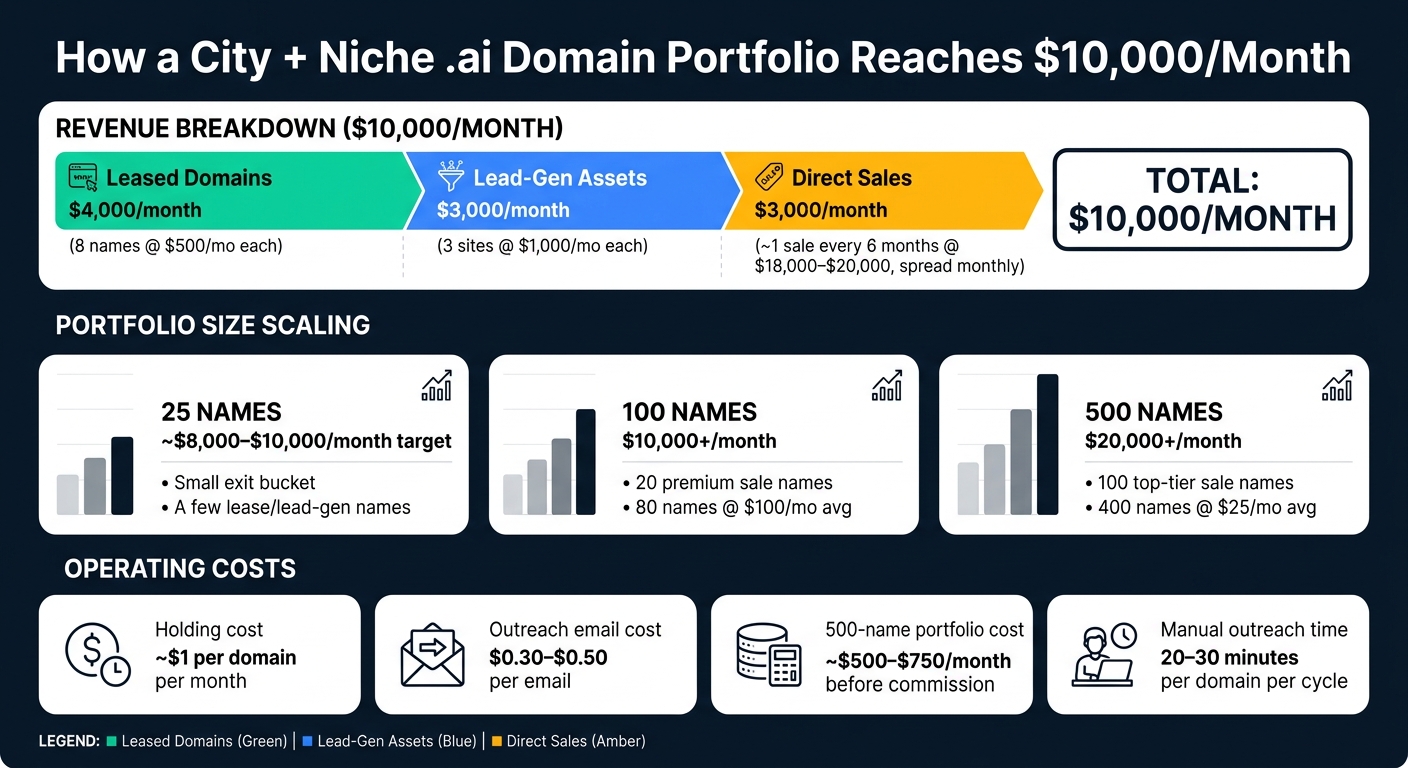
- Aim for a blended model, where monthly income plus an occasional $18,000: $20,000 sale can push a portfolio toward $10,000/month
A few numbers stand out:
- About 8 leased names at $500/month can produce $4,000/month
- 3 lead-gen sites at $1,000/month can add $3,000/month
- 1 sale every 6 months at about $18,000: $20,000 can average another $3,000/month
- Outreach and holding costs can run about $1 per domain per month plus $0.30: $0.50 per email
City + Niche .ai Domain Portfolio: $10K/Month Blueprint
Turning A $22 Domain Name Into A FULL Profitable Business With Ai!
Quick Comparison
| Area | What I’d focus on | What I’d avoid |
|---|---|---|
| Names | city + service + .ai with one clear buyer |
Vague, long, or info-style names |
| Niches | Law, tax, medical, insurance, urgent home services | Hobbies, low-ticket services, general info |
| Cities | Big metros for price ceiling; smaller cities for cheaper buys | Cities with too few local operators |
| Monetization | Leasing, lead gen, AI intake, direct sales | Parking and waiting |
| Validation | 10: 20 real buyer targets, high client value, live use on weak extensions | No buyer list, weak margins, no sales angle |
The core idea is not to collect domains. It’s to hold names that a local business can use to make money now.
1. What makes a city + niche domain worth buying
The traits of a commercially viable name
Once the model is clear, the next move is simple: filter hard before you buy.
Before you spend money, ask one plain question: Can a local business use this name to get leads, handle intake, or lease it as a brand? If the answer is fuzzy, that’s a red flag.
A name with commercial use usually checks a few clear boxes. The niche needs strong pricing power or urgent demand, like legal, tax law, insurance, medical, or emergency repair. The city should already have active local operators in that space. The name should sound like a brand a business would actually use, not a clunky keyword mashup. And the .ai extension should make sense for a smart, automated, or intake-focused service, not a broad info site.
It also helps to look for the same phrase already being used on weaker extensions like .net or .org. Then check for signs of movement in that city and niche: hiring, office expansion, or new locations. That kind of activity is a good hint that a real buyer may be out there.
Strong naming patterns versus weak ones
Strong names do one thing well: they point to one clear buyer and one clear service. That matters only if the name can support lead gen, intake, or a leased operator brand.
| Strong Pattern | Example | Weak Pattern | Example |
|---|---|---|---|
| City + Law | dubailaw.ai |
City + Legal Advice | londonlegaladvice.ai |
| City + Personal Injury | chicagopersonalinjury.ai |
City + News | dubainews.ai |
| City + Roofing / HVAC | dubairoofing.ai |
City + Directory | dubaidirectory.ai |
| City + Dentist | nycdentist.ai |
City + Tips | nychealthtips.ai |
Weak patterns fall flat because they don’t line up with a buyer who can make money from the name.
Once a name clears this filter, the next step is to check demand before you buy.
2. How to judge demand before you buy
A five-point validation framework
After the naming filters in Section 1, run this demand test before you buy. If a name clears the bar, it can move to monetization. If it doesn't, drop it.
- Local operator density: How many businesses serve that niche in the city? And how many already use weaker domains like
.net,.biz, or long hyphenated URLs? Those are often your best-fit prospects. They've already shown that the name idea matters to them, just on a weaker extension. - Average deal value: Put your time into niches where one client is worth $1,000+. Legal, medical, and insurance businesses are more likely to pay for a premium domain because a single new client can cover the cost.
- Urgent buyer need: Put urgent niches near the top of your list. Think legal disputes, insurance claims, medical issues, or tax season. When people need help NOW, the domain has more value as a lead-gen or intake asset.
- Search intent and brand fit: Does the name pull in high-intent leads? Using a lead qualification system can help you prove this value to potential buyers. Or does it give the business a clear local authority brand? That's the test.
Which niches support real operator demand
Not every local service niche is worth chasing. The ones that work tend to share one simple trait: one client can justify the domain cost.
| Niche | Lead Value | Buyer Urgency | Monetization Fit |
|---|---|---|---|
| Personal Injury Law | Very high | High (legal crisis) | Lead routing, AI intake agent |
| Tax Services | High | High (tax season) | Direct response, AI intake |
| Medical / Urgent Care | High | Very high (immediate need) | Intake, appointment routing |
| Insurance | High | High (claim-day urgency) | Lead gen, agent branding |
| General Creative / Hobbies | Low | Low (discretionary) | Ad revenue or low-cost subscriptions |
| Personal | Low | Low (discretionary) | Ad revenue or low-cost subscriptions |
The top half can support operator demand. The bottom half usually can't.
Once you know the niche has buyer demand, the next lever is city choice. That's what shapes how far the asset can go.
Small-city versus major-city strategy
The city changes the whole deal: how you buy, how you price, and who you can sell to. Major metros like Chicago or Miami come with more possible buyers and stronger pricing power. But those names are harder to register and often cost more to get. Smaller regional cities are often much more open, though the buyer pool gets thin fast.
| Metric | Major Metro (e.g., Chicago, Miami) | Small/Mid-Sized City |
|---|---|---|
| Acquisition Cost | High; competitive to register or buy | Low; often available for hand-registration |
| Buyer Count | Dozens to hundreds of potential operators | A handful of local businesses |
| Pricing Power | High ($10,000+ sale or monthly lease) | Moderate ($1,000: $5,000 realistic ceiling) |
| Competition | Intense; requires active outbound | Low; easier to reach the right operator |
| Monetization Fit | Brand authority, lead routing at scale | Direct operator use, local monopoly play |
Neither path is wrong. They just lead to different outcomes and different price ceilings.
"Selling a domain is an outbound problem, not a listing problem."
If a name passes this test, it may be worth leasing, building out, or pitching through outbound. If it fails, skip it.
3. Revenue models for a city + niche portfolio
Section 2 showed how to validate demand. Section 3 shows how to turn that demand into money.
Once a domain clears your demand checks, the next step is simple: choose the monetization path that fits the buyer, your timeline, and how much work you want to take on.
When to sell, lease, or develop
Sell if you want cash sooner. Lease if you want monthly income. Develop if the domain can fix an actual business problem.
| Revenue Model | Setup Effort | Time to Revenue | Recurring Potential | Hands-On Effort |
|---|---|---|---|---|
| Direct Sale | Low | Weeks to months | None (one-time) | Low |
| Leasing | Medium | Medium | High | Medium |
| Local Lead Gen | High | Slow | High | High |
| AI Intake/Routing | High | Medium | Very High | High |
| Directory | Medium | Slow | Medium | Medium |
The rule here is pretty straightforward: start with the simplest model that fits the domain's buyer intent. More moving parts only make sense when the upside pays for the extra work.
How AI intake and lead routing can raise domain value
A city + niche domain doesn't have to sit idle while you wait for a buyer. You can put it to work first.
For example, a name like dubailaw.ai can run an AI intake layer that qualifies leads and sends them to a local firm. That does two things at once: it shows the domain has a real use case, and it gives you a stronger story when it's time to lease or sell.
This works best in legal, medical, and insurance niches, where firms already pay $50: $300 per qualified lead through Google Ads. The main point isn't the niche list itself. It's that a working intake layer gives you proof of use, and proof of use can support a higher lease or sale price.
How outbound turns dormant names into active inventory
Most city + niche domains stay parked for one simple reason: nobody promotes them.
Speeder.ai changes that by turning dormant names into active inventory. It finds likely end users, sends personalized outreach, and routes replies back to you.
That repeatable workflow is what helps you move from owning a few solid names to running a portfolio that can grow without turning into a mess.
4. How a portfolio can reach $10,000/month
Portfolio math that actually works
The $10,000/month mark usually comes from a mix of recurring lease and lead-gen income plus the occasional domain sale that puts fresh capital back into the system.
Here’s a plain-English example of how that math can play out:
| Revenue Stream | Monthly Target | Asset Requirement | How It Works |
|---|---|---|---|
| Leased Domains | $4,000 | 8 names @ $500/mo | Best-fit city + niche names leased to local firms |
| Lead-Gen Assets | $3,000 | 3 sites @ $1,000/mo | Developed sites routing AI-qualified leads to operators |
| Direct Sales | $3,000 | ~1 sale every 6 months | A $18,000: $20,000 sale spread across six months to replenish capital |
| Total | $10,000 | About 11 revenue-producing assets, plus periodic sales | Requires a larger holding portfolio to surface these winners |
This mix lines up with the pricing data. The average sale price for domains on the Speeder marketplace is about $20,800. If you close one sale every six months and spread that revenue across the full period, that adds about $3,000/month to the blended total.
Illustrative allocation strategy for 25, 100, and 500 names
The point isn’t to pile up more domains. The point is to hold enough revenue-producing names so monthly cash flow and periodic exits can work together.
That same model looks different depending on portfolio size:
| Portfolio Size | Sale Bucket (Inventory) | Lease/Lead-Gen Bucket (Cash Flow) | Monthly Revenue Target |
|---|---|---|---|
| 25 Names | A small exit bucket of premium names | A few lease/lead-gen names carrying most monthly cash flow | ~$8,000: $10,000 |
| 100 Names | 20 premium names targeting periodic exits | 80 names at $100/mo avg. | ~$10,000+ |
| 500 Names | 100 top-tier names targeting periodic exits | 400 names at $25/mo avg. | ~$20,000+ |
With 25 names, each domain needs to earn its keep. At 500 names, the model shifts hard toward volume and automation.
That shift matters because manual outreach takes 20: 30 minutes per domain per outreach cycle. Do that across hundreds of names and the workload gets out of hand fast.
Costs add up too. At about $1 per domain per month, plus $0.30: $0.50 per outreach email, a 500-name portfolio runs around $500: $750/month before commission. Keeping commission out of the process helps protect margin when you’re operating at that size.
The next move is cutting weak names fast, because scale only works when the portfolio stays tight.
5. How to avoid weak names and build a tighter portfolio
Red flags that kill operator value
Scale only works when each name maps to a clear buyer or a clear use case. That should be your first screen before you buy anything.
Once you’ve done the portfolio math, the next step is checking demand quality. Skip names with no active operators, no live use on weaker extensions, and no plain path to an upgrade. Money comes from names you can lease, route, or sell to a real operator, not from names that look neat on paper but don’t have an end user.
Low-margin niches are another trap. Legal, insurance, and tax can support premium purchase and renewal costs. Hobbyist or low-ticket services usually can’t.
Awkward phrasing can kill a deal just as fast. If you can’t list 10: 20 likely buyers and write a direct three-touch email pitch, reject the name. If the niche fails that test, stop before you buy.
A pass-fail checklist for future buys
Before you register or buy any city + niche name, run it through these five questions:
| Question | Pass Condition |
|---|---|
| Who specifically buys this? | 10: 20 real companies you can name |
| What is one customer worth to them? | High-margin enough to justify a $1,000+ domain |
| Are there active buying signals? | Live .net or .org version in use, or recent trademark filings |
| Can you draft a three-touch email pitch right now? | Yes - or reject the name |
| Does it deserve ongoing holding costs? | At $1/month plus outreach credits, weak names drain capital fast |
If a name can’t clear all five, pass. Portfolio value comes from repeated matches between city, niche, and a real operator need. Dead weight eats up the time and money you could spend on names you can actually work.
FAQs
How many domains do I need to start?
You can start with just one domain. The Starter plan lets you build and manage a single company, which makes it a good fit for MVP validation.
If your goal is to grow toward $10,000 per month, you can scale over time. Starting with one focused city-niche domain gives you room to test the market, refine your messaging, and land your first paying customers before you add more.
Should I lease, sell, or build each domain?
It comes down to two things: your goal and the domain’s market potential.
Build if you want recurring revenue.
Sell if you want to cash out, especially when buyer intent is clear.
Lease if you want steadier, lower-effort income and still want to keep ownership.
In many cases, the smartest move is to build a portfolio of active micro-SaaS businesses that bring in steady cash flow, then sell them once they hit stable profitability and can command a higher valuation.
What makes a city + niche .ai domain actually valuable?
A city + niche .ai domain has value when it works as an operational asset, not just a placeholder someone hopes to flip later. What matters is simple: does it help people solve a real problem that keeps coming up, and one they already spend money to fix?
The best names tend to fit high-intent, industry-specific lead generation or service plays. That can include AI-powered legal intake, local directories, or agent-based platforms that make money through subscriptions or lead routing.
In plain English, the domain earns its keep when it supports a business model people can use right away - not when it just sits there waiting for a buyer.