
Premium domains are now seen as digital assets, much like prime real estate. These domains are rare, unique, and highly valuable, with the market generating $5 billion annually and top-tier domains appreciating by 15: 25% per year. Here's why premium domains matter and how they can generate income:
- Scarcity and Value: Short, memorable .com domains are limited and in high demand, driving consistent appreciation.
- Business Impact: A strong domain builds trust, reduces marketing costs, and boosts visibility for AI and SaaS startups.
- Revenue Potential: Domains can be flipped, leased, or developed into income-generating assets.
- AI Tools: Platforms like Speeder.ai simplify domain activation, management, and monetization.
Premium Domains as Long-Term Business Assets
What Makes a Domain Premium
A premium domain stands out due to several defining characteristics.
Length is a key factor. These domains are often short - ranging from one to three words or three to eight characters for brandable names. Shorter names are easier to remember, type, and share. They also pass the "radio test", meaning they’re simple to spell and understand when heard aloud, boosting their commercial appeal.
Keywords play an important role, but it’s not just about SEO. Domains featuring high-value terms like "loans", "insurance", or "finance" are particularly attractive to businesses in those industries because they signal transactional intent. Pairing strong keywords with a trusted extension like .com adds even more value. While .com remains the gold standard for trust and resale potential, newer extensions like .ai and .io are gaining traction in the tech and startup world.
"The real strength of a premium domain lies in its ability to support authority and visibility from day one." - dwbproject.org
A domain’s history is another crucial element. Domains previously associated with spam or penalized by search engines can carry hidden risks. Before purchasing, it’s wise to check its history using tools like the Wayback Machine and ensure there are no active trademark conflicts through the USPTO.
These qualities - length, keywords, extension, and history - mirror the principles of real estate, laying the groundwork for understanding domains as long-term assets.
How Domains Parallel Real Estate
The comparison to real estate is straightforward: there are only 17,576 three-letter .com domains in existence, and they were all claimed long ago. The supply is fixed, but demand continues to grow.
In domain investing, "location" translates to extension and keyword quality. Just as a prime location increases the value of physical property, the right domain attributes build digital value. For example, a .com domain with a high-intent keyword is like owning a storefront on a bustling main street - it brings in direct "type-in" traffic at $0 per click, eliminating the need for ad spend. On the other hand, a less desirable extension paired with a generic keyword is more akin to a side street: functional but far less impactful.
"A premium domain is a strategic tool. If a name reduces your customer acquisition cost or solidifies your brand in a crowded market, then a premium domain could make your business growth and marketing efforts a lot easier." - John Howard, 101domain Blog
Just as a building adds value to the land it occupies, developing a domain enhances its worth. A premium domain tied to an active, revenue-generating business is far more valuable than the same domain sitting unused. The domain itself appreciates over time, but a thriving business built on it can multiply its value exponentially.
Here’s a breakdown of how domain traits align with real estate fundamentals:
| Domain Trait | Real Estate Equivalent | Value Proposition |
|---|---|---|
| Scarcity | Limited land in a prime area | Only one exact match exists for any given keyword |
| Extension (.com, .ai) | Address and neighborhood | Impacts trust, traffic, and resale potential |
| Keywords | Visibility and foot traffic | Boosts organic reach and reduces customer acquisition costs |
| Clean history | Clear title and no liens | Avoids penalties, legal risks, and hidden liabilities |
| Development | Building on the land | A live business significantly increases the domain’s value |
sbb-itb-96552b7
How to Find, Evaluate, and Buy Premium Domains
How to Research and Source Domains
Finding the right domain starts with knowing where to search. Platforms like ExpiredDomains.net provide lists of expired domains that may still hold valuable backlinks and authority. Curated marketplaces such as Sedo, Afternic, and GoDaddy Auctions offer a range of options, catering to different budgets. If you're focused on AI or SaaS, prioritize domains with popular extensions like .ai and .com, especially those containing keywords linked to real-world needs like security, payments, or productivity.
To determine ownership or availability for purchase, use WHOIS lookups. If a domain isn't publicly listed for sale, you can try contacting the owner directly. Tools like Google Trends are also helpful for checking if a keyword is gaining traction, while NameBio provides historical sales data to guide your decision-making.
A quick test to gauge a domain's commercial value is the "homepage test." Ask yourself: could a founder confidently use this domain on their homepage without needing to explain its meaning? If yes, the domain likely has strong commercial appeal.
Before making an offer, assess the domain's potential using a structured checklist.
Domain Valuation Checklist
Evaluate a domain's value by considering these key factors:
| Factor | What to Check | Why It Matters |
|---|---|---|
| Length | 1, 3 words; 3, 8 characters | Shorter domains are easier to remember and often more valuable |
| Extension | Preferably .com; .ai or .io | .com has the highest resale value, while .ai is popular in tech sectors |
| Keywords | High-intent, trending terms | Relevant keywords increase organic traffic and reflect market demand |
| Domain History | Review via the Wayback Machine and backlink profiles | A clean history avoids SEO penalties and boosts value |
| Comparable Sales | Research similar domain sales | Helps set a fair and realistic offer price |
| Trademark Check | Use the USPTO database | Avoids legal disputes after purchase |
For example, in April 2026, the domain Law.ai sold for $350,000 on Sedo, showcasing the combination of an industry-specific keyword with a premium .ai extension. Similarly, in March 2026, stt.ai was sold for $74,456 through a 24-month lease-to-own deal, proving that even five-figure .ai domains can attract structured financing.
Avoid domains with hyphens, numbers, or unconventional spellings. These can reduce professional appeal and hurt future resale value.
Once you've determined a domain's worth, follow a safe process to negotiate and finalize the purchase.
How to Negotiate and Buy Domains Safely
After identifying a domain, compare it to three similar domains with the same extension to ensure you're not overpaying. This "three-alternative rule" helps maintain objectivity and avoid emotional decisions.
Pay attention to seller behavior. Listings with price cuts or "make offer" options often signal flexibility. If a domain appears underpriced compared to similar sales, act quickly - high-demand names, especially in AI, tend to sell fast due to limited availability.
When you're ready to buy, always use an escrow service to protect both parties. Platforms like Escrow.com or Atom securely hold funds until the domain transfer is verified. Many modern marketplaces also accept payments via major credit cards or cryptocurrencies like BTC, ETH, and stablecoins through escrow. Opt for sellers who can complete the transfer within 24 hours to reduce risks.
Domain Flipping with AI in 2025 | Full Tutorial
How to Make Money from Premium Domains Using AI
Premium Domain Monetization Models: Effort, Revenue & Best Use Cases
Revenue Models for Premium Domains
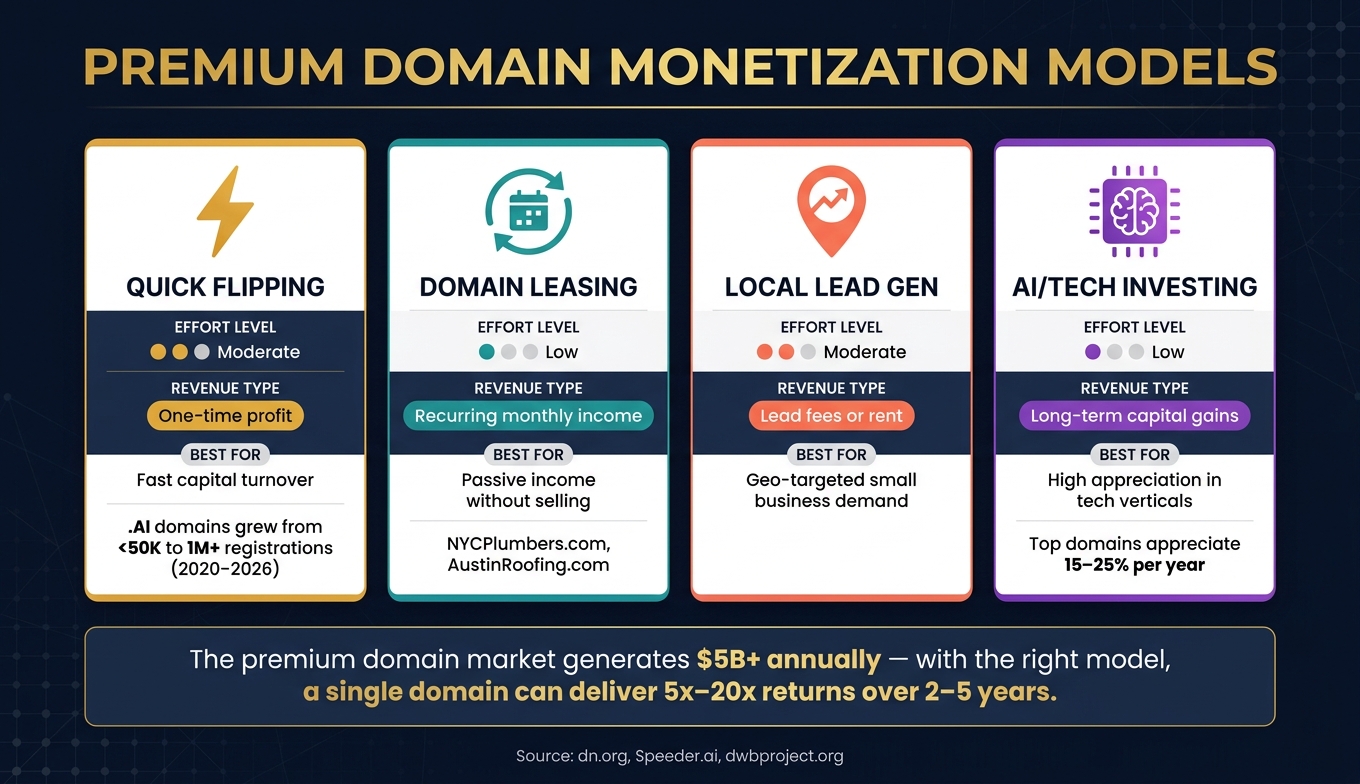
Premium domains can be lucrative through strategies like quick flipping, leasing, local lead generation, or long-term investing in tech-related domains.
Quick flipping is all about buying domains at a low price and selling them for a profit. Domains tied to AI and automation are particularly hot right now. For example, the .AI domain extension skyrocketed from under 50,000 registrations in 2020 to over 1 million by early 2026. That surge in demand means there’s serious money to be made if you act quickly. AI tools can give you an edge by spotting undervalued domains before they gain traction in the market.
Domain leasing is another option, offering steady, recurring income. Instead of selling a domain, you rent it out to businesses. This works especially well for geo-specific domains like NYCPlumbers.com or AustinRoofing.com, where local businesses are willing to pay extra for a domain that drives traffic and converts leads.
| Monetization Model | Effort Level | Revenue Type | Best For |
|---|---|---|---|
| Quick Flipping | Moderate | One-time profit | Fast capital turnover |
| Domain Leasing | Low | Recurring monthly income | Passive income without selling |
| Local Lead Gen | Moderate | Lead fees or rent | Geo-targeted small business demand |
| AI/Tech Investing | Low | Long-term capital gains | High appreciation in tech verticals |
These models show how AI can turn premium domains into valuable digital assets, making them more than just static real estate.
Using Speeder.ai to Activate Domain Assets
Owning a domain isn’t enough - you need to put it to work. A parked domain with no content won’t generate much income. Activation is essential, and AI makes this process easier by handling tasks like content creation, ad campaigns, and lead generation.
Speeder.ai is designed for this exact purpose. When you link a domain, the platform automatically creates a landing page with SEO-optimized content and a "vision statement" that highlights the domain’s potential. AI agents can also manage ad campaigns and handle lead inquiries, routing them directly to you.
"A short and memorable domain can immediately signal credibility and professionalism." - Digital Journal
This approach can be a game-changer. Many investors miss out on opportunities because they’re slow to respond or rely on generic parked pages. Speeder.ai works around the clock, ensuring your domains are actively marketed - even while you sleep. This is especially useful for solo entrepreneurs and SaaS operators managing multiple domains at once.
Managing a Domain Portfolio with AI
Once you’ve activated individual domains, scaling up requires efficient management. Handling a large portfolio manually can be overwhelming, but AI can automate key tasks like renewals, traffic analysis, and pricing adjustments.
For example, you can use AI to categorize your domains by type (e.g., brandable, keyword, geo-specific) and industry (e.g., tech, finance, health). By analyzing registrar data, AI can determine which domains to renew, park, or drop based on factors like acquisition cost, renewal fees, and traffic data.
Speeder’s Scale plan, priced at $199 per month, supports up to 10 companies at once. This makes it ideal for solo entrepreneurs or SaaS operators managing multiple domains. Each domain gets its own landing page, lead funnel, and AI-driven outreach, all managed from a single dashboard. The platform even provides a daily activity feed, so you can stay updated without getting bogged down in the details.
How to Scale and Exit a Premium Domain Portfolio
How to Build a Balanced Domain Portfolio
Focus on quality over quantity by investing in the right mix of domains. A good rule of thumb is to divide your capital into three categories: 40% in established premium .com domains for stability, 40% in high-growth TLDs like .ai and .tech, and 20% in speculative, emerging niches where early investments can lead to outsized returns. This approach positions premium domains as scalable digital assets.
Diversify your portfolio across industries such as technology, healthcare, and finance to support long-term balance. Natasa Vujovic, Marketing Specialist at Dynadot, emphasizes:
"Quality always trumps quantity. A focused portfolio of 10: 30 premium domains typically outperforms a scattered collection of hundreds of mediocre names."
To maintain liquidity and growth, allocate your holdings across three timeframes:
- Short-term flips (50%): For cash flow.
- Mid-term brandables (30%): Held for one to three years.
- Long-term premium anchors (20%): Reserved for high-value exits.
This strategy ensures a steady cash flow while preserving the potential for significant returns on your best assets.
Systems and Automation for Portfolio Management
Managing a growing portfolio requires a systematic approach. Keep track of key data like renewal dates, acquisition costs, traffic metrics, and listing status to avoid costly oversights.
Conduct quarterly audits using three criteria: acquisition cost vs. current value, annual holding expenses, and inbound inquiries. Use a Keep/Sell/Drop framework:
- Keep: Domains attracting traffic or inquiries.
- Sell: Domains with strong branding potential but low traffic.
- Drop: Domains with high renewal costs and little market interest.
Tools like Speeder.ai's Scale plan ($199/month) streamline this process by offering AI-built landing pages, lead funnels, and outreach sequences - all managed from one dashboard. Nightly automation ensures your domains stay active and visible.
Exit Options and How to Maximize Liquidity
Once your portfolio is well-managed, the next step is to turn it into cash. The premium domain market generates over $5 billion annually, with top-tier domains appreciating at rates of 15: 25% per year. But these gains only matter when they’re realized.
There are three main exit strategies:
- Selling individual domains to end-users: This typically offers the highest margins, as brands value domains for their unique digital identity.
- Bulk portfolio sales: A quicker option, though margins may be slightly lower.
- Developing and selling an AI-managed business: Domains with active landing pages, SEO content, and lead pipelines are far more valuable than parked domains. A basic development investment of $1,000, $5,000 can increase a domain's value by 1.2x, 1.5x, while full business development can raise that multiplier to 5x, 20x over two to five years.
For high-value transactions, use escrow services to protect both parties. To avoid emotional decisions, set a target exit price when acquiring a domain. Typically, the liquidity window for quality premium domains ranges from six to 24 months.
"Finding the right mix [of flips and holds] is often the difference between a profitable, sustainable business and one that is overly speculative or stagnant." - Staff Writer, dn.org
Conclusion: Turning Premium Domains into a Scalable Income Stream
The premium domain market is booming, with $5 billion in annual sales and top-tier assets appreciating at rates of 15: 25% per year. For solo founders, this presents a golden opportunity to enter a thriving space with a strategic approach.
A strong domain name removes barriers at every step - making marketing easier, building trust faster, and simplifying eventual exits. As Jannick Malling, Co-CEO of Public.com, aptly said:
"If the physical world is 'location, location, location,' digital is 'trust, trust, trust.'… Memorable domains naturally garner trust."
This clarity in strategy has opened doors to fresh monetization methods. Take the Speeder Agent program, for example. It allows solo founders to sell premium .ai domains from a curated portfolio of over 1,000 assets - without needing upfront capital, inventory, or contracts. The setup is simple: Speeder assigns a base price, and any amount you sell above that is yours to keep. Sell a domain with a $5,000 base for $15,000, and you walk away with $10,000. Closing just three deals a month could translate to $30,000+ in income, all without owning any domains yourself. It’s an AI-powered model that grows effortlessly as your portfolio expands, leveraging the automation principles discussed earlier.
For those aiming to scale further, Speeder.ai's Scale plan ($199/month) automates essential tasks like landing pages, lead funnels, and outreach for up to 10 companies. This ensures your domain portfolio stays active and visible, all while reducing manual effort.
Whether you’re flipping high-value .ai domains through the Agent program or building a long-term portfolio of digital assets, the tools and market conditions are aligned in your favor. Premium domains offer solo founders a chance to turn digital assets into a dependable and scalable income stream.
FAQs
How do I know if a domain is truly premium?
A premium domain is a digital asset that stands out for being short, easy to remember, and highly brandable. These domains often include high-demand keywords, which add to their appeal and value. Because they’re easier for people to recall and trust, they’re perfect for building a strong brand presence. Prices for premium domains can vary widely, from a few hundred dollars to several thousand, underscoring their role in boosting a brand’s image and long-term growth.
What’s the safest way to buy a high-value domain?
Buying a high-value domain requires a careful, well-thought-out approach to avoid potential pitfalls. Start by using reputable platforms that verify a domain's ownership and thoroughly vet their listings. This ensures you're dealing with legitimate sellers.
Next, make sure to conduct due diligence. Look into the domain's ownership history, check for any past or ongoing legal issues, and evaluate its market potential. These steps help you avoid surprises down the road.
For the transaction itself, rely on escrow services. These services act as a middleman, holding funds until both parties fulfill their obligations, which adds an extra layer of security to the process.
By combining trusted platforms, thorough research, and secure payment methods, you can significantly reduce the risks involved in acquiring a high-value domain.
How can I monetize a domain without building a full business?
You don't need to build an entire business to make money from a domain. There are a few straightforward strategies to consider, such as domain parking, leasing, or flipping.
- Domain parking: This method involves placing ads on a simple placeholder page. Whenever visitors click on these ads, you earn passive income. It’s a low-effort way to generate revenue from unused domains.
- Leasing: If your domain has value, you can rent it out to others for a recurring fee. This is especially useful for domains with high traffic or strong keywords.
- Flipping: This is all about buying domains at a bargain and selling them for a higher price. Platforms like online marketplaces make it easy to connect with potential buyers and turn a profit.
Each of these options allows you to monetize your domain without diving into the complexities of running a full-fledged business.