
Owning a domain today is like owning prime real estate in the digital world. With over 371.7 million domains registered by mid-2025 and premium names becoming scarce, the domain market is thriving. Key takeaways include:
- Premium domains appreciate in value: Business.com sold for $7.5M in 1999 and for $350M in 2007.
- AI domains are surging: By 2024,
.aidomains ranked 3rd in sales volume, driven by booming AI startups. - Valuation depends on factors like extension, length, and keywords: Short, memorable names on
.comor.aidominate. - Investors are seeing 15: 25% annual growth: Outpacing traditional investments like the S&P 500.
To succeed, focus on category-defining names, emerging trends like AI, and a balanced portfolio strategy. Whether flipping for profit or holding for long-term gains, domains are digital assets worth considering now.
Domain Name Investing 101 with Peter Askew - Founder of Deep South Ventures
sbb-itb-96552b7
What Drives Domain Value
Not all domains are created equal. For instance, Law.ai sold for a staggering $350,000 in April 2026, while a less striking name might languish unsold for years. What sets such domains apart? A handful of clear factors that investors carefully assess before making their move. These factors form the foundation of all domain valuation.
Core Valuation Criteria
The extension (TLD) is the most critical factor influencing domain value. .com continues to reign supreme for trust and liquidity, but .ai has become the go-to choice for tech-focused domains. By 2024, .ai led all TLDs in both average sales price and sell-through rate. Domain length also plays a huge role - short, single-word .ai domains like Bot.ai ($1.2 million) and Data.ai ($1.8 million) fetch significantly higher prices compared to longer, less concise alternatives.
"In every major .ai domain sale on record, the single-word names outprice their multi-word equivalents by a factor that cannot be explained by length alone." - NameBuzz
Other key factors include brandability and keyword relevance. A domain that passes the "radio test" - meaning it’s easy to spell after hearing it once - commands more value than convoluted abbreviations. Domains tied to high-commercial-intent keywords, like "Cloud", "Health", or "Law", often come with built-in SEO advantages and strong market positioning, which buyers are willing to pay a premium for. Additionally, a domain’s history - such as its age, organic traffic, and backlink profile - can significantly boost its worth.
| Trait | High Value | Low Value |
|---|---|---|
| Extension | .com, .ai, .io | .biz, .info, obscure TLDs |
| Length | Under 10 characters, single word | Hyphenated, multi-word strings |
| Brandability | Memorable, easy to spell | Confusing abbreviations |
| Keyword | High search volume, commercial intent | No search demand |
| History | Clean backlinks, aged domain | Spam history, penalties |
Interestingly, a developed domain can be worth exponentially more than a parked one.
"A parked domain might fetch $100. The exact same domain with a professional, single-page website built on it can suddenly command $1,000. It transforms an abstract asset into a tangible business." - Itamar Haim, SEO Team Lead, Elementor
Market Trends That Influence Value
The current market momentum plays a huge role in shaping domain prices. Take the AI sector, for example: the global AI software market reached $244 billion in 2025 and is projected to surpass $800 billion by 2030. With 77% of businesses already adopting or exploring AI solutions, demand for .ai domains has skyrocketed. This surge has pushed category-defining names like Lotus.ai and Genesis.ai to sell for $400,000 each in early 2026. These domains didn’t sell because of traffic or revenue - they sold purely for their brand positioning in a booming industry.
Beyond AI, fintech, SaaS, and climate tech are also driving demand for premium domains. Investors who spot emerging trends early and secure key domain names before the market peaks often see the highest returns. The meteoric rise of .ai - from being outside the top 20 TLDs in 2022 to ranking 3rd by 2024 - underscores the importance of timing. Identifying the right sector at the right moment is just as crucial as owning the perfect domain. These market dynamics are essential for building a lucrative domain portfolio.
Building a Profitable Domain Portfolio
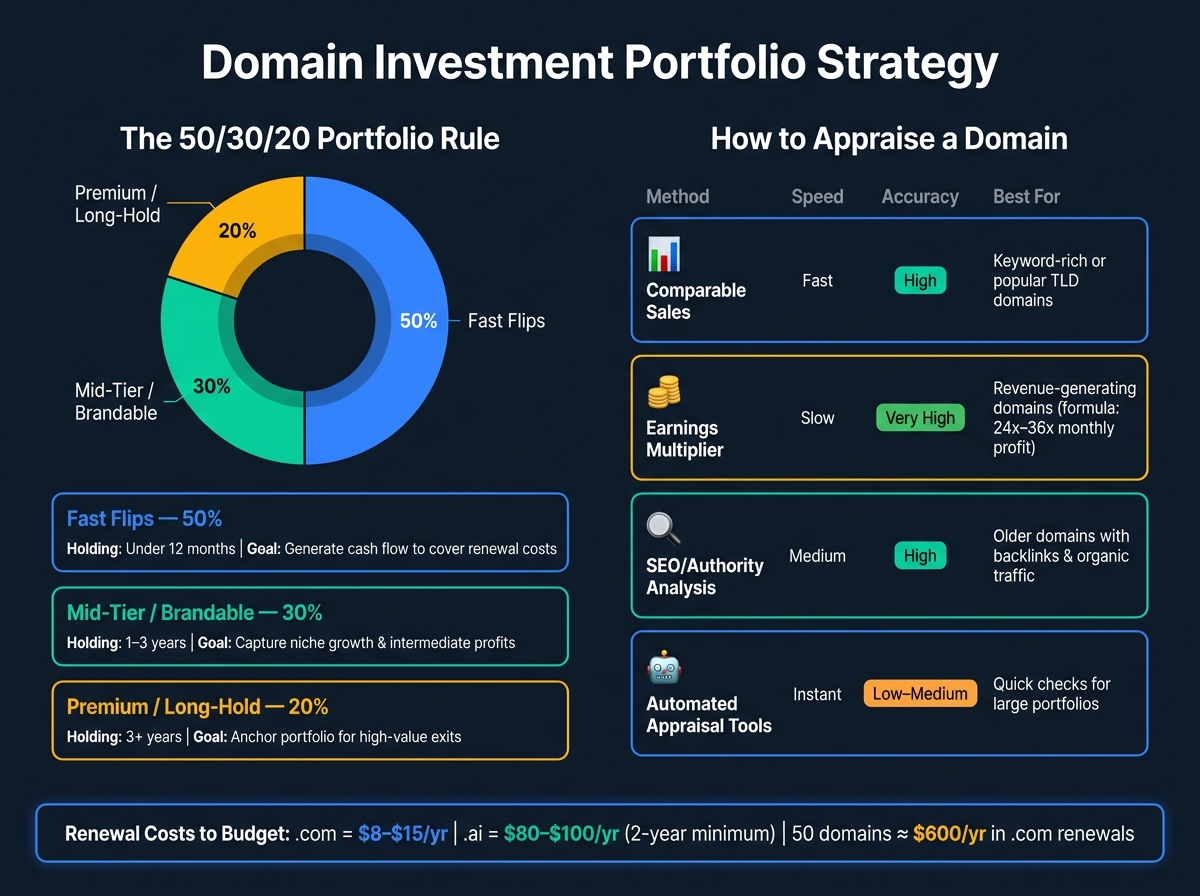
Domain Investment Portfolio Strategy: Risk Tiers & Valuation Methods
Portfolio Strategies for Beginners
For new domain investors, it’s easy to overspend without a clear strategy. The best way to start is by focusing on a specific niche with strong market demand. Popular sectors like AI, fintech, cybersecurity, and local business services can be great entry points. For instance, geo-specific domains such as DallasDentists.com or AustinRoofing.com are often sought after by small business owners looking for exact-match domains.
Once you’ve identified your niche, it’s important to diversify your investments across different price points. Many beginners start with low-cost domains, typically priced between $10 and $15, creating a mix of affordable names for quick resale and a few mid-tier domains that could gain value over the next 1: 3 years. Don’t forget to account for renewal fees - owning 50 domains at roughly $12 each will cost you about $600 annually. To maintain cash flow, allocate part of your portfolio to domains that you can sell quickly.
By sticking to this disciplined approach, you can establish a strong foundation for growth. This strategy also opens up opportunities for profitable exits and positions you to leverage domains for ventures in AI and SaaS.
Balancing Risk and Reward
A well-structured portfolio balances risk and potential reward. To do this, divide your investments into three distinct tiers, each with its own purpose:
| Portfolio Tier | Allocation | Holding Period | Primary Goal |
|---|---|---|---|
| Fast Flips | 50% | Under 12 months | Generate cash flow to cover renewal costs |
| Mid-Tier / Brandable | 30% | 1: 3 years | Capture niche growth and intermediate profits |
| Premium / Long-Hold | 20% | 3+ years | Anchor the portfolio for high-value exits |
The fast-flip tier, making up 50% of your portfolio, ensures liquidity. Without regular sales, even a promising portfolio can become a financial burden. Mid-tier brandable domains - especially those tied to trending SaaS or AI-related keywords - offer excellent opportunities to profit from emerging markets. These domains are often attractive to startups and solo entrepreneurs willing to pay a premium.
The long-hold tier, which accounts for 20%, is where you focus on high-value domains like one-word .com or .ai names. These are your portfolio’s anchors, and patience is key here. Before committing to a purchase in this tier, compare the domain to at least three similar sales in the same category and extension. Tools like NameBio for historical sales data and Google Trends for keyword validation can help you avoid overpaying.
This balanced strategy not only keeps your portfolio financially healthy but also sets you up for bigger opportunities in AI and SaaS markets down the line.
How to Monetize and Exit Domain Investments
How to Appraise a Domain's Value
Before selling a domain, you need to figure out its real market value. There are four main methods to do this, and the best one depends on the type of domain you’re working with.
Comparable sales are a solid starting point for standard .com domains. Tools like NameBio allow you to search past sales of similar domains - same keywords, extensions, or lengths. For example, if AItools.com sold for $45,000 last year, that can help you price AIplatform.com today. It’s quick and based on real-world data, making it a reliable option.
For domains that already generate revenue - like a parked domain earning ad income or a small lead-generation site - the earnings multiplier method is ideal. This approach uses a formula of 24x to 36x the monthly profit. For instance, a domain bringing in $500 per month could be valued between $12,000 and $18,000. While this method takes more time, it’s highly accurate when backed by solid revenue figures.
SEO and authority analysis is crucial for older domains. A domain with a strong backlink profile and organic traffic will be much more attractive to a buyer looking for an immediate SEO advantage. Tools like Semrush can help you evaluate this by separating organic traffic into branded and non-branded categories - buyers are typically willing to pay more for non-branded traffic.
Lastly, automated appraisal tools (offered by platforms like GoDaddy or Flippa) provide quick estimates. These tools are helpful for checking large portfolios, but their accuracy is limited, especially for niche or highly brandable domains. Use them as a general guide rather than a definitive valuation.
| Valuation Method | Speed | Accuracy | Best Use Case |
|---|---|---|---|
| Comparable Sales | Fast | High | Keyword-rich or popular TLD domains |
| Earnings Multiplier | Slow | Very High | Revenue-generating domains |
| SEO/Authority Analysis | Medium | High | Older domains with backlinks and organic traffic |
| Automated Appraisal Tools | Instant | Low: Medium | Quick checks for large domain portfolios |
Here’s a tip: always check the domain’s history using the Wayback Machine before listing it for sale. If it has a history of spammy or poor-quality content, it could lower your asking price. Buyers will likely discover this, so it’s better to address it upfront.
Once you’ve determined the domain’s value, the next step is choosing the right exit strategy.
Exit Strategies for Domain Investors
Picking the right exit strategy is essential, especially for investors in fields like AI or SaaS. Here are four common approaches, each with its own pros and cons.
Marketplace listings are the easiest option. Platforms like Afternic are great for selling .com and .ai domains. They connect you with a large audience of potential buyers, but you’ll have to pay a commission and deal with competition for visibility.
If you’re looking for higher sale prices, outbound outreach might be the way to go. This involves directly contacting potential buyers. For example, if you own ChicagoMedSpa.com, reaching out to med spas in Chicago can help you connect with the right buyer who values the domain the most. It requires more effort but eliminates middlemen and their fees.
Bundling is another effective strategy. By offering the .com, .net, and .org versions of a domain along with matching social media handles, you can create a complete branding package. This approach often leads to a higher price than selling individual domains. For those working in AI or SaaS, tools like Speeder.ai take it a step further by building landing pages for your domains and routing buyer inquiries directly to you. This turns parked domains into active lead generators while you wait for the right buyer.
Domain leasing is a smart option for premium names that haven’t sold yet. Instead of a one-time sale, you can lease the domain to a business, earning recurring monthly income while holding out for a better offer. This option is growing in popularity as more businesses prefer to test a brand before committing to a purchase.
To ensure a smooth transaction, always use a secure escrow service like Escrow.com or Atom. These services protect both parties from fraud and make ownership transfers hassle-free.
Using Domains to Launch AI and SaaS Ventures
Domains as Launch Assets
Domains are more than just web addresses - they’re foundational to a venture's identity and early perception. In the AI and SaaS space, they play a critical role in shaping first impressions. As the SAIPX Blog puts it:
"The domain extension you pick is the first thing a potential customer sees about your product. It sets expectations."
For founders in these industries, this initial signal can make or break engagement. A study conducted in 2025, 2026 revealed some eye-opening stats: .ai domains achieved a 22% higher click-through rate on technical search queries and 14% better conversion rates in SaaS-specific tests compared to other extensions.
The takeaway? If your product is AI-focused and targets a technical audience, a .ai domain can give you an edge. On the other hand, a .com domain remains the gold standard for broader consumer or enterprise markets. Avoid trendy or overly creative domain hacks (like "late.ly") - they often age poorly and can signal an inability to secure a premium domain.
Some companies, like Speeder.ai, even use parked domains to generate leads with auto-built landing pages, turning idle assets into active contributors.
Practical Use Cases for Solo Founders
For solo founders, domains can be powerful tools even before a product is fully developed. They’re not just branding assets but also strategic levers that can influence traffic, investor confidence, and market positioning.
Take the case of Lovable (lovable.dev). Despite its rapid growth in 2026, the startup struggled with traffic leakage because users instinctively typed in the .com version, which was owned by an unrelated underwear brand. This highlights the importance of securing a .com domain once your product gains traction.
For early-stage ventures, starting with cost-effective extensions like .io or .dev makes sense. Once your business proves its viability, upgrading to a premium .com domain can help solidify your brand and reduce traffic loss.
Domains can also act as trust signals for investors. In 2026, startups with .ai domains raised over twice the launch capital compared to those using .com domains. A carefully chosen domain in a sought-after category demonstrates thoughtful branding and strategic foresight, which can resonate strongly with early backers - even before you’ve launched your product.
Common Domain Investment Mistakes to Avoid
How to Spot a Bad Buy
The domain market is a magnet for fraud, alongside legitimate transactions. Individual buyers often lose between $2,500 and $15,000 to scams, while businesses can face losses ranging from $25,000 to over $500,000 on premium domain fraud. Spotting warning signs can make all the difference.
One glaring red flag? A price that seems too good to be true. Stolen domains are often listed at 30: 50% below market value to ensure a quick sale. If the domain turns out to be stolen, you lose both the asset and your money.
"You cannot gain title to stolen property, even as a good-faith purchaser. This applies to domains." - DomainDetails Team
To avoid falling into this trap, check the WHOIS history and verify trademarks before buying. This step can help you sidestep stolen domains or those tied up in legal disputes.
Domain quality is another crucial factor. Names with numbers replacing letters (like "4" instead of "for"), high spam ratings, or search engine blacklists are nearly impossible to resell. A quick radio test - saying the domain out loud to see if it's easy to understand and spell - can help you weed out problematic options.
| Red Flag | Indicator | Risk Level |
|---|---|---|
| Price too low | 30: 50% below market value | High - likely stolen |
| Payment method | Wire transfer, crypto, or "friends & family" | High - fraud |
| Pressure tactics | "Medical emergency" or 24-hour deadline | High - social engineering |
| WHOIS history | Registrar transfer in the last 30 days | High - possible theft |
| Contact details | Generic @gmail.com address for a "firm" | Medium - imposter |
By learning how to spot these red flags, you'll protect your investment and set yourself up for success in the competitive domain market.
Managing Liquidity Challenges
Once you've avoided bad buys, the next hurdle is managing liquidity. Domains are naturally illiquid assets - they can't be offloaded instantly like stocks. Premium domains, in particular, may sit unsold for years while renewal fees pile up. These fees range from $8: $15 per year for.com domains to $80: $100 annually for.ai domains, which also require a mandatory two-year block. For a portfolio of 20: 30 domains, these costs can quickly add up.
One way to stay liquid is by applying the 50/30/20 rule to your portfolio:
- 50% for short-term flips (within 12 months)
- 30% for mid-term prospects (1: 3 years)
- 20% for high-value, long-term assets
This approach ensures steady cash flow while waiting for the right buyer for your premium domains.
For domains that aren't selling, leasing is a practical alternative. Renting a domain to a business can provide consistent monthly income, helping cover renewal fees across your portfolio. It may not be the most glamorous solution, but it can ease the financial burden of holding onto unsold names.
"Domaining is not a quick-rich scheme... it is a hard-fought process and takes a lot of time and effort." - GoDaddy Resources
Finally, avoid chasing trends. When a niche like AI or crypto surges in popularity, domain prices in that category often spike but can crash just as quickly. Buying during these peaks can leave you with inventory that's hard to sell once the hype fades. Tools like NameBio can help you analyze historical sales data to confirm whether similar domains have sold at the price you're considering.
Conclusion: Why Now Is the Time to Invest in Domains
Looking at valuation trends and market dynamics, it's clear that acting quickly is essential in today's domain landscape.
The availability of high-value digital assets is shrinking fast. For example, the .com market is now facing extreme scarcity, with every dictionary word already registered. At the same time, .ai domains have skyrocketed in popularity, moving from outside the top 20 to 3rd in sales price volume by 2025. In 2024, .ai also boasted the highest sell-through rate and average sales price of any top-level domain (TLD). These shifts highlight a fundamental change in how online trust and authority are established.
The way search engines operate is also changing, favoring those who make early moves. AI-driven search algorithms now treat domain extensions as key semantic indicators when categorizing content and assessing credibility. For instance, a .ai domain can deliver a 22% higher click-through rate on tech-related queries and a 14% better conversion rate for inquiry-based searches.
"If you are building something you expect to matter in five years, .com or .ai. If you are shipping something to see if it matters at all, anything works." - saipx.com
Strategies like building staging sites, hunting for expired domains, or targeting emerging niches such as agentic AI all emphasize one thing: success comes from preparation, not hesitation. For example, a content site generating $2,500 per month is currently valued at approximately $100,000 as an asset. Waiting to act could mean missing out on substantial opportunities.
"A domain name is the only piece of the internet you can truly own. Everything else is just a lease." - Zack Liu
FAQs
How do I find premium domains before prices spike?
To grab premium domains early, start by diving into historical sales data using tools like NameBio. This helps you identify trends and understand what types of domain names tend to perform well. Look for names that are short, easy to remember, and packed with relevant keywords that can attract a wide audience.
Check out domain auctions or reach out directly to current owners with offers. To ensure you're not overpaying, rely on domain valuation tools to guide your pricing decisions. Also, keep an eye on branding trends and funding cycles - businesses often invest in premium domains after securing funding.
Success in this space requires a mix of patience and smart, strategic research.
What’s the safest way to buy a domain without getting scammed?
To buy a domain securely, take the time to research thoroughly and use reliable tools to evaluate market values and past sales data. Prioritize high-quality domains that align with your needs, and always check the seller's credibility as well as the domain's history to avoid potential issues.
Avoid making hasty decisions - careful consideration is key. Keep detailed transaction records for your reference, and stay informed about industry policies, including ICANN regulations. Following these steps can help reduce risks and ensure a smooth, secure purchase.
When should I sell a domain vs. lease it?
If you're looking for quick cash, selling a domain is the way to go - especially if it has strong resale potential thanks to desirable keywords, solid branding, or high market demand. On the other hand, leasing is a smarter choice if you'd prefer steady, recurring income while keeping ownership. This approach works best for domains with consistent demand or long-term value. Ultimately, your decision comes down to your goals: sell for immediate profit or lease for ongoing revenue and the option to retain future control.