
A domain broker is worth it only if they leave you with more money after fees. If a broker takes 10%: 20%, a $10,000 sale can cost you $1,000: $2,000 right away. And some deals come with minimum fees or upfront charges that cut even deeper.
Here’s the short answer:
- Use a broker for high-price domains, private deals, or sales with corporate buyers
- Skip the broker for many mid-range names, where fees can eat too much of the sale
- Compare net profit, time, and control before you decide
- Watch for fee traps like exclusivity, minimum commissions, and higher rates tied to nameservers
- Self-run outreach, marketplace listings, and AI-assisted outbound can cost less than broker-led sales
A few numbers make the trade-off clear:
- GoDaddy: 20% commission plus about $99: $112 upfront
- Afternic/DAN: 15% on their nameservers, 25% off them
- MediaOptions: 10% commission with a $1,500 minimum
- Sedo: 10%: 15%
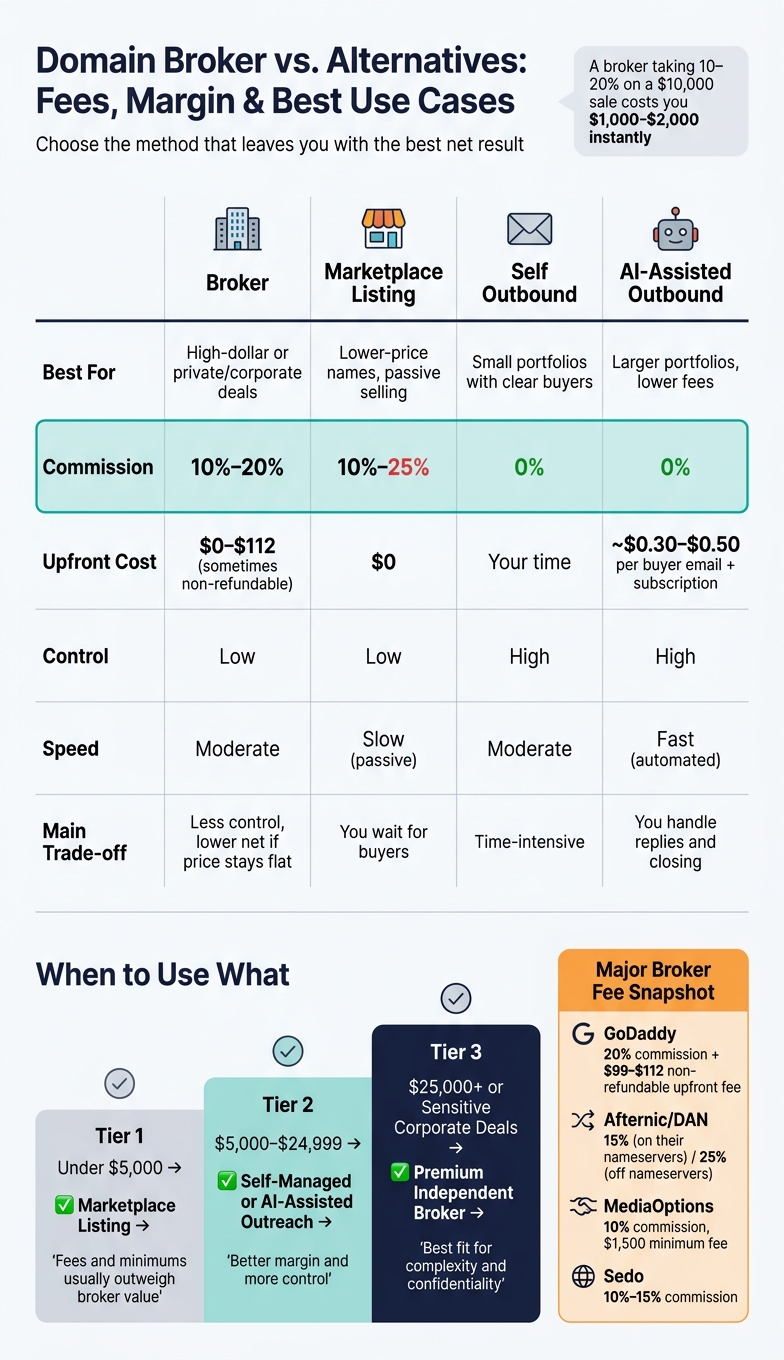
Domain Broker vs. Alternatives: Fees, Margin & Best Use Cases
From Scallop Kingpin to Selling 8-Figure Domains (4K)
Quick Comparison
| Option | Best for | Main cost | Main trade-off |
|---|---|---|---|
| Broker | High-dollar or private deals | 10%: 20% commission, sometimes minimums | Less control, lower net if price stays flat |
| Marketplace listing | Lower-price names and passive selling | 10%: 25% commission | You wait for buyers |
| Self outbound | Small portfolios with clear buyers | Your time | More work, no broker buffer |
| AI-assisted outbound | Larger portfolios and lower fees | About $0.30: $0.50 per buyer email plus subscription | You still handle replies and closing |
My take: if you can find and reach the buyer yourself, paying a broker often makes less sense on names under $25,000. But when the deal is private, tense, or high-stakes, a broker can earn the fee.
The rest of the article should help you decide which path gives you the best net result.
What a domain broker does and what you are paying for
A domain broker handles the full sales process: pricing, outreach, negotiation, and closing. In plain English, they help figure out what the domain is worth, identify the buyers most likely to want it, contact the right people, manage offers and counteroffers, and then help get the deal through escrow and transfer.
You’re not just paying for someone to pass messages back and forth. You’re paying for judgment. That means looking at comparable sales, matching the name to the right buyer type, and knowing how to move a deal without killing it.
Core broker tasks: pricing, outreach, negotiation, and closing
The biggest edge a broker brings is often negotiation and privacy. A good broker keeps the seller’s identity out of the conversation, which can help avoid price inflation tied to who owns the name. That buffer matters. If a buyer thinks the seller is wealthy, famous, or under pressure, the tone of the deal can shift fast.
Then there’s the negotiation itself. This is where experience earns its keep. A seasoned broker knows when to stay firm, when to counter, and when a deal is close enough that pushing harder could backfire.
Outbound outreach also plays a big role in premium domain sales. Dave Evanson, Senior Broker at Sedo, has said:
"The breakdown of my largest domain sales are approximately 60% from outbound efforts and roughly 40% from inbound buyers."
That split tells you a lot. Many high-value sales don’t come from sitting back and waiting. They come from targeted outreach to the right end users. So if you’re looking at brokers, it helps to ask a simple question: do they actively go out and pitch names, or do they mostly handle buyers who already showed up?
Marketplace brokers vs. independent brokers
There are two main broker types, and the difference matters.
Marketplace brokers - like those at GoDaddy or Afternic - mainly work inbound leads coming from large registrar networks. They can be helpful for filtering weak buyers, answering early questions, and moving deals along when interest already exists. But in most cases, their focus is incoming demand, not custom outbound campaigns.
Independent brokers - like Media Options or Grit Brokerage - tend to do more direct outbound work and usually take on a smaller set of names. They’re often focused on premium deals in the six- to seven-figure range and offer a more hands-on service. Media Options, for example, focuses on premium domains valued at $75,000 or more.
For lower-priced domains, marketplace brokering is often closer to inbound deal handling than a custom sales push. For mid-range domains, it may work more like a sales channel than a full broker-led campaign. That distinction matters when you start looking at fees, because the type of service you get can change your net sale price in a big way.
How domain broker fees work: commissions, minimums, and exclusivity
Once you know what a broker does, the next question is simple: what will it cost? In most cases, the answer comes down to commission, minimum fees, and exclusivity. A broker only makes sense if the better odds of closing, or the higher sale price, leave you with more money after fees.
Fee structures and what they do to your net sale price
The headline commission can look fine at first glance. But the full contract is what matters. One extra charge can cancel out a lower rate fast.
Here’s how the main options stack up:
| Broker/Platform | Commission Rate | Upfront Cost | Minimum Fee |
|---|---|---|---|
| GoDaddy | 20% | $99: $112 (non-refundable) | None |
| Afternic/DAN | 15% (on their nameservers) / 25% (off) | $0 | None |
| MediaOptions | 10% | $0 | $1,500 |
| Sedo | 10%: 15% | $0 | None |
Minimum fees matter a lot more on lower-priced deals than most sellers expect. MediaOptions charges a $1,500 minimum commission. If your domain sells for $2,000, that means 75% of the gross sale is gone before you even think about anything else.
GoDaddy has a different catch. It adds a non-refundable $99: $112 upfront service fee, whether the domain sells or not. That may not sound huge, but it changes the math, especially on lower-value names.
Afternic has another fee rule worth watching closely: it charges 25% if your domain is not pointed to their nameservers, versus 15% if it is. That 10-point spread can take a big bite out of your return. On a $10,000 sale, the gap between 15% and 25% is $1,000.
That’s why your asking price should be built around your target net, not just the number you’d like to see on paper. If you want to clear a certain amount, price with the commission already in mind.
Exclusivity clauses and contract red flags
Most brokers require an exclusivity period, usually 30 to 90 days, where you can’t list the domain somewhere else or use another broker at the same time. That matters more than it may seem. It affects whether you can still work a direct buyer while the broker is marketing the name.
If you want to keep that door open, get a plain answer before you sign. Ask how direct inquiries are handled during the exclusivity window and whether a sale you find on your own still triggers a commission.
A few contract issues deserve extra attention:
- Vague outreach claims or upfront fees with no clear milestones
- Commission penalties tied to nameservers or landing pages; some platforms move the fee from 15% to 25% if the domain is not pointed to their nameservers or landing pages
- Brokers representing both sides of the deal, which can weaken your position in negotiations
Read the agreement line by line. If there’s an upfront fee, tie it to a clear deliverable or milestone. And if you might find a buyer yourself during the exclusivity period, make sure the contract says exactly what happens in that case.
Once the fee setup is clear, the only thing that matters is the net result: can the broker beat what you could do on your own after all costs are taken out?
Alternatives to a broker: self outbound, marketplaces, and AI-assisted outreach
If broker fees eat too much of your margin, it helps to stack them up against the cost of finding buyers on your own. In most cases, you have three paths: run outbound yourself, list on a marketplace and wait, or use an AI-assisted setup to handle outbound at scale.
Self-managed outbound and marketplace listing
Running your own outbound means doing the full job yourself: researching end users, finding the right contact, writing the pitch, and sending follow-ups by hand. You can avoid broker commission if you close the deal privately. But that saved fee comes with a time cost, and that time cost grows fast. This route tends to work best when you only have a few domains and a pretty clear idea of who the buyer is.
Passive marketplace listing flips that trade-off. You do almost no work, but you give up a lot of control and still pay 10%: 25% in commissions. At that point, you're mostly waiting for the right buyer to come across your listing.
If manual outreach feels too slow, AI can take over that same outbound process.
AI-assisted outbound with Speeder.ai
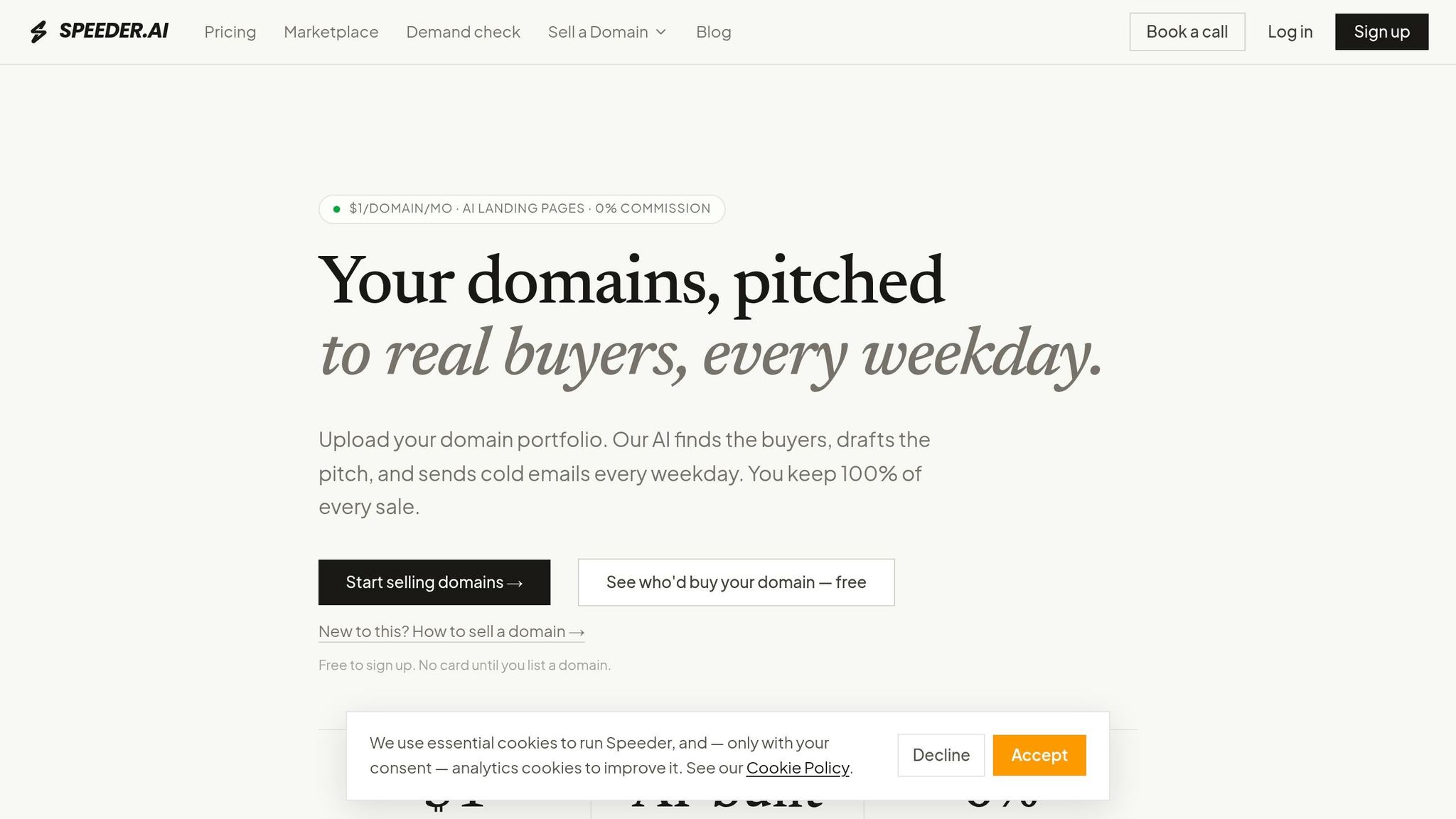
AI-assisted outbound handles research, contact picking, and follow-up without broker commission. The process runs in three automated steps:
- Scout finds companies that match each domain well.
- Courier writes and sends a personalized three-touch email sequence to the right buyer contact.
- Concierge forwards replies to your inbox.
Sales commission is 0%. You still pay the subscription and outreach credits, which come out to about $0.30: $0.50 per buyer email.
Which route gives you the best margin, speed, and control
The best option depends on your portfolio size, your available time, and how much commission you're willing to give up. If you manage a large portfolio and don't have hours to spend on outreach, automated outbound can protect margin and give you more control than a broker. If you have one high-value domain and don't want to run outreach at all, a broker's network may still earn its keep.
That trade-off leads straight to the next question: when is a broker worth paying for?
When a broker is worth it and when it is not
Use a broker for high-value, complex sales
Once you know the fees and the other options, the main question is simple: will a broker help you keep more money after the deal closes?
A broker makes sense when the sale is hard to handle well on your own. That usually means ultra-premium names, corporate buyers with legal teams, or brand-protection purchases where privacy matters. In those cases, three things matter most:
- How complex the deal is
- How much confidentiality you need
- Whether you can reach the buyer yourself
In deals like these, the broker's job goes beyond sending emails. The upside comes from negotiation, privacy, and closing support. A broker with experience can help protect the price without pushing so hard that the deal falls apart.
Skip the broker for mid-range names, larger portfolios, and sellers who want full control
For mid-range names, the math often works against using a broker. Commission and minimum fees can take too much of the final sale price. If the end buyer is easy to spot, direct outreach often beats broker-led outreach on both speed and margin.
For this part of the market, self-managed or AI-assisted outreach usually lets you keep more of the upside and stay in direct control of the negotiation.
Here’s a simple way to match the method to the deal:
| Domain Value | Recommended Approach | Why |
|---|---|---|
| Under $5,000 | Marketplace listing | Fees and minimums usually outweigh broker value |
| $5,000: $24,999 | Self-managed or AI-assisted outreach | Better margin and more control |
| $25,000+ or sensitive corporate deals | Premium independent broker | Better fit for complexity and confidentiality |
Conclusion: choose the method that leaves you with the best net result
When deal size and buyer complexity are clear, the choice gets a lot easier. Brokers can make sense for ultra-premium names and complex corporate deals, especially when privacy and negotiation skill matter. But for ordinary inventory, fees often eat up more than they add back.
Self-managed and AI-assisted outreach give you more control and better margins on mid-range names. If you can handle outreach well, you keep more of the sale price. Choose the method that leaves you with the best net result.
FAQs
How do I calculate my net after broker fees?
Subtract the broker’s commission and any fixed fees from the final sale price.
For example, if a domain sells for $10,000 and the broker takes a 20% commission, your net payout is $8,000.
Before you say yes, check the numbers closely. Confirm the commission rate, minimum fees, upfront costs, and any transaction or escrow fees so you know what you’ll actually take home.
What should I ask before signing a broker agreement?
Before you sign anything, get clear on how the broker gets paid. Ask about success fees, retainers, and hourly rates. Also check for any exclusivity terms so you know exactly what you’re agreeing to. One more thing: find out if the broker will represent only you or both parties.
Then dig into their track record. Ask about their experience with similar domain types, recent acquisitions, and how they plan to market your name to qualified buyers. You’ll also want to hear how they intend to run a competitive sales process.
Can I sell my domain myself without hurting the price?
Yes. You can sell a domain yourself without cutting into the price, as long as you can handle the negotiation and closing process well.
Doing it yourself puts you in control of the conversation and the asking price. The main thing is to use a secure transaction process and take care of the closing the right way. If you're comfortable dealing with buyer questions and setting the terms, you can skip broker commissions.