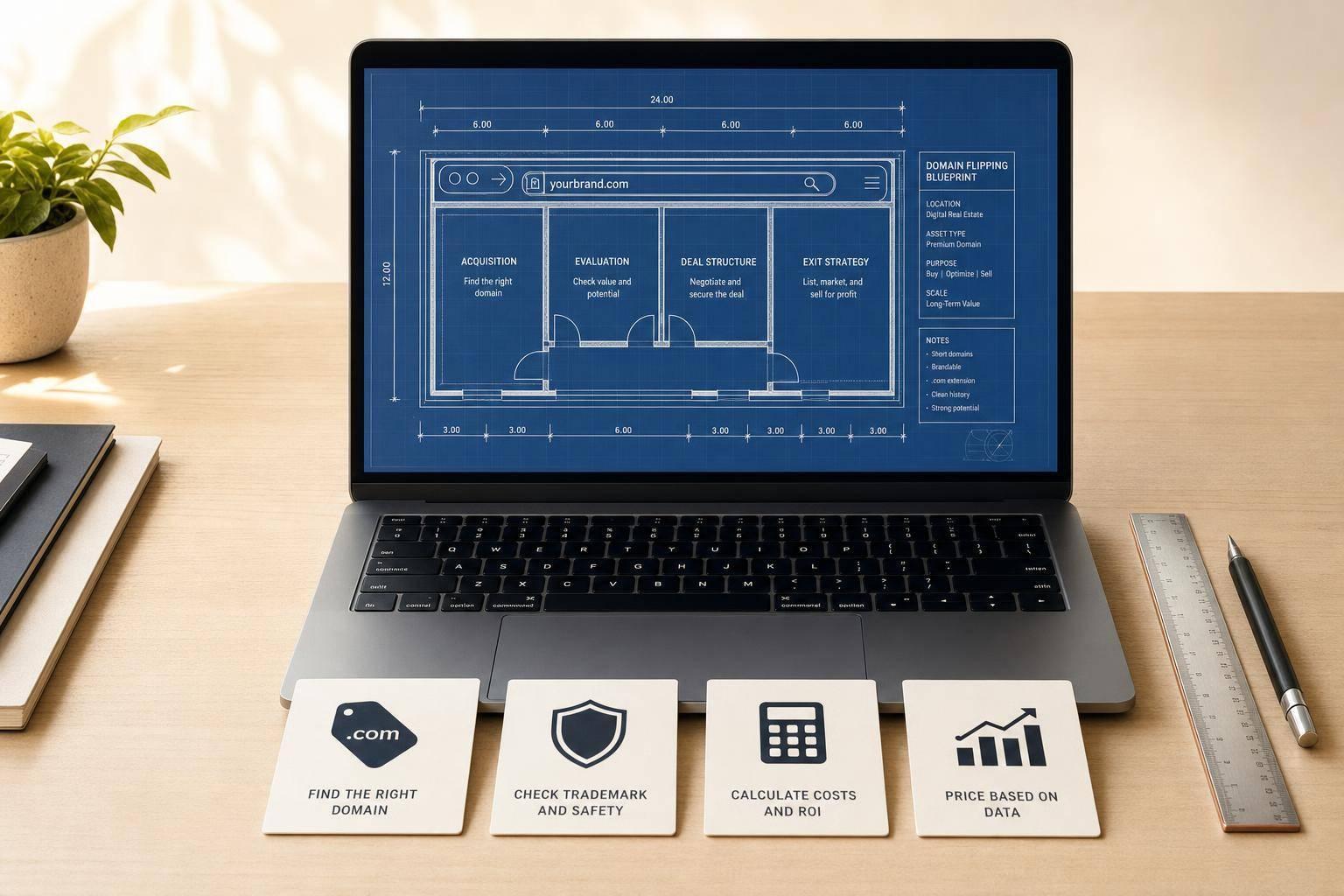
You do not need a big budget to start flipping domains. In many cases, I can start with $100 to $500, buy a few domain names, avoid bad picks, and wait for the right buyer.
Here’s the short version:
- I buy domains with clear resale potential
- I avoid names with trademark risk, spam history, numbers, hyphens, or high renewal fees
- I check comparable sales, past use, and renewal costs before I pay
- I list the domain with the right price and sale format
- I track fees, hold time, and profit so my next deal is better
One example from the article says a beginner started with $36, bought four domains, and sold one for $700 in about two months. That shows what can happen. But it also shows the main point: this is not instant money. I need to buy with care and be ready to hold a domain for weeks or months.
If I had to boil the whole process down to one idea, it would be this: the money is made when I buy, not when I list.
A fast side hustle this is not. A simple system? Yes.
I’m looking for domains that are:
- Short
- Easy to spell
- Easy to say
- Business-focused
- Low-cost to renew
- Free of trademark issues
And I’m skipping domains that look cheap or risky, even if the upfront price is low.
A small comparison makes that clear:
| Domain type | What I look for | What I avoid |
|---|---|---|
| Format | Short, clean, easy to remember | Long, clunky, hard to type |
| Extension | .com first; sometimes .ai or .io | Weak extensions with thin buyer demand |
| Buyer fit | Clear use for a company or niche | Vague names with no obvious buyer |
| Risk | Clean history, standard renewals | Spam past, trademark issues, high annual fees |
So if I want my first flip to have a shot, I keep it simple: buy carefully, price with data, use escrow, and track every dollar.
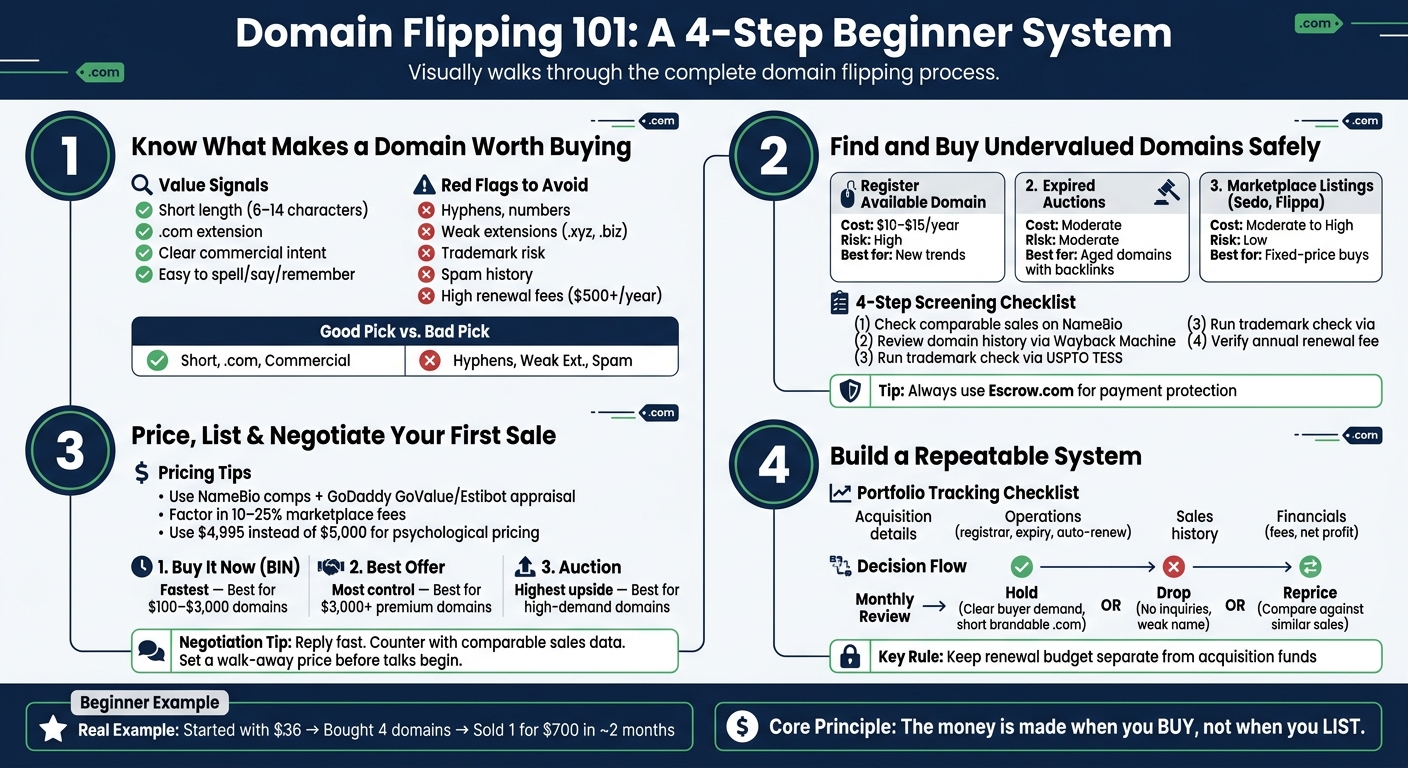
Domain Flipping for Beginners: 4-Step System to Buy & Sell Domains
Domain Flipping with AI in 2025 | Full Tutorial
sbb-itb-96552b7
Step 1: Know What Makes a Domain Worth Buying
Not every domain that seems promising is worth your money. Before you register or bid on anything, you need a simple filter: what helps resale value, and what’s just fluff.
The Value Signals That Matter Most
Start with extension, length, and buyer intent.
In the U.S. market, .com is still the default for trust and resale value. And yes, many of the top names in that extension are already gone.
After that, look at length and clarity. A good target is 6 to 14 characters. Shorter names are easier to remember, type, and share. If a name is awkward to say, it’s usually awkward to sell too. That’s the logic behind the Radio Test: if someone hears the domain once and can’t spell it right, pass on it.
Then there’s commercial intent. This matters a lot. Domains tied to a clear business use tend to sell faster than vague brandables. PhoenixRoofing.com, for example, points to one plain buyer: a roofing company in Phoenix. That’s a much easier sale path than a name that sounds catchy but doesn’t point to any clear use.
Use those signals as your first screen before you spend time on listings.
Red Flags That Kill Resale Potential
Some issues should stop you on the spot.
Skip domains with hyphens, numbers, and weak extensions. They tend to look cheap, feel less polished, and get lost when spoken aloud.
The biggest danger is trademark risk. If a domain is too close to an existing brand, even in a small way, you could face a UDRP claim and lose the name. It’s worth doing a quick search in the USPTO's Trademark Electronic Search System (TESS) before you register anything.
New buyers should also watch for two easy-to-miss problems:
- High renewal fees: some domains look cheap upfront but come with annual renewal costs of $500 or more
- Spam history: if a domain was used for spammy content in the past, it can be tougher to resell
A cheap registration price doesn’t always mean a cheap hold. That’s where a lot of beginners get burned.
Good vs. Bad Domain Picks for a Beginner
The table below shows what a solid beginner pick looks like next to a weak one.
| Factor | Good Pick (Hypothetical) | Bad Pick (Hypothetical) |
|---|---|---|
| Length | Short, easy to scan (e.g., BoiseAgri.com) |
Long or clunky (e.g., BestBoiseAgricultureDeals.com) |
| TLD | .com, .ai, or .io | .xyz, .biz, or .club |
| Keywords | High-volume, commercial intent | Random numbers or hyphens |
| Spelling | Clear and easy to pronounce | Misspellings or text speak |
| Trademark risk | Generic or descriptive term | Brand-adjacent (e.g., Insta-help) |
| Renewal cost | Standard renewal | High renewal fees |
| History | Clean history | Spam history or past penalties |
Stick with names that show clear demand, have a clean past, and won’t cost much to hold. The next step is putting these filters to work when you search listings.
Step 2: Find and Buy Undervalued Domains Safely
Now it’s time to use those filters on live listings. The goal is simple: use the value signals from Step 1 to spot domains other buyers skipped.
Where to Search: Registrars, Auctions, and Marketplaces
There are three main ways to buy a domain: register one that’s still available, bid in expired-domain auctions, or buy from marketplace listings.
Registering an available domain is the lowest-cost way to get started. You can search a registrar like Namecheap, find an open name, and register it for about $10: $15 per year. This works well for new trends and niche brandables.
Expired-domain auctions are where many beginners land their first solid deal. When an owner stops paying renewal fees, the domain can go to auction. These names may come with backlinks and direct traffic already in place, which can help resale value. Prices can jump fast, so set your max bid before you join in.
Marketplace listings on sites like Sedo and Flippa tend to feel less intense. Sellers may post a fixed price or allow Best Offer. Flippa also includes domains sold with websites.
| Path | Cost | Buyer Risk | When to Use |
|---|---|---|---|
| Registering an Available Domain | $10: $15/year | High | New trends, niche brandables |
| Expired Auctions | Moderate | Moderate | Buyers seeking aged domains |
| Marketplace Listings | Moderate to High | Low | Fixed-price, lower-pressure buys |
Next, run those listings through the same value signals from Step 1.
A Simple Screening Process Before You Bid or Buy
Use the same four checks for every domain. That keeps you from making a snap decision and paying too much.
Start with comparable sales. Check similar domains on NameBio or DN Journal to see what buyers have actually paid, not what sellers hope to get. After that, use a free appraisal tool like Estibot or GoDaddy Appraisals for a rough baseline.
Then look at the domain’s past. Use the Wayback Machine to see how the site was used before. Check WHOIS or ICANN Lookup for ownership history. If the domain has a spammy or harmful history, walk away.
Next comes the trademark check. Do this before you bid. If the name overlaps with an existing brand, you could end up in a UDRP dispute and lose the domain without compensation.
Last, check the annual renewal fee in U.S. dollars. Keep a separate budget for renewals, and decide on your max bid before any auction starts.
"Always have a walk-away price and stick to it. Emotional buying leads to overpaying."
If the domain clears all four checks, buy only if the price stays at or below your preset limit.
How to Complete the Purchase Without Rookie Mistakes
Set up your account, finish any verification steps, and then place your bid or buy the domain. Use the platform’s built-in payment flow. Don’t send money outside the platform.
If the sale doesn’t include built-in escrow, use Escrow.com as the payment middleman. It holds your money until the domain shows up in your account, then sends payment to the seller.
After that comes the transfer. If the domain is moving between registrars, ask for the transfer code, also called the EPP code, and check for any transfer blocks. Most transfers take 5 to 7 business days, and domains that were just registered or just transferred often have a 60-day lock.
Once the domain lands in your account, you’re ready to price it for resale.
Step 3: Price, List, and Negotiate Your First Sale
Once the domain is in your account, the next step is simple: turn it into a listing a buyer can scan and judge fast. That starts with pricing it well, picking the right sales format, and knowing how to react when someone sends an offer.
How to Price a Domain Without Guessing
Start with the lowest price you can defend, then let the market tell you if it's too low.
Use data first. Check comparable sales on NameBio, then use an automated appraisal tool like GoDaddy GoValue or Estibot to get a starting point. After that, look at the domain's extension, length, keyword demand, and brand appeal.
Domains tied to strong search volume or high cost per click (CPC) tend to draw more buyer interest. And for resale, .com is still the top extension. In tech niches, .ai and .io can also sell for solid prices.
For the list price, $4,995 often feels easier to accept than $5,000. Small difference, same ballpark, but it can help. Also, factor marketplace fees into your minimum price. Those fees can run from 10% to 25%.
Auction vs. Buy It Now vs. Best Offer
Match the format to the domain's demand and price point.
| Format | Speed | Control | Upside | Downside | Best Use Case |
|---|---|---|---|---|---|
| Buy It Now (BIN) | Fastest | High | Limited to set price | May leave money on the table | Lower-value domains ($100: $3,000) |
| Best Offer | Slow | Highest | High (negotiable) | Time-consuming; lowball offers | Premium domains ($3,000+) |
| Auction | Fixed term | Low | High (bidding wars) | Risk of a low final price | High-demand domains |
A quick way to think about it:
- BIN works best when you want a clean, fast sale
- Best Offer gives you more room if the domain may be worth more than a fixed number
- Auction makes the most sense when you expect strong buyer interest right away
How to Handle Offers and Close the Transfer
When an offer comes in, reply fast. Buyers move on all the time, and a slow response can kill the deal.
If the opening offer is low, don't get rattled. Stay calm, counter with your target price, and back it up with comparable sales or keyword CPC data. That gives your number some weight. Before any back-and-forth starts, set a walk-away price so you know the lowest deal you'll take.
Once both sides agree on a price, unlock the domain and get the EPP code ready. Only send that code after payment is confirmed through escrow.
Before you jump to the next domain, write down the sale price, fees, and hold time. That record gives you a clean benchmark for your next flip.
Step 4: Build a Repeatable Domain Flipping System
After your first sale, stop treating domain flipping like a one-time win. Start running it like a portfolio. The aim is simple: make the process repeatable without losing sight of what you own, what it costs, and what actually sells.
Track Renewals, Cash Flow, and Sell-Through Rate
Use a spreadsheet or database to track every domain. Give each one a unique internal record ID and log the details that matter:
| Tracking Category | What to Record |
|---|---|
| Acquisition | Purchase price, source (auction or hand-reg), date, screening notes |
| Operations | Registrar, expiration date, auto-renew status, EPP status codes |
| Sales | Listing platforms and offer history |
| Financials | Renewal costs to date, platform fees, net profit or loss |
It also helps to keep one folder for each domain with receipts, trademark notes, and transfer details. Set renewal reminders ahead of every expiration date.
One thing that trips people up? Mixing renewal money with buying money. Keep your renewal budget separate from your acquisition funds, so hanging on to inventory doesn't depend on making the next sale.
These records do more than keep you organized. They show which domains are worth another renewal and which ones are just taking up space.
When to Hold, Drop, or Develop a Domain
Review your portfolio every month and make a call on each name: renew, drop, or reprice. If you leave everything on auto-renew, dead inventory can stack up fast.
Hold names with clear buyer demand, especially short, brandable .coms. Drop weak names that have had no inquiries. If a name isn't moving, compare its price against similar sales before you renew it.
For borderline names, a simple "For Sale" landing page can help you test demand.
Conclusion: The Beginner Playbook in One Pass
At this stage, the goal isn't volume. It's making better decisions. The beginner playbook is straightforward: buy only names with clear buyer demand, track every cost, review the portfolio each month, and drop weak inventory fast. Each sale should make your next move a little smarter.
FAQs
How long does it usually take to flip a domain?
There’s no fixed timeline. Some domains sell in a few weeks, especially when demand is high or the name lines up with a current trend.
Others sit on the market for months or even years before the right buyer shows up. That’s just part of the game. Many investors mix fast flips with longer-term holds, so patience often plays a big part in making a profitable sale.
How many domains should I start with as a beginner?
There’s no fixed number.
If you’re just starting out, build your portfolio with a clear focus on one niche. That could be brandable names, keyword-focused domains, or location-based service domains.
Start small. One strong domain or a small handful is enough while you learn what has value and what’s just digital junk.
Then scale up only after you’ve gained some experience and shown that you can spot domains with profit potential.
What if my domain doesn't sell?
If your domain doesn’t sell right away, stay patient. Domain flipping isn’t a get-rich-quick play, and some domains can sit for months or even years before the right buyer comes along.
To improve your chances, list the domain on more than one marketplace or set up a simple landing page. Many flippers also build a portfolio, mixing domains that may sell sooner with others that need more time to gain value.