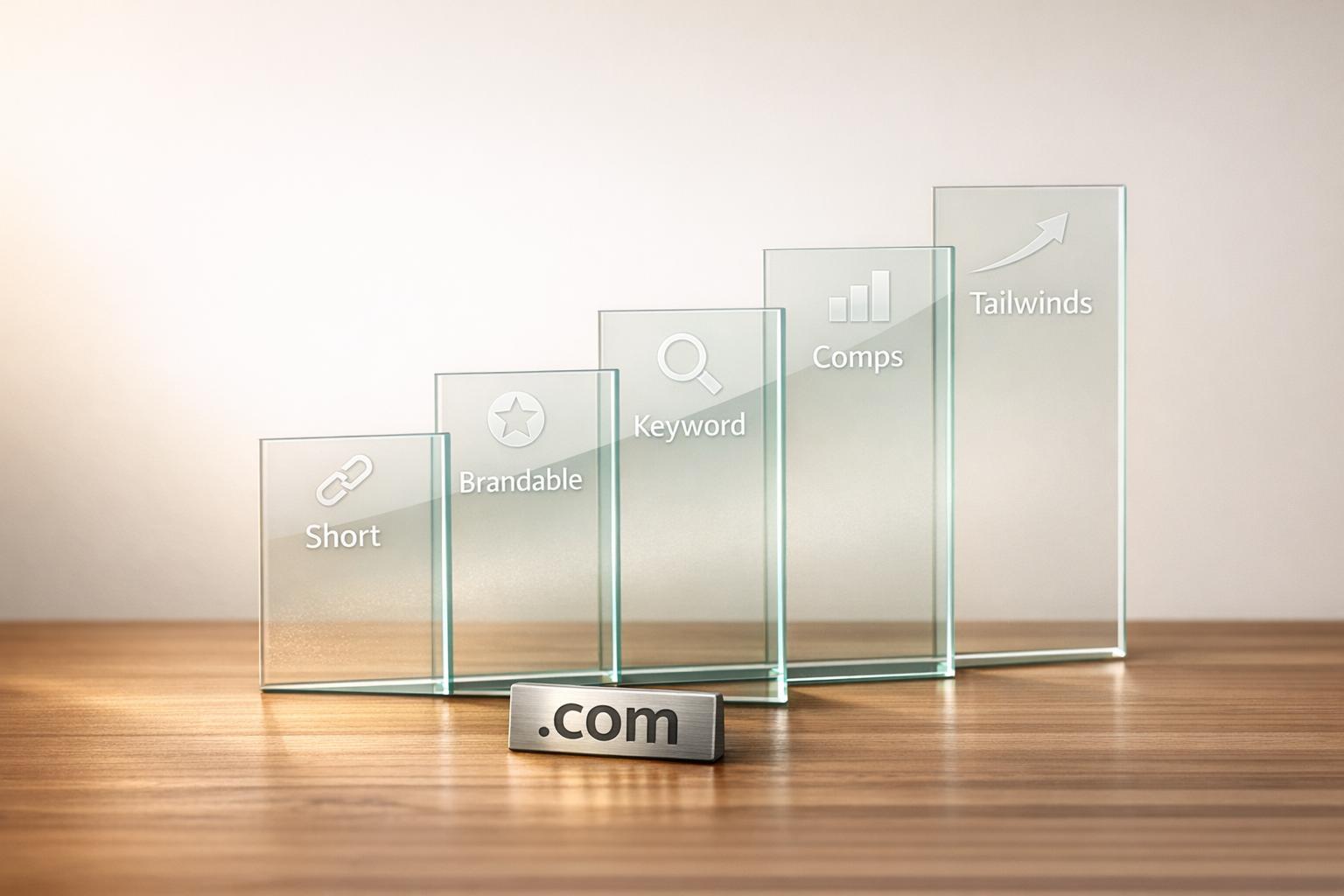
Want to know if a domain name will grow in value? Here’s what to look for:
-
Short, Memorable Names: Domains that are easy to spell, pronounce, and pass the "radio test" have higher demand. Stick with trusted extensions like
.com, though.aiis gaining traction in tech and AI industries. - Keyword Popularity: Domains with high-commercial-intent keywords (e.g., "buy", "pricing") attract buyers ready to spend. Use tools like Google Keyword Planner to check search volume and CPC (Cost-Per-Click).
- Growing Niches: Domains tied to emerging markets (e.g., AI tools, micro-SaaS) often increase in value as demand rises. Monitor funding trends, hiring data, and search growth for clues.
- Historical Sales Data: Look at past domain sales for pricing benchmarks. Tools like NameBio can help identify trends and fair market values.
- Business Potential: Domains that can be turned into functional businesses, especially with automation, are more attractive. AI tools like Speeder.ai can create landing pages, run outreach, and manage leads for just $1/month.
Key takeaway: Focus on short, brandable names, strong keywords, niche trends, and tools that simplify evaluation. With the right strategy, a domain can become a valuable asset.
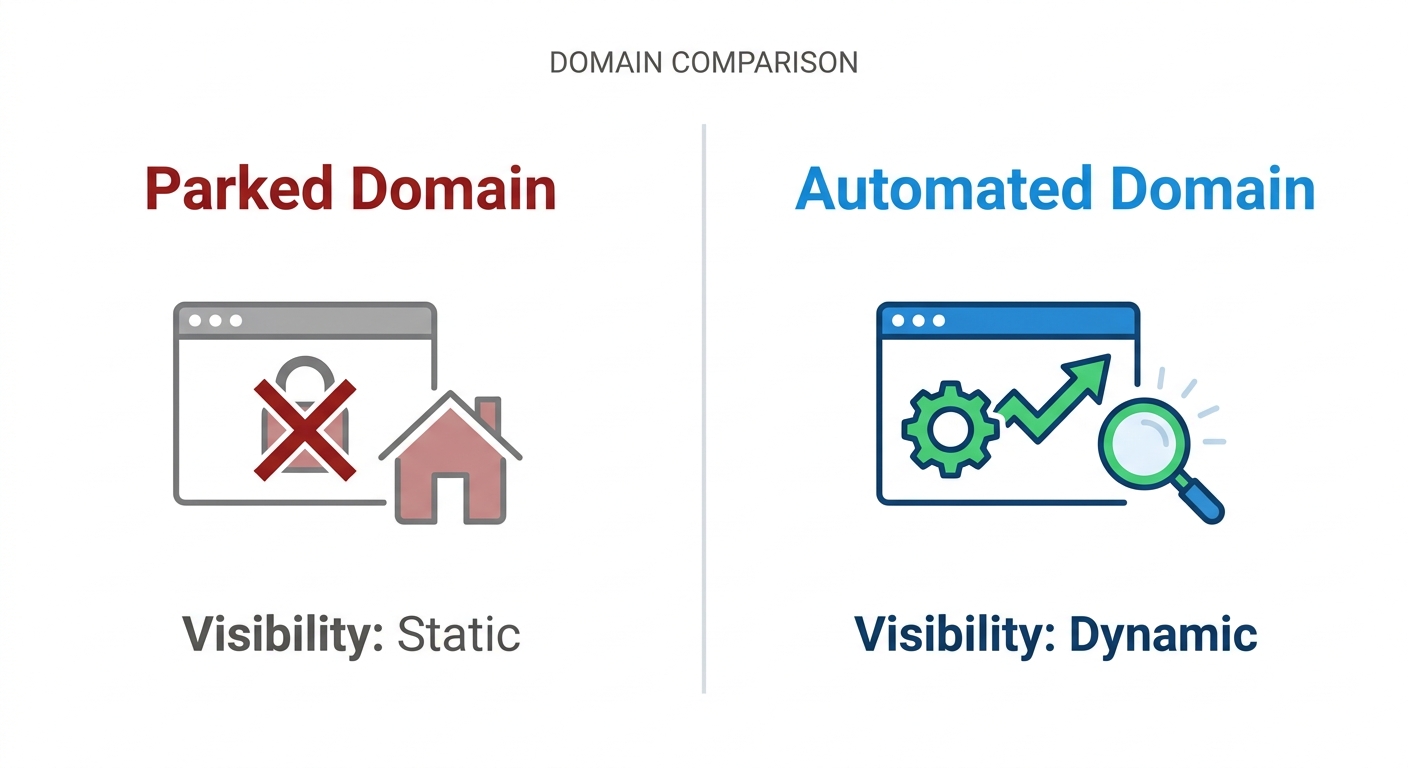
Parked Domain vs. Automated Domain: Which Sells Faster?
How much is your domain name worth?
sbb-itb-96552b7
1. Short, Brandable Names With Strong Extensions
Short and easy-to-remember names are key to a domain's value. A study of 101 successful SaaS companies revealed their brand names average just 2.48 syllables. Think of names like Stripe, Notion, and Figma - simple, memorable, and easy to pronounce.
To test your domain name, try the "radio test." If someone can easily type your domain after hearing it on a podcast, you're on the right track. As Tom Ward, Founder of URLGenie, says:
"If you have to explain the spelling, the name is broken."
A name that's clear and easy to spell not only sticks in people's minds but also performs better in today's automated business world.
The domain extension you choose is just as important as the name itself. Research shows users are 3 to 4 times more likely to trust a business with a .com domain over newer extensions. With a 44% memorability score, .com remains the most recognized and trusted extension, thanks to its long-standing familiarity.
However, the .ai extension is gaining traction, especially among AI-focused companies. For example, Anthropic uses claude.ai to emphasize its AI roots. The popularity of .ai domains has surged, with registrations climbing from 598,000 in mid-2025 to 859,000 by August 2025, and they’re expected to hit 1 million by early 2026.
For a balanced strategy, consider securing both .com and .ai extensions. Use .ai to highlight your modern, AI-driven identity, while .com protects against potential traffic loss from typos. Although .ai renewals are pricier, owning both extensions enhances trust and positions your brand as forward-thinking. Plus, short, easy-to-pronounce domains paired with these extensions often fetch high resale values.
Next, let's explore how keyword demand and commercial intent play a role in determining a domain's worth.
2. Keyword Demand and Commercial Intent
The value of a domain lies in the type of traffic it attracts. While high search volume can show how many people are interested in a topic, search intent uncovers whether those visitors are likely to spend money. For instance, a domain bringing in 5,000 monthly searches for "buy project management software" is far more valuable than one attracting 50,000 searches for "what is project management".
This distinction is critical because commercial intent keywords - terms like "pricing", "get a quote", and "request demo" - are closely tied to revenue. As Azedenkae, Chief SEO Strategist at SeekLab.io, explains:
"High-commercial-value keywords are not 'the highest volume keywords.' In 2026, they are the queries most tightly connected to revenue outcomes: demos, quotes, contact forms, purchases, and qualified pipeline."
To measure a domain's keyword strength, tools like Google Keyword Planner can help. Look at monthly search estimates and the "Top of page" bid range. A high Cost-Per-Click (CPC) signals strong competition among advertisers, which usually means the keyword drives actual sales. With CPCs climbing across industries in 2026, owning a domain that captures organic traffic for these terms becomes a smart way to avoid rising ad costs.
Beyond search volume, focus on "money intent" patterns. Search results featuring shopping modules, local packs, or rows of ads indicate that buyers - not just information seekers - are actively searching. Geo-specific queries like "[service] in [city]" or "[service] near me" are especially lucrative, often commanding the highest CPCs and conversion rates in local service markets.
Before committing to a domain, analyze related queries. If you see terms dominated by words like "free", "guide", or "how to", the domain's commercial potential weakens. Sully, a domain investor, sums it up well:
"Volume tells you how many people care. Intent tells you if they'll spend money. One of those matters way more than the other."
From here, it's crucial to explore how niche trends and market shifts further shape domain value.
3. Niche and Market Tailwinds
Domains tied to growing industries tend to not only hold their value but often increase in worth as the market gains traction. When a category starts attracting more businesses, investors, and entrepreneurs, the top domain names become scarce commodities. Early movers in such markets often see their acquisitions resold later at a much higher price. This growth can often be tracked through signals like funding rounds and job postings.
To spot early momentum, keep an eye on funding trends and hiring activity. Look for industries where Series A funding rounds are gaining speed, but Series B activity hasn’t yet surged. Another clue? When companies describe a function but don’t mention a specific software solution, it may indicate that the market lacks a dominant product - and a category-defining domain could still be available.
Pay attention to markets where search volume for a category grows by at least 30% year-over-year for two consecutive quarters. This kind of growth is a reliable indicator of market momentum. Tools like TrendProof can help you measure this, offering a "Velocity Score" - a score above +80% suggests a brief 3: 7 day window for capitalizing on rapid trends.
"Timing kills more market entries than bad products do." - Oscom.ai
For domain investors, these signals are gold. Once you've acquired high-potential assets, you can list on our marketplace to reach buyers through AI-powered landing pages. High-growth categories right now include AI-native productivity tools (trading at 3.5, 5× SDE), developer tools and APIs (4, 5.5× SDE), and vertical micro-SaaS solutions (3, 4× SDE). Short, memorable domains with .ai or .com extensions that align with these niches are in high demand. To reduce risk, focus on resilient industries like health, wealth, and relationships.
When evaluating market momentum, go beyond keywords and look at broader trends. Google Trends’ "Topics" feature is especially useful - when a niche appears as a recognized Topic, it indicates a more established market rather than a passing fad. Cross-check this data with Reddit discussions and Amazon sales to confirm actual commercial interest. These insights, combined with funding and search trends, create a well-rounded approach to assessing the potential of a domain.
4. Historical Sales Data and Comparable Domains
When it comes to evaluating a domain's potential, historical sales data offers a solid foundation by providing measurable benchmarks tied to market trends and niche activity.
Historical sales act as a pricing compass, helping to determine whether a domain is fairly priced, undervalued, or overpriced. This is where comparable sales, often called comps, come into play.
Platforms like NameBio, which tracks over 6.7 million sales amounting to $3.2 billion, are invaluable for this purpose. Its Comps Engine allows you to review up to 25 relevant sales, and you can filter by recency using the "months_old" option to ensure you're working with up-to-date data.
For example, in May 2026, AgenticIntelligence.com sold for $150,000 on Afternic, Reply.ai fetched $77,000, and Twig.com reportedly sold for $695,000. These transactions highlight pricing trends across various domain categories and TLDs.
"I look at what similar domains have sold for to gauge whether a domain is in the $2,000, $8,000, or $25,000 range." - Sully, SullysBlog.com
To dig deeper, NameBio's Keyword Stats can show whether a term performs better as a prefix or suffix. Additionally, TLDStats helps compare average and maximum sale prices for a specific extension over recent years. Sometimes, what might seem like a bargain could hold much greater potential, especially when trends in TLDs are factored in.
This historical perspective lays the groundwork for analyzing how branding and automation potential can further influence a domain's value.
5. Brand and Business Building Potential With Automation
Looking at historical trends, it's clear that combining branding with automation can significantly enhance a domain's market appeal.
A domain's value often lies in its potential to grow into a fully operational business. A parked domain is like a waiting game - you list it, sit back, and hope someone stumbles upon it. On the other hand, an automated domain operates like a proactive business asset. It features a professional landing page, outbound sales efforts, and pre-qualified leads, all of which help justify higher prices for end-users.
| Feature | Parked Domain | Automated Domain |
|---|---|---|
| Visibility | Static "For Sale" page | AI-generated professional landing page |
| Sales Strategy | Passive (wait for buyers) | Active (AI agents run cold outreach) |
| Buyer Proof | None | Qualified leads and buyer analysis |
| Commission | Often 10: 20% on marketplaces | 0% commission |
| Cost | Renewal fees only | $1/month per domain |
This comparison highlights how automation can turn a domain from a passive listing into an active, market-ready business asset.
Automation tools like Speeder.ai make this transformation seamless. With a simple five-step process, you can upload your domains, let AI create professional landing pages, list them on major platforms like Afternic and Sedo, run automated outreach campaigns, and manage negotiations - all for just $1/month per domain and without paying any commission. It’s a cost-effective way to boost a domain's appeal and functionality.
This shift also changes how buyers view the domain. Instead of just seeing a URL, they see the framework of a potential business. Examples from Speeder's portfolio include domains like taxhelp.ai ($45,000), trademarklawyer.ai ($39,000), and telehelp.ai ($15,000). These aren't just domain names - they're positioned as ready-to-go brand assets that companies can immediately build upon.
"Speeder's AI pages and qualified buyer leads make selling hands-off." - Speeder.ai
Conclusion
Identifying a domain with the potential to grow in value isn’t just guesswork - it’s a process you can refine and repeat. Look for short, memorable names, strong commercial keywords, emerging niche trends, reliable historical data, and tools that streamline the process. These elements together signal a domain’s potential.
The secret lies in layering these signals effectively. As Avery Collins, Senior SEO Content Strategist, explains:
"The skill is not only spotting good names. It is spotting the market conditions that create urgency before everyone else notices."
Before making any purchase, dedicate just 15 minutes to due diligence. Check trademarks via the USPTO, review UDRP history, and examine past content using the Wayback Machine. These simple steps can save you from legal troubles that might cost upwards of $20,000. And don’t forget the "Three-Buyer Rule": if you can’t identify at least three potential buyers, it’s time to rethink the investment. These precautions ensure your approach is both strategic and secure.
Once you’ve found the right domain, put it to work. With Speeder.ai, you can create AI-powered landing pages and launch automated outreach campaigns for just $1/month per domain. Want to take it a step further? Speeder’s AI agents can even help you build a working micro-SaaS around your domain in as little as seven days.
The best domains are more than just great names - they’re paired with a smart strategy that taps into market trends and automation to drive long-term success.
FAQs
How do I quickly estimate a domain’s resale value?
To get a quick estimate of a domain's resale value, you can turn to tools like GoDaddy's valuation tool or APREC Marketplace. These platforms offer rough market-based estimates. For a broader perspective, look at recent sales of similar domains on websites like NameBio. To dig deeper, review the domain's history using the Wayback Machine and check for any trademark issues through the USPTO or other global databases. By combining these steps, you can gain a solid understanding of the domain's resale potential.
Should I buy the .com, the .ai, or both?
Choosing between .com, .ai, or both comes down to your specific goals, target audience, and budget. The .com domain is widely recognized, offering a sense of trust and reliability, making it an excellent choice for broader branding efforts. On the other hand, .ai conveys a modern, tech-savvy image, perfect for AI-related ventures, though it often comes with higher renewal fees. Opting for both domains can give you the best of both worlds - .com for universal recognition and .ai for niche relevance - while also safeguarding your brand in multiple markets.
What legal checks should I do before buying a domain?
Before buying a domain, it's wise to run a trademark search using the USPTO database. You might also want to look into international trademarks if your business has global ambitions. Take time to investigate the domain's history - this includes checking for any negative associations it may have had in the past. Additionally, confirm there are no ongoing legal disputes or competing brands in your industry tied to the domain. Taking these precautions can save you from legal headaches and safeguard your investment.