A bad domain can cost you far more than the registration fee. In 2026, I’d buy a domain only if it is easy to say, easy to spell, legally clean, and still makes sense if the company grows.
Here’s the short version:
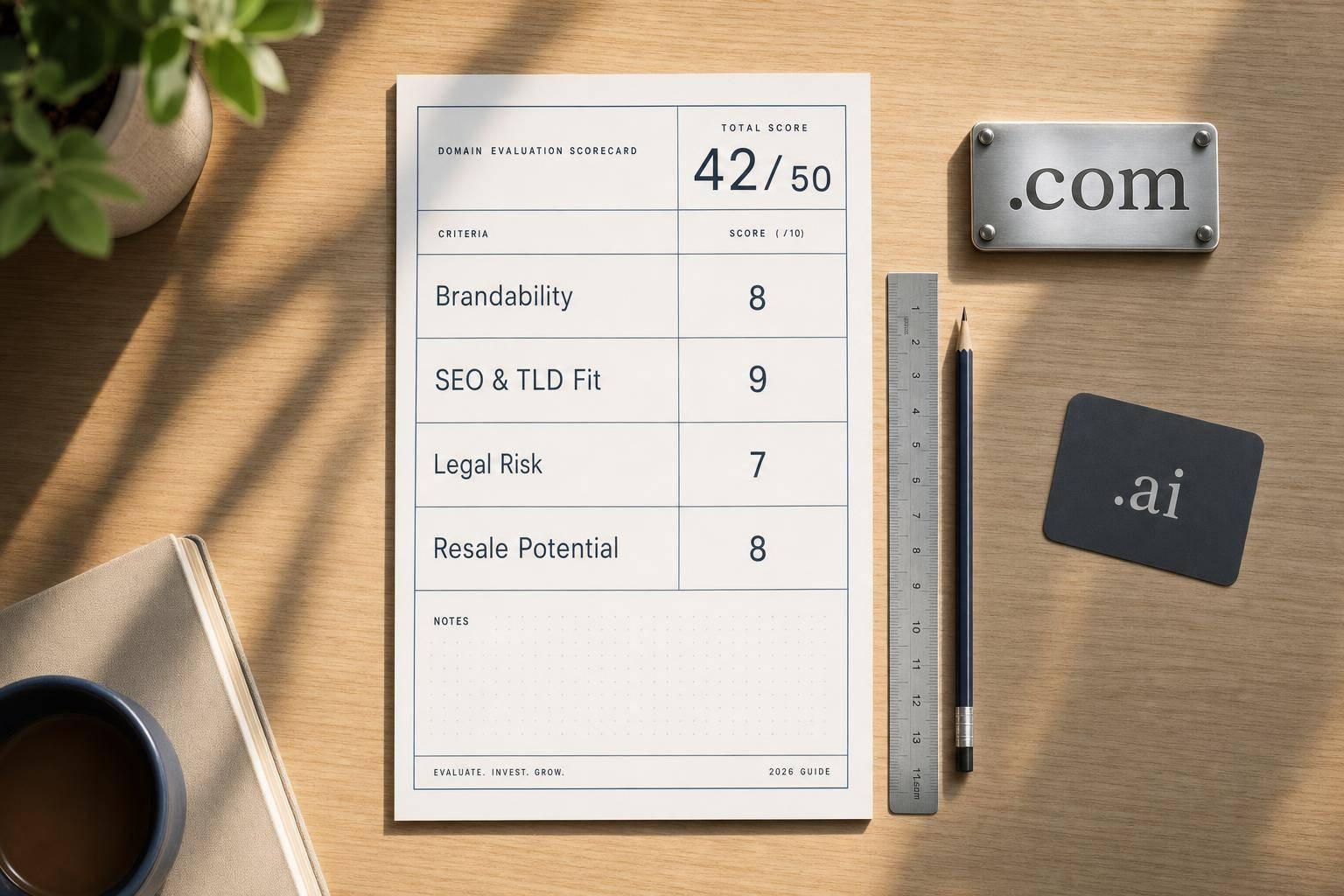
- I score a domain on 5 checks: brand clarity, search/AI fit, extension quality, legal risk, and resale/commercial upside
- I treat 40/50+ as a strong buy, 30: 39 as usable with trade-offs, and under 30 as a pass
- I avoid names that fail the radio test, feel too narrow, or create trademark trouble
- I default to .com when I can, while .ai can work for AI products if the higher renewal cost fits the budget
- I remember that a rebrand can cost $30,000+, while a solid hand-reg might cost only $10: $15/year
The big point is simple: a domain is not just a name - it affects trust, search clicks, word-of-mouth, and long-term costs. That’s why I’d check the name fast, score it the same way every time, and move on if it shows clear risk.
| Check | What I look for |
|---|---|
| Brand clarity | Short, clear, easy to pronounce, easy to spell |
| Search/AI fit | Easy for Google and AI tools to treat as one brand |
| Extension | .com, .ai, .io, and whether the TLD fits the audience |
| Legal risk | Trademark conflicts, confusion risk, bad history |
| Upside | Room to grow, resale interest, and total cost |
If I can’t say the name once and trust someone to spell it right, I usually stop there.
Domain TLD Comparison: Cost, Trust & Best Fit (2026)
Domain Name Evaluation and Selection of Good Domains
sbb-itb-96552b7
1. Score brandability, memorability, and product fit
Start here. If a name falls apart at this stage, better SEO or a nicer extension won't fix it. This is the brandability part of the 50-point scorecard.
Length, pronunciation, spelling, and the radio test
Use the radio test first: if someone hears the name once, can they spell it right?
Successful SaaS names average 2.48 syllables, and more than 75% sit in the two- to three-syllable range. That makes sense. Shorter, cleaner sound patterns tend to stick in people's heads.
Pay close attention to spelling friction. Doubled letters, hyphens, numbers, and fuzzy spellings like "ly" versus "lee" can mess up word-of-mouth sharing.
A quick test: say the name out loud to 10 people. If more than 2 can't spell it correctly on the first try, give the name another pass.
Clarity vs. cleverness for SaaS and AI brands
There's a real tradeoff here. Some names tell people exactly what the company does. Others hint at it.
Descriptive names can feel safer at first. But they tend to be harder to trademark, and they can trap a company inside one product, one use case, or one lane.
In 2026, names that read like clear brands are also easier for search systems and AI models to separate from the pack. AI systems can blur your brand into a category or even a competitor. Abstract or invented names like Rolex or Sony are identified correctly at about 99%, suggestive names like Pinterest or Netflix at about 85%, and descriptive names like Best Buy or General Motors at around 40%.
For most SaaS and AI companies, the better bet is a suggestive name. It hints at an outcome, mood, or promise without saying the thing outright. Think Zipline instead of Fast Delivery. Or Arctic instead of Cold Ice Cream.
That kind of name gives you more room. It's easier to trademark, easier for AI systems to treat as a separate entity, and less likely to feel too narrow if the company grows past its first product.
Brand distinctiveness matters most once the name can also rank and trust signals can back it up.
A 15-point brandability and clarity checklist
Use this rubric to score each candidate domain. A higher score usually means fewer problems later.
| # | Criterion | Pass Condition |
|---|---|---|
| 1 | Syllable count | 2: 3 syllables |
| 2 | Radio test | Spellable after hearing once |
| 3 | Pronunciation | No ambiguity on first read |
| 4 | No hyphens or numbers | Clean alphanumeric only |
| 5 | No doubled letters that confuse | Spelling is unambiguous |
| 6 | No intentional misspellings | Avoids Flickr-style vowel drops |
| 7 | Trademarkable | Not merely descriptive in its class |
| 8 | Distinct from competitors | No obvious confusion risk |
| 9 | Broad enough for pivots | Not locked to one product or city |
| 10 | Global meaning check | No negative connotations in major languages |
| 11 | Social handles available | Consistent across X, LinkedIn, GitHub, and YouTube |
| 12 | Credible on an invoice | Looks professional in formal context |
| 13 | AI entity clarity | Unique enough for LLMs to identify distinctly |
| 14 | Sounds credible in conversation | Passes the "Hi, I work at [Name]" test |
| 15 | Fits the intended product and audience | Name matches what you're building and who it's for |
Run every name through this list before you get too attached. If it clears this screen, move on to SEO impact and extension fit.
2. Check SEO impact and pick the right extension
Once a name clears the radio test, the next step is simple: check whether it helps people trust the brand and find it in search.
What domains still affect SEO in 2026
Google has been pretty direct here: keywords in a domain name have "little direct ranking effect" on their own.
So in 2026, domains matter less for keyword rankings and more for trust, click-throughs, and brand recall. People scan URLs in search results. A clean, credible domain can earn more clicks.
When keywords help and when they hurt
There’s still a small use case for keyword-rich domains. For local services or B2B, a descriptive domain can tell people what you do right away and give a clear category signal.
But outside that lane, these names usually cause more trouble than they’re worth. A domain like BestCRMSoftware.com doesn’t feel like a brand. It feels like keyword stuffing. And it can box you in later. If you move into new products or a bigger market, the name starts working against you. TripActions rebranded to Navan for exactly that reason: its descriptive name couldn’t stretch as the company grew.
"A descriptive name is a marketing tax that you pay every single month." - Stuart Crawford, Creative Director, Inkbot Design
So the rule is pretty straightforward: use keyword-rich domains only when they help recognition for a narrow local or B2B offer. For most SaaS and AI products, a keyword-heavy name creates a brand ceiling that can limit growth.
If the name still looks good at this stage, move to the next filter: legal risk and long-term defensibility.
Compare .com, .ai, and other TLDs before you buy
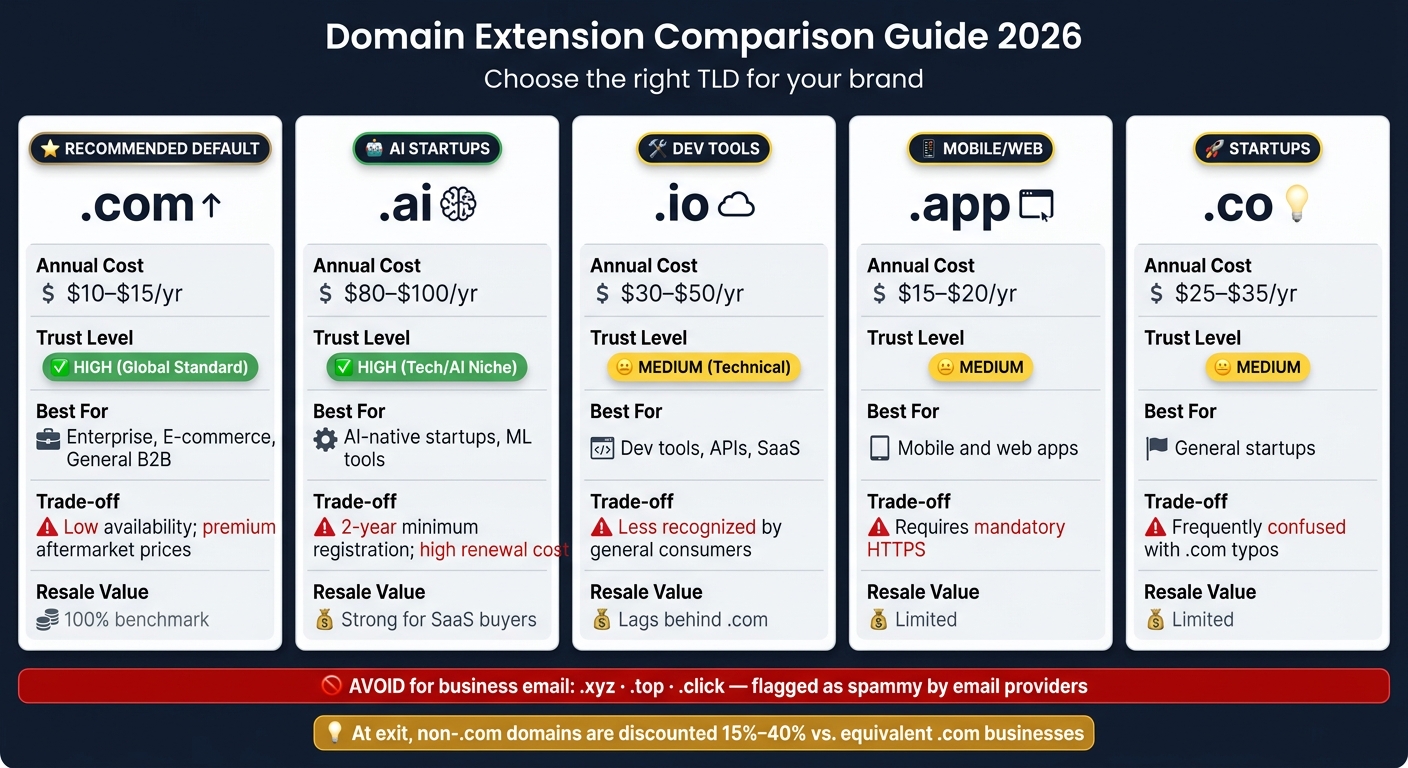
Your extension isn’t a side detail. It shapes trust, cost, availability, and audience fit. Here’s how the main options compare:
| TLD | Annual Cost (USD) | Trust Level | Best Fit | Key Trade-off |
|---|---|---|---|---|
| .com | $10: $15 | High (global standard) | Enterprise, e-commerce, general B2B | Low availability; premium aftermarket prices |
| .ai | $80: $100 | High (tech/AI niche) | AI-native startups, ML tools | 2-year minimum registration; high renewal cost |
| .io | $30: $50 | Medium (technical) | Dev tools, APIs, SaaS | Less recognized by general consumers |
| .app | $15: $20 | Medium | Mobile and web apps | Requires mandatory HTTPS |
| .co | $25: $35 | Medium | General startups | Frequently confused with .com typos |
A few patterns stand out:
- .com is still the safest default for U.S. brands. It sends the strongest trust signal and has the best resale liquidity.
- .ai tells people what you build right away, which is a plus for AI companies. The downside? It’s getting crowded, and renewal costs can pile up fast.
- .io works well with technical audiences, but it doesn’t carry the same weight with non-technical buyers or enterprise procurement teams.
- .app and .co can work for the right use case, but each comes with recognition and confusion risks.
One more thing: avoid spammy extensions like .xyz, .top, and .click for onboarding emails.
After you pick the extension, screen the name for trademark risk.
3. Cut legal risk and avoid weak long-term bets
How to spot trademark and confusion risk fast
A domain can look strong and still bring legal trouble. With more than 5.5 million active registered marks at the USPTO and over 765,000 new applications filed in FY2024 alone, name conflicts aren't rare. They’re part of the game.
This is the legal-risk part of your scorecard.
Use this 10-minute pre-check:
| Step | Action | Time |
|---|---|---|
| 1 | Search USPTO TESS - filter by "live" marks in Classes 9 (software) and 42 (SaaS/tech services) | 3 min |
| 2 | Check TMView for EU and international coverage | 2 min |
| 3 | Google the name + "app" or "software" to catch unregistered common-law users | 2 min |
| 4 | Check domain availability across .com and .ai | 2 min |
| 5 | Check social handles on X and LinkedIn | 1 min |
Don't stop at exact matches. Look for likelihood of confusion. That’s where people get burned.
A fitness app called "Momentum" had to rebrand after a legal challenge from "Momentumm", a corporate wellness platform. Even though they served different groups, the court found a likelihood of confusion. The result? The app lost its name, its user base, and spent six figures on legal fees.
Trying to file a trademark on your own is a gamble. Self-filing succeeds only about 46% of the time, compared with roughly 60% when an attorney is involved. A full attorney search usually costs $300: $600. That may sting a little now, but it’s tiny next to a forced rebrand, which can average over $30,000.
Regulated words, reputation risk, and names that age poorly
Some words come with extra risk. Names tied to finance, healthcare, or security often face tighter regulatory review. They also tend to need stronger trust signals, like a .com, to earn buyer and user trust.
Then there’s the aging problem. Suffixes like -ly and -ify feel played out in 2026. And if a name is too narrow, it can box your brand in later. That makes pivots harder and more expensive.
Descriptive names have their own problem set. They’re tougher to protect, tougher to stretch into new markets, and easier to mix up with other brands.
A red-flag penalty system for your scorecard
Not every issue should kill a domain. But each one should cost points.
Here’s a simple penalty framework to add to your review:
| Risk Level | Action | Criteria |
|---|---|---|
| Critical | Reject | Direct trademark match in Classes 9 or 42; spammy backlink history; fails the radio test |
| High | Caution / Hold | Descriptive name with weak trademark potential; terms in regulated categories; consumer-facing non-.com domains |
| Moderate | Deduct points | Cliché suffix (-ly, -ify); social handles unavailable; .io geopolitical uncertainty |
Any Critical flag is a hard stop. Forcing a weak name through usually costs more than it gives back - legal fees, rebrand costs, and lost momentum add up fast.
"The wrong name can cost millions in workarounds and lost income over the lifetime of the brand." - Marty Neumeier, Author of The Brand Gap
Use the penalty total to decide whether the name is still worth buying.
If it clears this filter, score resale value next to decide whether to build, hold, or pass.
4. Estimate resale value and decide whether to build, hold, or pass
If a name clears legal risk, the next filter is simple: price in, price out. If the numbers don’t work, the domain doesn’t deserve your cash.
Domain prices usually fall into three bands. Hand registrations cost about $10: $15 per year for .com and roughly $80: $100 per year for .ai, which often comes with a 2-year minimum block. The aftermarket usually sits between $1,000 and $30,000. Premium domains start at $30,000 and go up from there based on length and keyword demand.
Inside each band, a few things push value up or down:
- Length
- Search demand
- CPC
- Recent comparable sales
For resale, .com is still the yardstick at 100% of value. .ai and .io can come close for SaaS buyers, but they usually lag behind .com for content sites. At exit, brokers often cut non-.com domains by 15%: 40% compared to the same business on a .com. That haircut matters. A lot.
"A domain is worth exactly what a buyer is willing to pay for the competitive advantage it provides." - Ed, Domavest
Build value vs. flip value for AI and micro-SaaS domains
A strong domain and a strong business asset are not always the same thing.
Build value comes from a name that feels broad, solid, and able to grow with the product. If the name can stretch beyond one feature or one narrow use case, it gives you more room later. That kind of flexibility tends to matter when the product changes shape, which it often does.
Flip value plays by different rules. A domain has better resale odds when it has a clean WHOIS history, no spam history, and low typo risk. Abstract or invented names are often easier to trademark and resell. On the flip side, the smaller the buyer pool, the harder it is to get a top-dollar sale.
For AI and micro-SaaS names, .ai is still a strong signal. But by 2026, it’s a common signal, not a built-in edge. Put plainly: .ai helps with positioning, but it doesn’t do the heavy lifting on its own. A clean .com with an invented name still has the best long-term resale profile.
Use Speeder.ai to test domain demand before committing
Live demand beats a paper estimate every time.
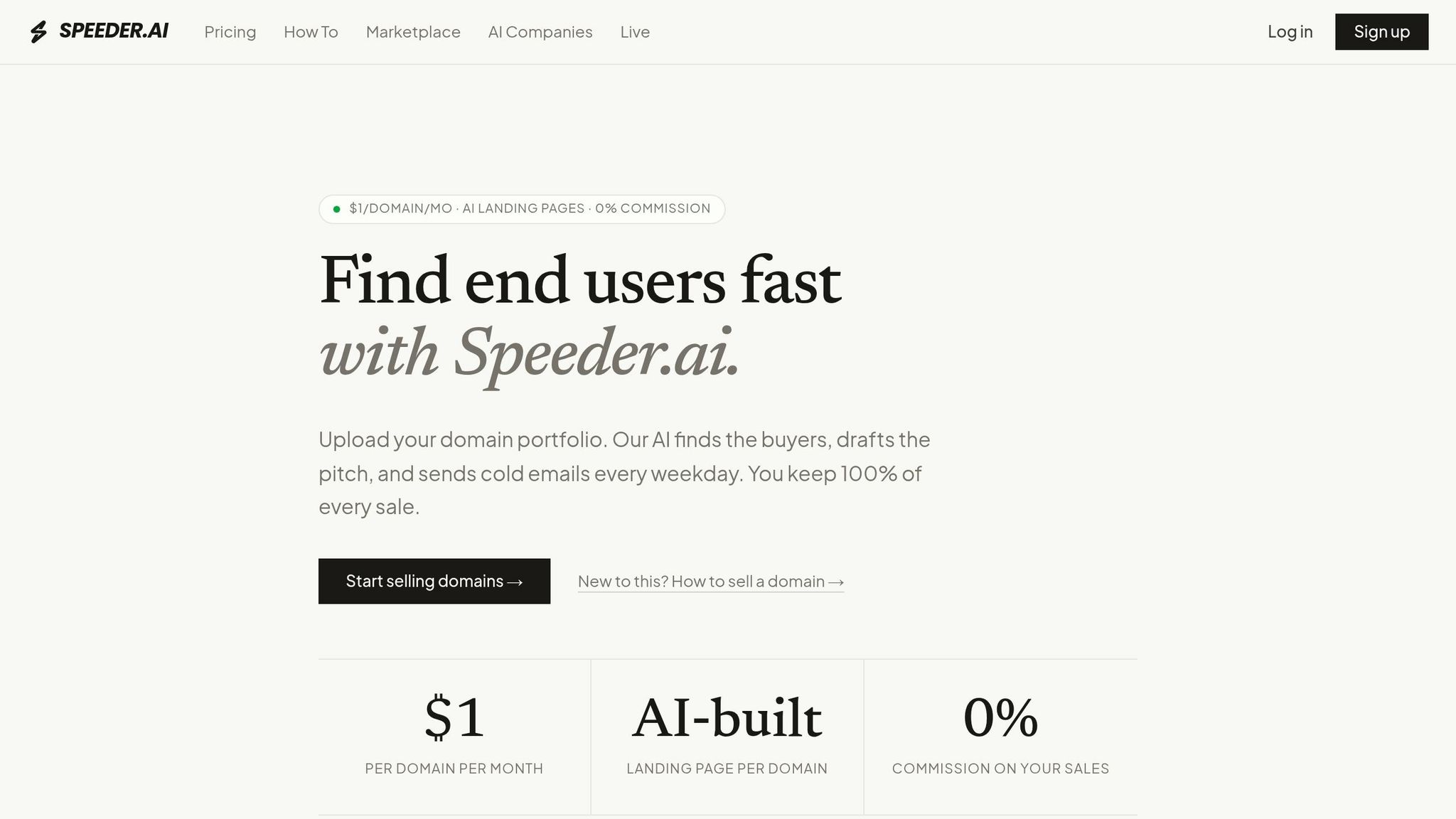
Before you commit, test the name in the market. Use Speeder.ai to launch a landing page, test positioning, and measure clicks and leads fast. Then let the response guide the call.
If the domain brings in leads, build. If it gets buyer interest but no product demand, hold or list it. If it gets neither, pass.
Conclusion: A simple process for better domain decisions
Use four checks: brandability, search/TLD fit, legal risk, and total cost of ownership.
Once your scorecard is done, the choice is usually pretty clear. Buy if the domain scores 40/50 or higher and stays within your budget. If you're looking to sell your domain portfolio instead, AI-powered marketplaces can help maximize value. Negotiate lower if a premium .com comes in above your price ceiling. Hold if it’s only meant to be a short-term launch name. Reject it if it fails the radio test, has a trademark conflict in your business class, or carries a negative meaning in a key market.
Easy-to-spell, legally clean domains build trust and give you room to grow over time. Descriptive names can feel safe on day one, but they often turn into a ceiling. They’re harder to trademark, easier to mix up, and more costly to move away from later. And if a name falls apart in key markets, the rebrand bill can get ugly fast.
The best domain is the one that still fits when your business gets bigger. That’s the test that matters.
FAQs
How do I score a domain quickly?
Use a simple 1: 5 scoring system across seven criteria:
- pronunciation
- brevity
- memorability
- trademark availability
- digital discoverability
- SEO potential
- domain/handle consistency
A total above 24 points is usually worth pursuing.
Before you score anything, cut the weak options first. Make sure each name passes the radio test. Then check USPTO marks, confirm .com, .ai, .io, and .app availability, review any spam or malware history, search Google for similar brands, and look for offensive meanings in other languages.
Should I buy the .com or the .ai?
Choose .com if you can get it at a standard registration price. It’s still the top pick for trust, business use, and resale value.
If the .com is taken or priced too high, go with .ai for AI-first products. Just note the cost difference: .ai often comes with a two-year registration and renewal fees of $80: $100 per year, compared with about $12 per year for a .com.
When is a domain too risky to use?
A domain becomes too risky when it can lead to serious legal, operational, or reputational problems.
Steer clear of names that are trademarked by an active business in your industry. Also avoid domains with a spammy past and names that fail the radio test.
It’s also smart to pause if another company in your space uses the same name on a different extension. That kind of overlap can lead to brand confusion and traffic leakage.