Top Domain Name Trends to Watch and Invest in This Year
May 27, 2026 · 16 min read

Top Domain Name Trends to Watch and Invest in This Year
In 2026, domain names are more than just web addresses - they're critical assets for trust, branding, and business growth. Key trends shaping the domain landscape this year include:
- AI-Focused Domains (.ai): AI-related domains are booming. With 8.9M .ai registrations by April 2026 and high-value sales like AI.com for $70M, these extensions are perfect for tech startups. However,.ai domains come with higher renewal costs ($80: $100/year).
- Short, Brandable .com Domains: .com remains the gold standard, with 72% of domain sales in 2025. Premium sales like Icon.com ($12M) highlight their enduring value for trust and credibility.
- Next-Gen TLDs (.app, .dev, .xyz): Affordable and secure, newer extensions like .app and .dev are gaining traction for SaaS and tech projects. But some, like .xyz, face reputational challenges.
- Repurposed ccTLDs (.io, .co, .ai): Country-code domains are popular among startups. .ai leads with strong resale value (20: 40% of.com), but others like.io face geopolitical risks.
- Local and Geo-Specific Domains: City + Service combos (e.g., AustinPlumbing.com) are SEO-friendly and cost-effective for local businesses.
- Expired and Aged Domains: Domains with clean histories and backlinks are highly sought after, offering faster SEO results and higher resale value.
- Domain Portfolio Protection: Owning multiple extensions (.com, .ai, etc.) safeguards your brand identity and improves AI recognition.
Quick Tip: Start with a .ai or .io domain if you're on a budget, but aim to secure the matching .com for long-term growth. Tools like Speeder.ai help manage domain portfolios and automate buyer interest.
Quick Comparison of TLDs
| TLD | Use Case | Annual Cost | Resale Value vs. .com | Notes |
|---|---|---|---|---|
| .com | General business | $10: $15 | Highest | Best for trust and credibility |
| .ai | AI/tech startups | $60: $100 | 20: 40% | High renewal costs |
| .io | SaaS/dev tools | $25: $60 | 5: 10% | Geopolitical risks since 2024 |
| .dev | Developer tools, SaaS | $12: $18 | Low | Built-in HTTPS, niche appeal |
| .app | Apps, SaaS | $14: $20 | Low | Secure and affordable |
| .xyz | Web3/crypto | $1: $15 | Low/variable | Spam concerns, may be blocked by firewalls |
Act fast - premium domains are selling at record highs, and trends like AI-focused branding are driving demand. Whether you're building a startup or investing, the right domain can make or break your online presence.
The Future of Domain Marketplaces: Strategies and Tools
sbb-itb-96552b7
1. AI-Focused Domains (.ai and AI-Keyword .coms)
The rise of .ai domains has been nothing short of explosive. Since 2020, usage has surged by 300%. By the first quarter of 2025, 28% of tech startups opted for .ai extensions, while the share of new startup registrations using .com domains dropped from 64% in 2020 to just 46%. Recent high-value sales like Ace.ai for $205,000 and PrivateLLM.com for $250,000 highlight the growing demand for both .ai and AI-related .com domains. This shift reflects how businesses are leaning into AI-centric branding.
As Nitin Chhabria, Founder and Product Leader, explains:
"AI isn't a feature. It's an identity. Brands want to be associated with it at the domain level, before anyone visits the site, before a single product decision is made."
For solo founders, .ai domains offer a practical solution to a common problem: most quality .com names are either unavailable or priced far beyond reach. A short, memorable .ai domain not only avoids the pitfalls of keyword-stuffed names but also signals a clear, modern brand identity.
That said, cost is a major consideration. While renewing a.com domain typically costs $10: $15 annually,.ai domains come with a much heftier price tag - $80: $100 per year. Many registrars also require a two-year registration upfront, meaning founders could face over $780 in renewal costs over a decade. For industries where trust and familiarity are critical, such as finance or healthcare, .com remains the preferred choice, as it aligns with user expectations.
For solo entrepreneurs, balancing budget and branding is key. One strategy is to launch with a .ai domain for its strong market positioning and upgrade to the matching .com once revenue allows. For domain investors, premium .ai names hold 20: 40% of the value of their.com equivalents on the secondary market, a significant edge compared to.io domains, which typically capture only 5: 10%. This makes .ai domains a more appealing option for building a valuable portfolio. Investors can also use AI to sell domains by creating automated landing pages for their listings.
2. Short, Brandable .com Domains
Even with the rise of .ai domains, .com still reigns supreme, accounting for about 72% of reported domain sales in 2025 - a 32% increase from the previous year. This dominance is no accident; it's rooted in the trust and familiarity that .com evokes among investors, journalists, and customers alike.
Tom Ward, Founder of URLGenie, puts it plainly:
".com remains the default for trust and resale value. For e-commerce, B2B enterprise sales, or any business where customer trust drives conversions, .com is worth the premium."
The numbers back this up. In April 2025, Icon.com sold for a staggering $12,000,000 through Hilco Digital and Lumis, while January 2026 saw Midnight.com fetch $1,150,000 via Sedo. These headline-grabbing sales highlight why a concise, brandable .com domain is a cornerstone of credibility.
For solo founders, simplicity is key. Stick to two- or three-syllable names - over 75% of successful SaaS companies do, with an average of 2.48 syllables. Test your name with the "radio test": if more than 20% of people can't spell it after hearing it, it's too complicated. Also, steer clear of intentional misspellings, hyphens, or trendy suffixes like "-ify" or "-ly", which can make your brand feel outdated fast.
If you're on a tight budget, starting with a .ai or .io domain can work, but aim to upgrade to the matching .com as soon as your revenue allows. The numbers tell the story: by January 2026, 63% of funded startups (339 out of 539) were operating on .com domains, meeting the market's expectations for credibility and professionalism. Having an exact-match .com domain makes investor pitches, press coverage, and customer recall that much smoother.
3. Next-Gen TLDs (.app, .dev, .xyz, .shop)
Next-generation TLDs (Top-Level Domains) have opened up new opportunities for solo founders to launch projects quickly and affordably. Between 2020 and 2025, usage of these newer TLDs surged by 50%, while traditional TLD registrations saw a decline. By Q1 2026, non-traditional extensions accounted for 15.3% of new domain registrations, a significant rise from 8.9% in 2023. These shifts highlight their growing appeal and practical advantages.
These newer extensions align perfectly with cost-effective and innovative branding strategies. For example, .app and .dev, both managed by Google Registry, come with built-in HTTPS enforcement, which boosts security by default. This makes them ideal for developer tools, SaaS platforms, and AI-driven apps where technical trustworthiness is critical. A great example is Linear, a productivity app hosted on linear.app, which reached a valuation of $400 million by January 2026. Similarly, Lovable.dev gained rapid traction among non-technical founders after choosing a .dev domain when the .com version was unavailable.
"Inside the technical bubble, these [.dev, .io, .app] appear native. Outside it, they register as something less memorable." - SAIPX
For e-commerce, .shop domains effectively communicate a transactional intent before a visitor even clicks, streamlining the user experience for online storefronts. On the other hand, .xyz has a mixed reputation. While affordable, it’s often linked to spammy or low-quality sites, with some corporate firewalls even blocking access. Google Analyst Gary Illyes summed it up well: "My gut reaction is people should stay away from the cheapest TLDs."
When it comes to domain investing, next-gen TLDs like .app and .dev have a modest aftermarket compared to heavyweights like .ai or .com. These domains typically sell for $1,000: $10,000, making them niche opportunities rather than headline-worthy flips. With annual renewal fees ranging from $14 to $20 for.app and.dev - far lower than the $80: $100 typical for.ai - these domains strike a balance between affordability and credibility. However, extensions like .xyz may require extra caution due to their reputational challenges. For startups, these TLDs can serve as a smart starting point before transitioning to premium .com names.
4. Repurposed ccTLDs (.io, .co, .ai)
Country-code TLDs (ccTLDs) were initially tied to specific regions - like .ai for Anguilla, .io for the British Indian Ocean Territory, and .co for Colombia. Over time, these extensions have evolved into popular branding tools, especially for tech-savvy businesses. For solo founders eyeing niche investment opportunities, they strike a balance between pricey .com domains and newer TLDs.
The .ai extension, in particular, has experienced explosive growth. From May 2022 to May 2023, registrations jumped by 156%. By January 2026, it crossed the milestone of 1 million registered addresses, with around 2,000 new registrations daily. Companies like Anthropic have embraced .ai, as seen with their flagship model hosted on claude.ai. This choice underscores how the extension itself can reflect a brand's identity.
"The .ai suffix acts as a silent endorsement of the underlying tech stack. It tells the user: 'We aren't just a company with a website; we are a company built on the technology you are searching for.'" - Isazeni Solutions
The resale market mirrors this trend. For instance, Bot.ai sold for $1,200,000 in February 2026, while Ace.ai fetched $205,000 in early 2025. Typically, a brand.ai domain commands 20, 40% of the value of its equivalent.com on the secondary market - far outpacing.io domains, which usually bring in just 5, 10%. This pricing difference is worth noting for anyone considering domain investing. Tools like Speeder.ai even allow investors to manage premium .ai and .com domains, creating landing pages and capturing buyer interest automatically, so your domain can generate leads even while parked.
Other repurposed ccTLDs come with their own dynamics. The .io extension, for instance, faced challenges after a 2024 sovereignty change announcement for the British Indian Ocean Territory, prompting many startups to move to .dev or .app. While existing .io domains retain value, new purchases carry more risk. Meanwhile, .co remains a sleek and professional choice for consumer-facing startups. However, it comes with a common issue: users often type .com by habit, leading to lost traffic. To counter this, owning the matching .com is a smart defensive strategy.
| Extension | Annual Cost | Secondary Market Value vs. .com | Key Risk |
|---|---|---|---|
| .ai | $60: $100 | 20: 40% | High renewal cost; requires 2-yr blocks |
| .io | $25: $60 | 5: 10% | Sovereignty uncertainty since 2024 |
| .co | $25: $35 | Moderate | Typo traffic lost to .com |
One final note: owning a .ai domain doesn’t automatically make your site globally optimized. Be sure to set International Targeting to "Unlisted/Generic" in Google Search Console to maintain global SEO.
5. Local and Geo-Specific Domains (.us, City + Service Combos)
Geo-specific domains are becoming a smart choice for solo founders aiming to establish AI-driven service businesses with a local focus. Why? Because search engines in 2026 now prioritize geographic signals, often favoring local relevance over global authority.
One highly effective tactic is to secure a Geo-Service Exact Match Domain (EMD). Think of domains like AustinPlumbing.com or PortlandFurnishedRentals.com. These "City + Service" combinations immediately convey local relevance and authority to search engines. For small operations, this can significantly reduce the need for expensive paid ads. As Jay, a prominent NamePros member, explains:
"If you can own your city/service.com for life at $10/year, an initial outlay of $1,000: $5,000 to obtain the domain is really nothing in the grand scheme of things." - Jay, Top Member, NamePros
This approach not only saves on advertising but also improves rankings in local search results.
From an SEO perspective, the potential is huge. If a "City + Service" search on Google mostly returns forum posts, it’s a sign of an underserved niche. A dedicated domain can rank more easily in such cases. A strong geo-niche typically shows these metrics: 1,000 to 10,000 monthly searches, a cost-per-click of $2 to $15, and fewer than 50 referring domains on the top-ranking sites.
GeoTLDs, such as .nyc, further enhance local credibility. Studies show that users are three to four times more likely to trust a business when its domain extension matches their location. However, the resale market for geo-specific domains is often smaller compared to .com domains, as the pool of potential buyers is limited to the region.
For domain investors, geo-service .com domains are particularly attractive, often trading between $1,000 and $5,000. This makes them a compelling option for new investors looking to tap into this trend. Tools like Speeder.ai's domain investor product can simplify the process: after registering a promising city/service .com, the platform can automatically create a landing page and handle buyer inquiries. This automation frees up time to explore more opportunities while capturing leads with ease.
6. Expired and Aged Domains with Clean Histories
In addition to the appeal of AI-related and brandable domains, aged domains with clean histories represent another valuable investment niche. These domains are becoming increasingly hard to find, and their rarity is driving up prices by 15: 30% annually. Premium domains that are at least seven years old, with thousands of high-quality backlinks and no spam penalties, are especially sought after.
Why are these domains so valuable? A clean, aged domain can rank up to four times faster than a freshly registered one. This is because it skips Google's "sandbox" period, which often delays the ranking of new domains. Plus, an established backlink profile - imagine 11,000 high-authority links - can be worth over $200,000 if you were to build it manually. This speed and value mirror the rapid growth seen in AI-focused and next-generation TLD markets.
The aftermarket for aged domains is booming. For example, AI.com sold for a staggering $70,000,000, making it the largest disclosed domain sale to date. This sale underscores how an extensive history and clean backlinks can elevate a domain's market value. Even lesser-known domains like reply.ai ($77,000) and gstudio.com ($87,729) have fetched impressive sums at expired domain auctions.
"A Category Killer isn't just a domain - it monopolizes a word, maintaining its value as long as that term remains in use." - Ed, Author/Analyst, Domavest
For those looking to invest in aged domains, proper due diligence is critical. The first step is to ensure the domain's history is free from spam, private blog networks, or any Google penalties - a strategy often referred to as the "cleanliness-first" approach. Tools like Crawic, which evaluates over 100,000 daily domain drops using more than 60 quality filters, or SERPed.net can help identify domains with strong authority metrics. It’s also important to calculate the domain’s "replacement cost." For example, a domain attracting 1,000 monthly visitors at a $50 cost-per-click could save around $50,000 in monthly ad spending.
Platforms like Speeder.ai can streamline this process. Once you’ve secured a promising aged domain, Speeder.ai’s tools can automatically create a landing page and manage inbound buyer interest, making it easier to capitalize on your investment.
7. Brand Protection and Domain Portfolio Registrations
Relying on just one domain for your business can leave your brand vulnerable. In today's world, where AI tools play a major role in how people discover businesses, your domain portfolio is more than just a web address - it’s part of the semantic infrastructure that tells AI systems who you are and verifies your authenticity. By expanding your domain portfolio, you not only protect your brand identity but also improve how AI platforms recognize and represent your business.
Take the example of Kris Marszalek, CEO of Crypto.com, who spent a staggering $70,000,000 in February 2026 to acquire AI.com during a pivotal moment for the brand. While most solo founders don’t need to make such a hefty investment, the key takeaway is to act early - before someone else claims a domain critical to your brand.
Consider the case of Lovable.dev, a fast-growing startup that lost significant traffic because its .com counterpart was owned by another brand. Users instinctively typed ".com" and ended up on a different website entirely. Securing the .com equivalent of your .ai domain is a low-cost way to avoid such issues and protect your business.
A strong domain portfolio also helps establish your brand as a unique entity in AI knowledge graphs. Modern search engines and AI assistants like ChatGPT and Perplexity now prioritize entities over keywords. Owning your primary .com, .ai, and key regional variants minimizes the chances of AI systems confusing your brand with a competitor or flagging it as a "probable error". By safeguarding these domains, you strengthen your brand’s credibility and ensure consistent recognition across platforms. As Stuart Crawford, a brand strategist at Inkbot Design, explains:
"A name without categorical clarity, entity uniqueness, and phonetic distinctiveness is invisible to the systems your customers are using to find you right now." - Stuart Crawford, Inkbot Design
Before purchasing additional domains for protection, it's essential to do your homework. Check the USPTO TESS database for potential trademark conflicts, use the Wayback Machine to confirm the domain’s history is clean, and ensure there are no adverse UDRP records. These steps turn what might seem like idle domain registrations into valuable brand assets. Once secured, tools like Speeder.ai can help you create landing pages for these domains, allowing them to generate leads or route buyer interest - ensuring your investment delivers real value instead of gathering dust.
TLD Comparison Table: Use Cases, Trust, Pricing, and Resale Potential
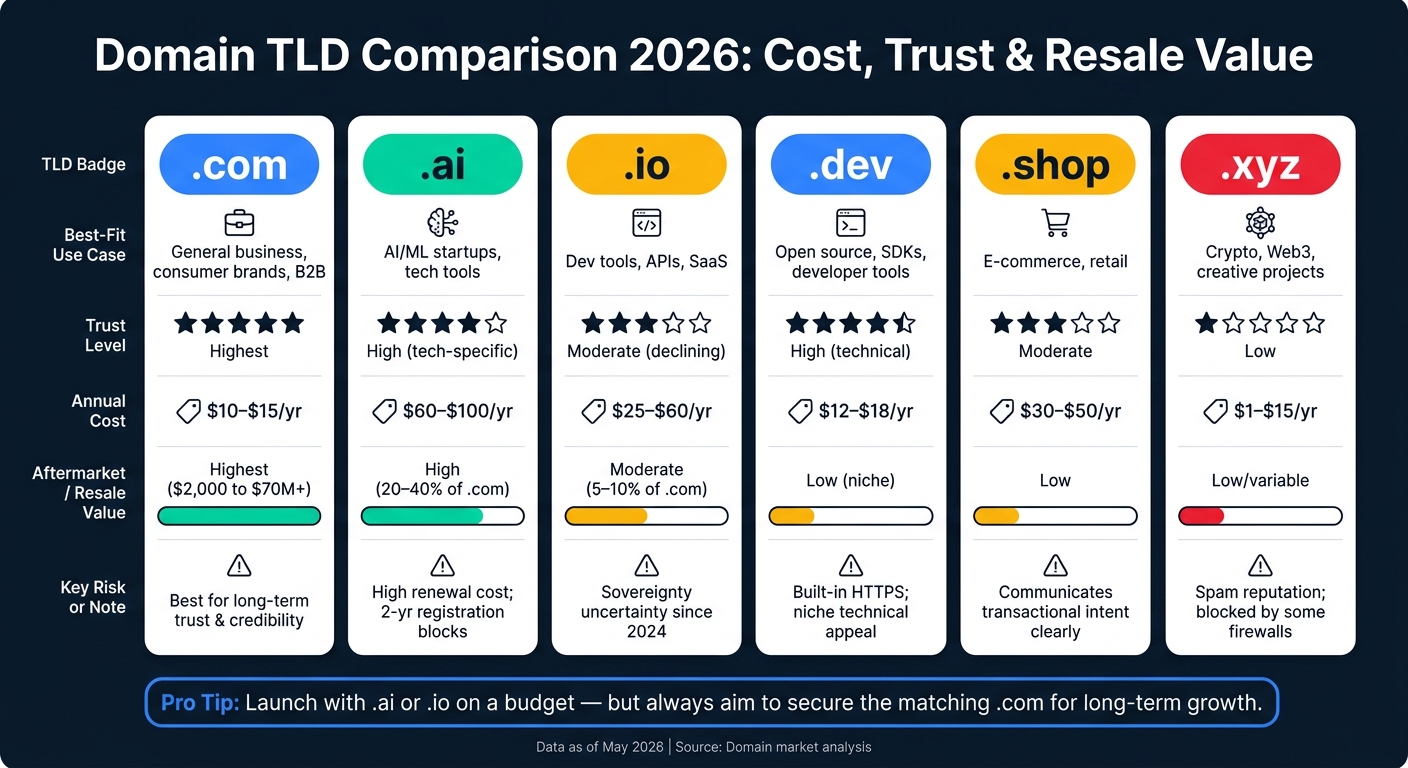
Domain TLD Comparison 2026: Cost, Trust & Resale Value
When choosing a domain extension, you're not just picking a web address - you're signaling your business identity to users and potential investors. Whether you're launching a product or investing in domains, understanding how different TLDs perform in terms of trust, cost, and resale value is essential.
As of May 2026, .com remains the dominant TLD, holding a 41.3% market share among ranked websites. It's widely regarded as the gold standard for credibility. On the other hand, some extensions, like .xyz, come with challenges, including a reputation for spam and potential blocking by corporate firewalls.
"My gut reaction is people should stay away from the cheapest TLDs." - Gary Illyes, Google
Resale values also vary significantly. For example, domains with the .ai extension are typically valued at 20: 40% of their .com counterparts, while .io domains usually fetch only 5: 10%. These differences are crucial if you're buying domains as investments versus using them for a single project.
Here's a quick comparison of popular TLDs based on their best-fit use cases, trust levels, pricing, and resale potential:
| TLD | Best-Fit Use Case | Trust Level | Annual Cost | Aftermarket Value |
|---|---|---|---|---|
| .com | General business, consumer brands, B2B | Highest | $10: $15 | Highest ($2,000 to $70M+) |
| .ai | AI/ML startups, tech tools | High (tech-specific) | $60: $100 | High (20: 40% of.com) |
| .io | Dev tools, APIs, SaaS | Moderate (declining) | $25: $60 | Moderate (5: 10% of.com) |
| .dev | Open source, SDKs, developer tools | High (technical) | $12: $18 | Low (niche) |
| .shop | E-commerce, retail | Moderate | $30: $50 | Low |
| .xyz | Crypto, Web3, creative projects | Low | $1: $15 | Low/variable |
For startups and tech products, .ai or .io can offer a quick and practical solution. However, securing a .com is often considered the best long-term strategy. If you find a clean, brandable .com domain priced under $30,000, many domain experts view it as one of the most valuable branding investments you can make.
Conclusion
The domain market in 2026 is moving fast. Whether you're after a short .ai domain for a cutting-edge product or searching for expired .com domains with clean backlink profiles, one thing is clear: decisions based on data outperform those driven by instinct.
Here’s what to keep in mind as you navigate this space: secure your exact brand match early. By early 2026, 46% of funded startups had already adopted EBM (exact brand match) domains, avoiding the steep costs of rebranding down the line. For AI-focused ventures, a .ai extension instantly communicates your niche before visitors even land on your site - a trend that’s gaining momentum. And if your audience is local, geo-specific domains offer a meaningful SEO edge without the hefty price tag of a generic .com.
"If you are building something you expect to matter in five years, .com or .ai. If you are shipping something to see if it matters at all, anything works." - SAIPX
The real challenge? Securing the right domains before they’re gone. That’s where automation can make all the difference. Tools like Speeder.ai simplify the process: their investor platform lets you build a portfolio of premium .com and .ai domains, automatically creating landing pages and directing buyer interest your way - no need for manual outreach or endless research.
In 2026, the best domain opportunities will belong to founders who act quickly, choose their extensions wisely, and leverage smart tools to stay ahead of the competition.
FAQs
Should I launch on .ai now or wait until I can buy the .com?
You don’t have to hold off on launching just because you don’t have a .com domain. If your product revolves around AI, a .ai domain is both relevant and well-regarded by your target audience. Plenty of startups have grown successfully using only a .ai extension.
For new businesses, it’s often smarter to allocate your budget toward building your product instead of splurging on a pricey .com domain. If your business expands and the need arises, you can always secure the .com later. In the meantime, a .ai domain is a great way to establish your brand and get started.
How can I check if an expired domain has a clean history before buying?
To make sure an expired domain has a solid history, start by checking its past content using the Wayback Machine. Look for any signs of spam or unrelated topics that might indicate misuse. Next, use WHOIS tools to review the domain's registration history. Frequent ownership changes can be a red flag.
Finally, assess the domain's reputation. Do a Google search using site:domain.com to see indexed pages and any potential issues. Check if the domain is blacklisted by antivirus databases. Lastly, analyze its backlink profile with tools like Moz or Ahrefs to ensure it doesn’t have spammy or harmful links. These steps can help you avoid potential problems down the road.
Which TLDs are safest for brand protection and AI recognition?
For safeguarding a brand, .com stands out as the most reliable and established option. It provides stability and helps maintain consumer trust while offering solid trademark protection. On the other hand, .ai domains are gaining traction for their strong association with artificial intelligence, making them a favorite among tech enthusiasts and investors.
A smart approach often combines the two: using a .com domain for versatility and long-term security, while leveraging a .ai domain to signal expertise in the AI field. However, it’s worth noting that .ai domains can come with higher costs and some potential infrastructure challenges.