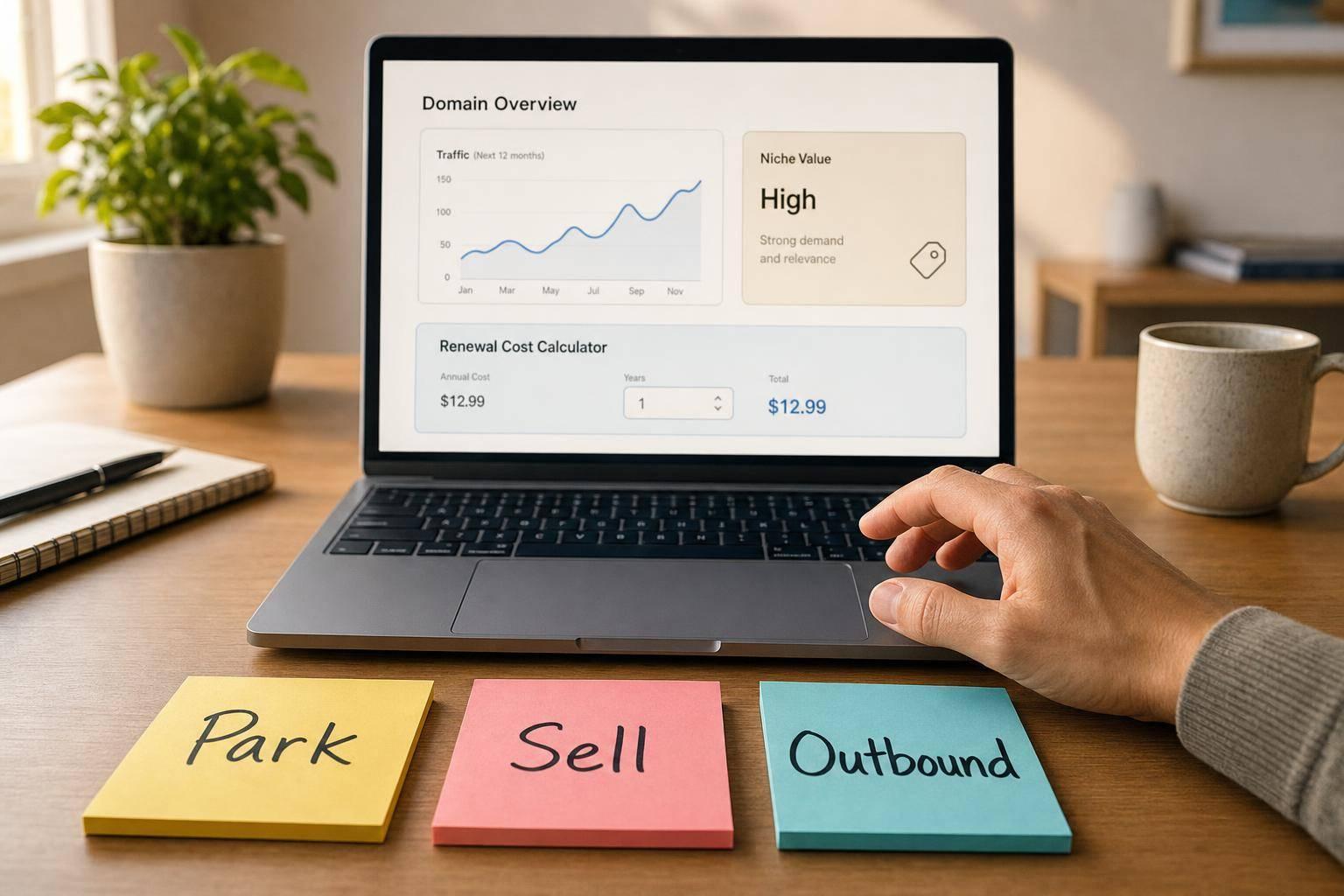
In 2026, most parked domains do not make enough to cover a $10 to $15 .com renewal. If a name has no human type-in traffic, parking is often just a placeholder.
Here’s the short answer:
- Keep a domain parked if it gets direct visits, old backlink traffic, or sits in a high-CPC niche like finance, insurance, or legal.
- Use AI-powered for-sale landers if the name is a premium .com, .ai, or brandable with buyer appeal but little traffic.
- Test a hybrid page if the domain gets some traffic and might also sell.
- Drop or liquidate it if it earns $0.00 to $0.05 per month, gets no real visits, and no one asks about buying it.
- Move to outbound if the name has end-user fit but parking income is near zero.
I’d look at parked domains one way: Does this name pay for itself? If not, I wouldn’t keep parking it by default.
A few numbers make the point fast:
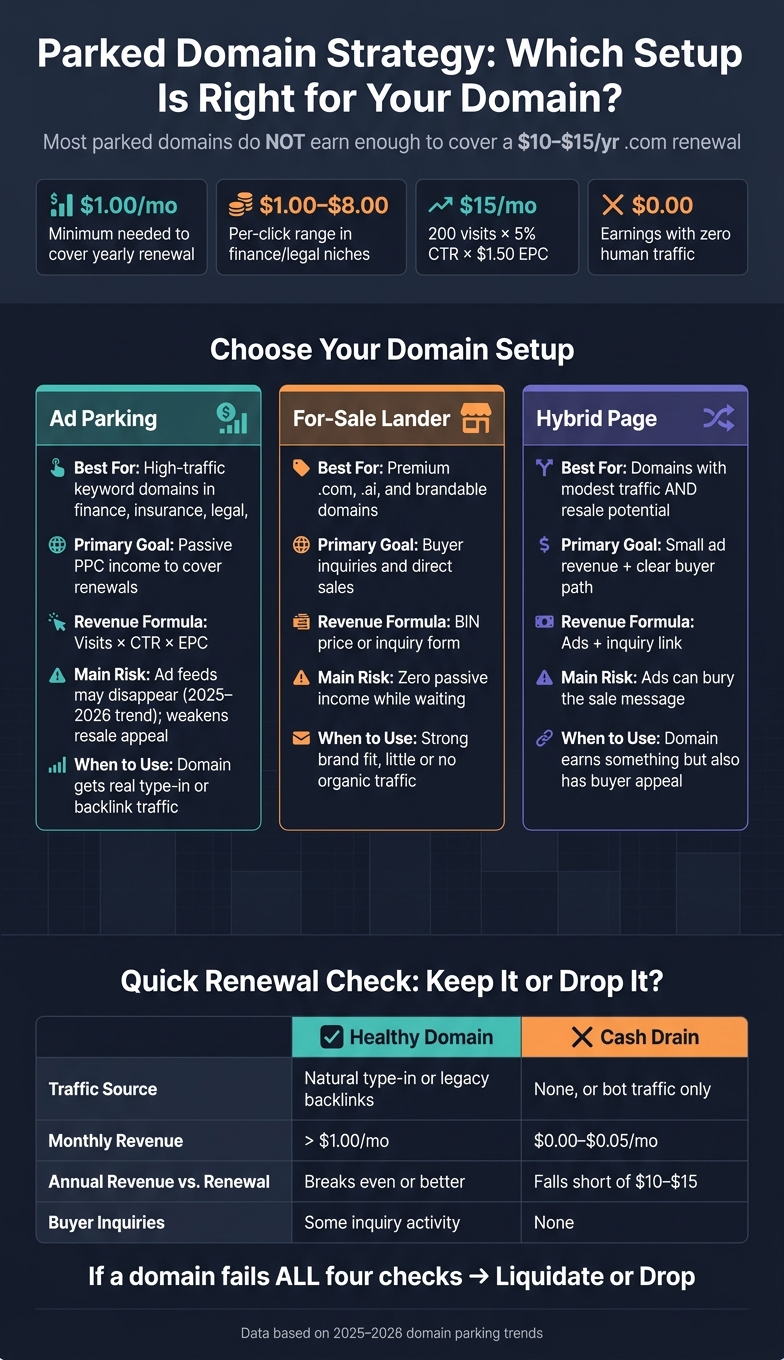
- Many domains need only about $1.00 per month to cover a yearly renewal.
- A parked name with 200 visits/month, 5% CTR, and $1.50 EPC can make about $15/month.
- In high-value niches, some clicks can reach $1.00 to $8.00.
- But if there’s no traffic, the math drops to $0.
| Setup | Best use | Main goal | What to watch |
|---|---|---|---|
| Ad parking | Traffic-heavy keyword domains | PPC income | No ad feed, weak earnings |
| For-sale lander | Premium or brandable names | Buyer inquiries | No passive income |
| Hybrid page | Traffic + resale potential | Ads + sale path | Mixed message on page |
So the decision is pretty simple: traffic, niche value, and renewal cost should decide what you do next. If those numbers don’t work, parking probably shouldn’t either.
Parked Domain Strategy: Which Setup Is Right for Your Domain?
CashParking GoDaddy Review - Does It Actually Pay or Is It a Waste of Time?
How domain parking works and how parked domains earn money
Once a domain is parked, the page type makes all the difference. Instead of sending visitors to a live website, the domain points to a temporary landing page. And not all of those pages make money.
There are three common setups:
- A registrar default page: a basic placeholder from your registrar. It usually doesn't earn anything for you.
- A dedicated parking page: a page from a parking platform built to make money from contextual PPC ads tied to the domain's keywords.
- A for-sale lander: a sales-first page with no ads, built to get offers or inquiries from buyers.
PPC ads, lead generation, and for-sale inquiries
Money from parked domains usually comes from three paths: clicks, leads, or direct buyer interest.
Pay-per-click (PPC) ads pay you a share when someone clicks a related ad or search link on the parked page. The amount can swing a lot by niche. Finance, insurance, and legal terms can pay up to $8 per click. On the other hand, low-value traffic may earn close to nothing.
Lead generation swaps ads for a contact form. Visitors leave their info, and those leads get routed or sold. This tends to work best when the domain name closely matches a service people are already looking for.
For-sale inquiries take a more direct route. A clean sales lander can show a set price or just an inquiry form, so buyers can reach out without any extra clutter.
How platforms like Sedo and GoDaddy CashParking fit in
In day-to-day use, the platform you pick shapes how that traffic turns into money. You point the domain's nameservers to the platform, add keywords, and the platform serves either ads or a sales page while taking its share.
Sedo is free to use and can show parking pages in more than 20 languages with geo-targeted ads. It can also help get the domain in front of more buyers. The minimum payout threshold is €20.
GoDaddy CashParking has historically offered owners up to 80% of ad revenue. But there's a catch: it also has a monthly subscription starting at about $9.59. As of late 2025 and into 2026, some users reported less access to Google AdSense for Domains feeds. When that happens, parked pages may show up without keyword links or any revenue at all. That's why it helps to check the parked page itself, not just the earnings dashboard.
When parked domains earn real money and when they do not
Parking can still work, but only for a small slice of domains. For most names, the math is pretty unforgiving: renewal fees cost more than the parking income. So the main question is simple: does the traffic pay for the renewal?
Direct-navigation names and domains that can cover renewal costs
The domains that still make money tend to have direct-navigation traffic or old backlinks, often in high-intent niches. disabilitylawyers.com is a good example. It sits in a legal niche where one click can bring in $1.00 to $8.00. At that rate, keeping the name can make sense.
The math is straightforward:
Monthly revenue = visits × CTR × EPC
At 200 visits per month, a 5% CTR, and $1.50 EPC, monthly revenue comes out to $15. Even at just $1.00 per month, a domain can still pay for a $10: $15 yearly.com renewal.
Why brandable names with no type-in traffic rarely earn anything
Invented words, two-word startup names, and new .ai domains usually don't get much natural type-in traffic. And no visitors means no clicks, which means no PPC income. It's that blunt.
Bot traffic doesn't help much either. It rarely turns into clicks or revenue. So if a name has no real human traffic, parking it won't suddenly make it earn.
A simple profitability check before the next renewal
Before renewing, look at the last 3: 6 months of traffic and revenue. Then compare that with the renewal fee and any buyer interest. If the domain is not breaking even and no buyers have reached out, it's probably just sitting there costing you money.
| Check | Healthy Domain | Cash Drain |
|---|---|---|
| Traffic source | Natural type-in or legacy backlinks | None, or bot traffic only |
| Monthly revenue | > $1.00 | $0.00: $0.05 |
| Annual revenue vs. renewal | Breaks even or better | Falls short of $10: $15 |
| Buyer inquiries | Some inquiry activity | None |
If the domain has not paid for its renewal and has not brought in a single inquiry, it is likely a cash drain.
When a name fails this check, parking is no longer the right holding pattern.
Picking the right setup: ad parking, for-sale landers, or hybrid pages
Match the landing page to the domain's traffic and resale value. The traffic and inquiry check from the last section should guide the choice here.
Ad-focused parking for domains with traffic
If a domain gets real type-in traffic and sits in a high-paying niche, ad parking can still work. Finance, insurance, legal, and B2B software usually bring the best payouts. In some cases, financial keywords can reach $8.00 per click.
There’s a catch, though. In late 2025 and into 2026, some parking pages lost ad feeds for many users. That left some portfolios with little or no revenue even when traffic was still coming in. If you check your domains and the ads aren’t showing, switch those names to a for-sale lander instead of letting that traffic do nothing.
| Strategy | Best For | Primary Goal | Main Risk |
|---|---|---|---|
| Ad Parking | High-traffic, high-paying niches like finance and legal | Passive income to cover renewals | May weaken resale appeal |
| Sales Lander | Premium .com, .ai, and brandables | Buyer inquiries and sales | No passive income |
| Hybrid Page | Domains with both traffic and resale value | Some revenue plus a clear sales path | Ads can weaken the sale message |
For-sale landers for premium .com and .ai names
Brandable and premium domains usually perform better with a clean for-sale lander than with ad-heavy parking. The point is simple: help a motivated buyer take action. Don’t bury the page under ads.
A visible Buy It Now (BIN) price is often stronger than an open-ended Make Offer form. For premium .com and .ai names, the big thing is clear intent. Show a price, or at least make the inquiry path obvious.
Hybrid pages for domains with both traffic and resale value
Some domains sit right in the middle. They get modest traffic and still have resale value. For those, a hybrid page can make sense. It lets you pick up small ad payouts while keeping a clear path for buyers to inquire or purchase.
Keep the sales path easy to spot. If the For Sale message gets buried under an ad grid, the buyer may leave.
Keep hybrid pages simple:
- A short domain description
- A clear price or inquiry link
- Minimal ad placement
Small ad revenue can help offset renewals while keeping the domain sale-ready. And if a domain still earns nothing in this setup, it shouldn’t stay parked by default.
Beyond parking: when to stop waiting and move to active sales
At renewal time, parking should be a choice, not the default. If parking stops bringing in enough money, the next move isn't more waiting. It's a sales move.
Signs that parking is no longer the right choice
The clearest sign comes down to simple math: if a domain has earned less than its renewal cost for two or more years in a row, it's a liability, not an asset. Other signs are just as clear - no measurable human traffic, a niche with low ad value, or a name that sells more on brand fit than keyword traffic.
If a domain fails the traffic-and-renewal test, use the decision map below to pick the next step: optimization, sales, or liquidation.
| Signal | Decision Path | Action |
|---|---|---|
| Pays for renewal; real type-in traffic | Keep Parked | Maintain setup; optimize keywords |
| High traffic but low click-through; high-value niche | Optimize | Switch parking providers; test hybrid landers |
| Premium .com or .ai; zero traffic; strong brand fit | Switch to Sales | Use a clean "Buy It Now" lander |
| Clear industry fit; no passive inquiries; high end-user value | Active Outbound | Use Speeder.ai to find and contact decision-makers directly |
| No traffic, no buyers, below renewal | Liquidate or Drop | Sell at wholesale auction or let expire |
Using Speeder.ai for idle domains that have buyer value but no parking revenue
For names that have buyer appeal but no parking income, it makes sense to move from passive holding to outbound sales. That's exactly where Speeder.ai fits. You upload the domain, find buyers that match, send personalized outreach, and have replies routed to your inbox. Outreach runs every weekday.
The pricing is simple: $1 per domain per month, 0% commission, and about $0.30: $0.50 per verified buyer email. Credits apply only when an email actually sends, and only after you verify domain ownership through the built-in verification step. If a domain is just sitting there and earning nothing, that cost is a lot easier to justify than waiting around for passive income that may never show up.
Conclusion: a clear framework for parked domain decisions
Parking still works, but for a pretty narrow group of domains: generic terms, common typos, and high-traffic expired names that bring in real human visitors. For most portfolios - especially zero-traffic brandables - parking revenue won't cover renewal costs.
Keep parking only when traffic and niche value beat the renewal cost. If not, switch to sales or active outreach before the next renewal. Look at each domain through three lenses: traffic quality, niche ad value, and annual carrying cost. If a name clears that bar, keep it parked. If it doesn't, move it off parking before the next renewal.
FAQs
How can I tell if my domain has real human traffic?
Focus on traffic quality, not just big visit numbers. High traffic with zero ad clicks or no revenue is often a red flag. In many cases, that points to bots or scrapers, not actual people.
For a better read, use a parking platform with solid bot filtering. Also check independent analytics instead of trusting only the parking dashboard. If traffic keeps looking high but earnings stay at $0, it likely isn’t human traffic.
What CTR and EPC benchmarks make parking worth it?
There are no universal CTR or EPC benchmarks that make a domain worth parking. These days, profit depends more on traffic quality and niche fit than on any fixed percentage.
Some investors still report niche wins, like $37.33 from 12 visitors. Others see clicks worth $0.01 or nothing at all. So in practice, those numbers matter less than one simple thing: whether the landing page helps sell the domain.
Should I park, list for sale, or do outbound?
It depends on the domain and what you want from it. Parking usually isn't a steady passive income play for most investors anymore.
If a domain gets strong type-in traffic, parking might cover the renewal cost. But in most cases, it won't do much more than that. If the domain gets little or no natural traffic, parking often turns into dead weight. In that case, listing it for sale or doing outbound can make more sense.