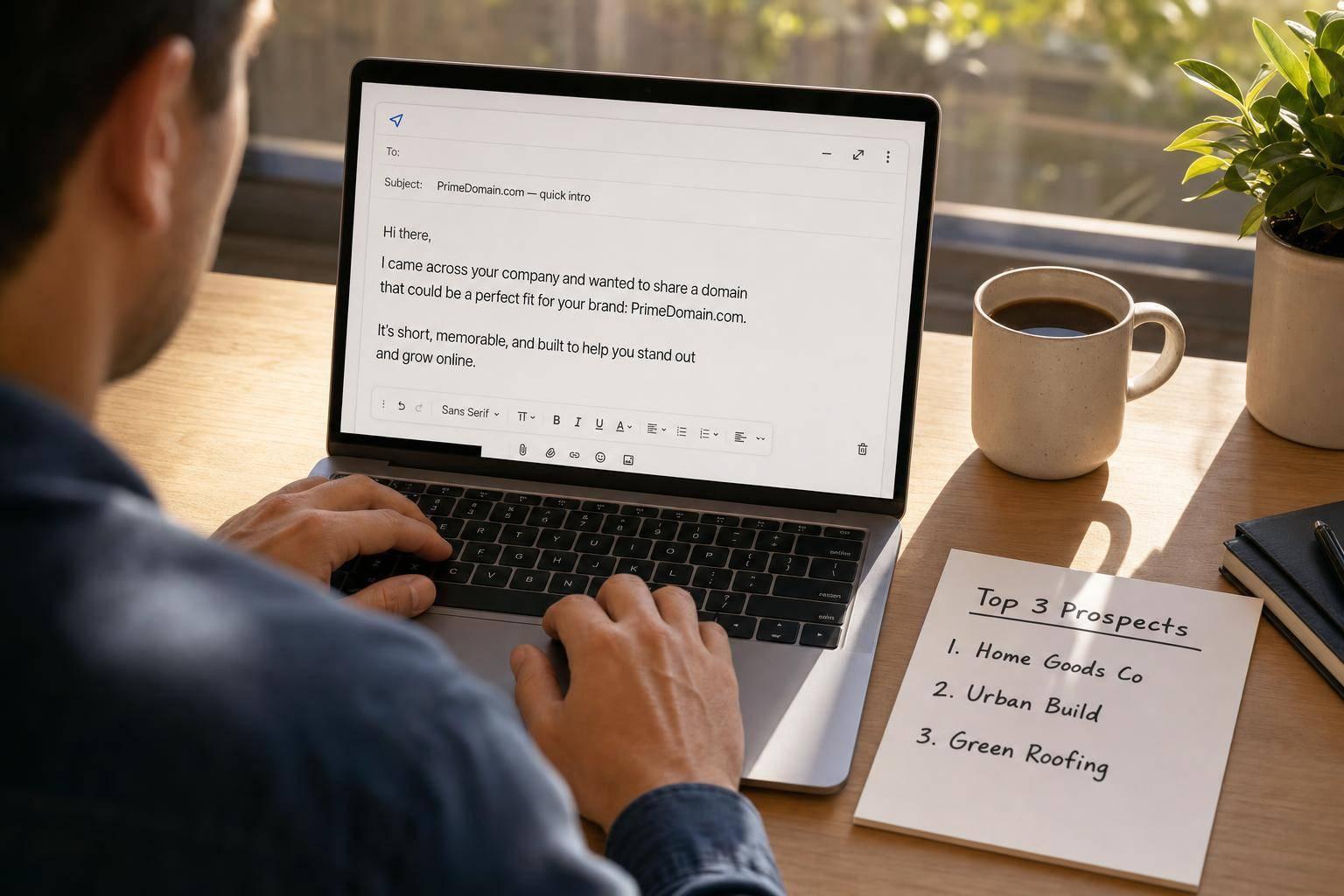
If I want to sell a domain faster, I don’t wait for random inbound offers. I make a short list of companies that can use it, contact the right person, and pitch the business case in 3 to 4 short sentences.
Here’s the whole process in plain English:
- I look for 10 to 50 buyer targets that match the domain
- I focus on firms using weak domains like long URLs, hyphens, odd spellings, or non-
.comnames - I score each lead by fit, company quality, marketing activity, and timing
- I send short, personal emails instead of generic “domain for sale” blasts
- I follow up 2 more times max
- I set a floor, target, and stretch price
- I close through escrow for safety
A simple outbound process can cut the sales cycle from years to weeks or months for domains with clear end-user demand. And end users often pay more than wholesale buyers.
What matters most: don’t pitch everyone. Pick the firms with the clearest reason to upgrade now.
- Startups on weak domains
- E-commerce brands with hard-to-type URLs
- Agencies that want a stronger web address
- Companies already spending on ads or SEO
If I had to boil the article down to one line, it would be this: find buyers with a domain problem, show them how my domain fixes it, and make the next step easy.
This guide walks through that process from research to outreach to pricing and transfer.
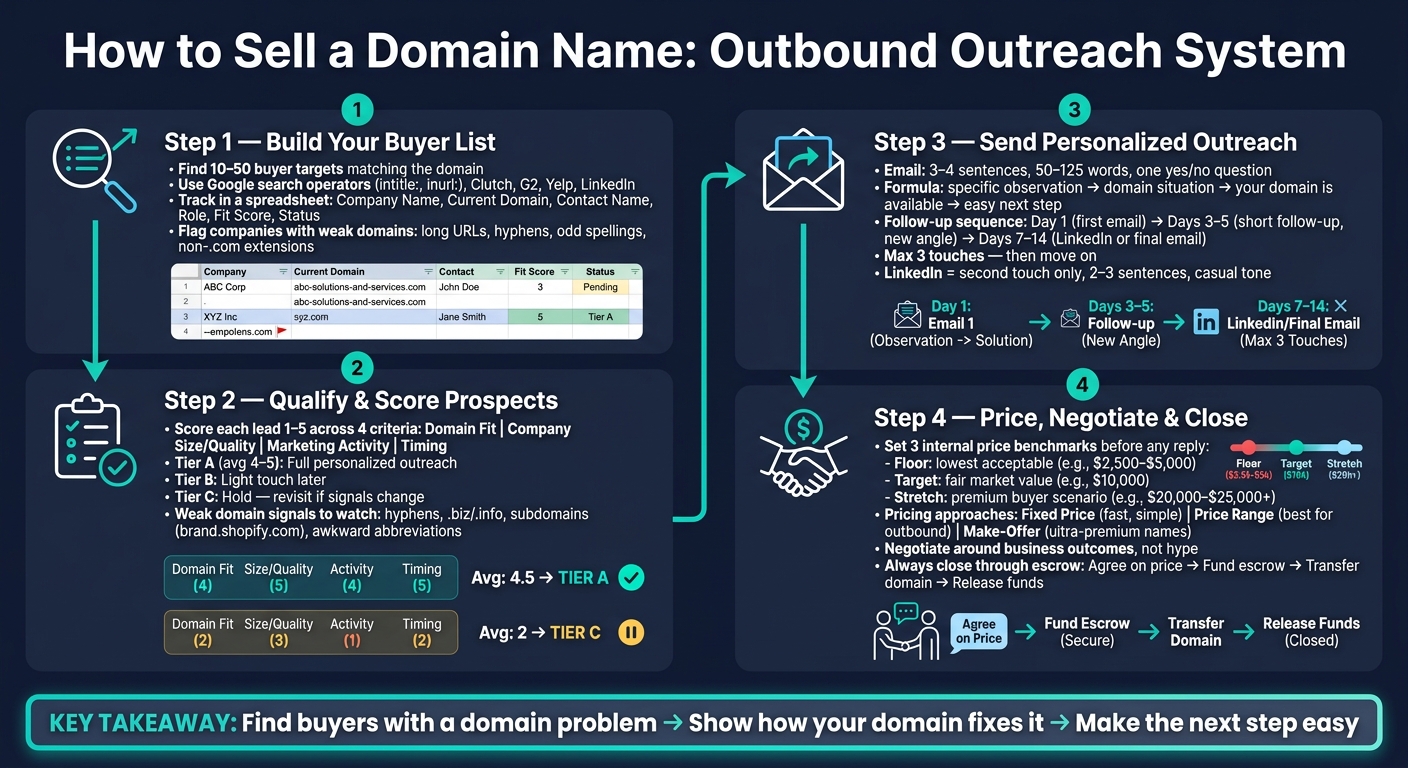
Domain Name Outbound Sales Process: From Research to Close
How to Sell Domain Names Using Outbound Sales & Pitchbox - Full Details
sbb-itb-96552b7
Step 1: Build a list of buyers who can actually use the domain
Before you send a single outreach email, build a tight spreadsheet of companies that could actually use the domain.
Open Google Sheets or Excel and add these columns:
- Company Name
- Current Domain
- Industry/Niche
- Location
- Contact Name
- Role
- LinkedIn URL
- Likely Email Pattern
- Fit Notes
- Fit Score
- Status
Start with companies already active in the niche. Then narrow the list to the ones with the clearest case for an upgrade.
Use Google, directories, and search operators to find matching companies
Search the main keyword with buyer-intent terms and locations, like "payroll software", "payroll Austin", or "payroll Texas." Then add search operators to tighten the results.
For example, intitle:"payroll" agency can surface companies with the keyword in their page titles. And inurl:"payroll" can show sites using the keyword inside a longer URL instead of owning the clean version. That’s often a sign they may want a better domain.
Next, run the same keyword through directories like Clutch or G2 for agencies and SaaS products, plus Yelp or Google Business Profiles for local service businesses. Check the first page of results for each search, skim the sites, and look for companies that are clearly in your niche but stuck with a long, hyphenated, or off-brand domain.
Put the most weight on companies where a stronger domain could help with:
- Trust
- Memorability
- Local search
If their current domain looks weaker than yours, keep them on the list. If it doesn’t, skip them and keep moving.
Use LinkedIn to find founders, marketers, and decision-makers
Once you have a company, find the person who can say yes.
Use LinkedIn to spot the right contact:
- founders for early-stage startups
- marketing leaders for growth-stage brands
- owners for local businesses
- agency owners or business leads for agencies
The goal is simple: reach the person who controls brand, growth, or customer acquisition.
On the company’s LinkedIn page, open the People tab and filter by title. Then check the company website for public emails. That can help you figure out the email pattern, like firstname@, firstname.lastname@, or flastname@.
Add that pattern to your spreadsheet along with the LinkedIn URL. It saves time later and keeps your outreach list clean.
Use Speeder.ai to cut research and list-building time
Building a solid lead list can take 2: 3 days per domain; Speeder.ai compresses that into a daily export.
Speeder.ai's market research and strategy agents scan a niche, flag businesses whose brand names closely match your keyword but whose current domains are noticeably weaker, and export a fresh list you can review each day.
That said, don’t treat the export like a done-for-you list. Treat it like a draft.
Before anyone gets an email, do a fast manual check. Remove irrelevant entries, confirm the domain mismatch is real, and make sure the business is active and fits your target market. Speeder.ai cuts down the time spent finding prospects. Your job is to decide which ones are worth contacting.
Verify fit by hand, then use that list for fit scoring in the next step.
Step 2: Qualify buyers with simple fit signals
Once your list is built, don’t contact everyone. Start with the 10: 30 buyers who look most likely to act, and put your time there.
Spot weak-domain signals that create upgrade demand
Start by looking for domains that feel clunky or second-best.
Long, multi-word domains like bestnewyorkplumbingservices.com are a common sign. So are hyphens. A domain like brand-name.com often tells you the company took what was left instead of getting the name it wanted. The same goes for awkward abbreviations, like brthlth.com when the brand is "Bright Health." You should also watch for companies using .biz, .info, or a country-code extension.
Another strong signal: a business still using a subdomain as its main site, such as brand.shopify.com or brand.wixsite.com. That setup can make the brand feel less polished and harder to remember. A cleaner domain can fix confusion, trust issues, and recall problems that often come with it.
Check fit, budget, and timing
A weak domain shows need. Growth signals show the company can afford to do something about it. You need both.
A polished site, clear pricing, active ads, or a blog/resources section can point to a business that already spends money on growth. If it runs Google or LinkedIn ads, it’s already paying for visibility.
Timing matters just as much as budget. Companies that have recently raised funding, launched a new product, started hiring for marketing roles, or begun a rebrand are often in the right frame of mind for a domain upgrade. These are moments when brand choices get made.
A company that just closed a Series A and is hiring a Head of Marketing is a very different prospect from one that has stayed flat for three years.
Score prospects before you send anything
Use a simple 1-to-5 score across four areas:
- Domain fit
- Company size/quality
- Marketing activity
- Timing
For example, a hyphenated .net site with active ads and a recent launch should score high. A small local business with a basic site, no visible ads, and no recent changes should score low, so skip it for now.
Then sort the list by total score and break it into tiers. Tier A (scores averaging 4: 5) gets your full attention and personalized cold emails. Tier B gets a lighter touch later. Tier C stays on the shelf unless something changes.
If you’re using Speeder.ai, keep the list up to date by watching for new funding announcements, hiring activity, and marketing signals. Re-rank prospects when funding, hiring, or rebrand signals show up.
Use the top scores to decide who gets contacted first.
Step 3: Send short, personalized outreach that explains business value
Start with the highest-scoring prospects from Step 2. Your Tier A list is set. At this stage, the job is simple: make the value clear fast.
Write cold emails that read like a real business email
Keep the email to 3, 4 sentences and 50, 125 words.
The format that tends to work is simple: mention something specific about the company, point out the domain situation, say that your domain is available, and end with one easy yes/no question.
Here’s what that looks like for a company called Brightwell that’s running ads under brightwell-health.com:
Subject: Brightwell.com - available if you're interested
Hi [Name], I noticed Brightwell is advertising under brightwell-health.com. I own Brightwell.com and thought it could fit your brand - a shorter domain is easier to remember and can strengthen ad clicks and trust. Would you like pricing details?
That’s it. No hype. No fake urgency. No pressure. Just one specific observation, one clear business upside, and one direct next step.
The best value points map to what the buyer already cares about. For example:
- A startup may care most about brand clarity and credibility during launch or fundraising.
- An e-commerce brand may care about cleaner checkout messaging and easier customer recall.
- A service company may care about looking more authoritative in sales outreach.
Tie the domain to a business result the buyer can picture. Skip vague claims about “domain value.”
Use LinkedIn as a second touch, not a main channel
Use LinkedIn as a second touch when email goes quiet or when you can’t find a direct email. The goal is to support the same offer, not repeat it word for word.
LinkedIn messages should be even shorter than email - two or three sentences max. If you already emailed, mention it: “Sent a quick note last week about a domain that might fit your brand.” Then connect the offer to one use case and keep the tone casual and human. If it sounds like a mass message, it’s probably a bad sign.
The table below shows where each channel tends to fit best:
| Primary role | First touch / main pitch | Second touch / follow-up |
| Personalization | High - reference domain, signals, business context | High - tied to individual profile and use case |
| Trust level | Professional, reads like a standard business note | High - verified profile adds credibility |
| Response expectation | Direct business inquiry | Light, conversational |
| Best use case | Explaining full business value to a decision-maker | Re-engaging or when no email is available |
Follow up without spamming
Most replies show up on the second or third touch, so a short sequence is enough.
- Day 1: Send the first personalized email.
- Days 3, 5: Send a short follow-up in the same thread with one new angle, like a domain observation or a business upside. Don’t just bump the thread.
- Days 7, 14: Send a final touch on LinkedIn or a brief last email. If there’s still no reply, stop.
After three touches with no engagement, move on. More outreach without a response can hurt credibility and start to feel intrusive. Each follow-up should return to the same core business upside, not switch to a new pitch.
Keep a simple outreach log so you don’t contact the same prospect twice. Speeder.ai’s AI agents can help draft personalized messages, pull company-level signals, and keep that log up to date so nothing falls through the cracks.
Once a buyer replies, shift the conversation to pricing and transfer terms.
Step 4: Price the domain, handle replies, and close securely
Once a buyer replies, the job shifts. Now you're dealing with price, terms, and the transfer.
Choose a pricing approach that fits the buyer and the domain
Before you quote a number, set three internal benchmarks:
- Floor: the lowest price you'll take
- Target: the price you believe is fair
- Stretch: what a well-funded buyer, or one with a strong reason to want the name, might pay
That simple prep helps you stay calm and avoid making emotional calls in the middle of a negotiation.
For example, a brandable .com might have a floor in the $2,500: $5,000 range, a target of $10,000, and a stretch of $20,000: $25,000+.
Your pricing method should line up with both the domain and the buyer:
| Pricing Approach | Speed | Control | Negotiation Flexibility | Best-Fit Scenario |
|---|---|---|---|---|
| Fixed Price | High | High | Low | Lower-tier brandables or straightforward outbound deals where you want faster decisions and fewer emails |
| Make-Offer | Low | Low | High | Highly subjective or ultra-premium names where value depends heavily on the buyer's use case |
| Price Range | Medium | Medium | Medium | Mid- to high-value outbound where you want to anchor a ballpark while staying flexible |
In most outbound deals, a price range works best. It gives the buyer a clear starting point without boxing you in. Use a fixed price when speed matters. Save make-offer for names where value is tied closely to how that buyer plans to use it.
Once the buyer has a number, keep the discussion centered on value and move to escrow as soon as you can.
Negotiate around outcomes, not hype
The business value you used in your outreach should also shape your pricing reply.
When a buyer asks, "what's your price?" or says, "that seems high", keep your answer short and tied to business use. For example: "We're asking $10,000 for the domain, given its memorability and fit for a direct-to-consumer brand." That lands better than vague talk about scarcity or what the name might be worth someday.
If a counteroffer comes in, treat it like a normal step, because it is. Acknowledge it, restate the domain's practical upside, and then make a measured move if it makes sense. Think easier recall, cleaner branding across ads and email, and stronger brand trust.
A solid reply might sound like this: "Thanks for the offer. Based on the name's fit and category relevance, I'd be closer to $12,500. If that's too high, I'm open to discussing timing or structure."
That tone works because it stays calm. No pressure tactics. No "last chance" language. In many cases, movement on terms, timing, or payment structure does more to keep a deal alive than cutting the price too fast.
Use escrow and a secure transfer process
Once you agree on price, make the next step simple and safe.
Use escrow for every meaningful sale. If the buyer refuses, pause the deal. The usual flow is simple: agree on price, fund escrow, transfer the domain, then release the funds. Escrow protects both sides, especially on higher-value deals.
Before you start the transfer, check a few basics. Make sure the domain is unlocked, have the authorization code ready if needed, and confirm that both sides understand the timeline and transfer method.
A clear process helps buyers feel comfortable moving ahead fast.
Conclusion: A repeatable outbound system for every domain you own
This playbook isn't a one-off. It works whether you own one domain or a large portfolio. At its core, it's a repeatable outbound system: find the right buyers, check fit, reach out with a clear value message, and close cleanly.
Outbound turns a domain from a passive listing into an active sales process.
The best way to make this stick is to run it once, start to finish, on a single domain. Pick one name with a clear use case. Then run one campaign end to end and refine your list, message, and pricing based on what gets replies.
Track replies, objections, and drop-off points. Use what you learn to improve the next campaign, not to rebuild the whole system.
The goal isn't one sale. It's a process you can repeat across every domain you own.
FAQs
How do I know if a company is a good buyer?
Focus on companies where your domain lines up with their growth plans, industry, or competitive position. Good targets often include startups in your niche, businesses riding market momentum, or companies using longer, weaker domains.
It helps to put the highest priority on companies that are already showing commercial intent. That can mean they’re running ads, hiring, or doing both. Those are usually signs they’re spending money and pushing for growth.
From there, tailor your outreach around the branding gap or pain point the domain can solve. If their current domain is clunky, hard to remember, or a poor fit for where the business is headed, say that plainly. The goal is to show why your domain makes more sense for them right now.
What should I say in my first outreach email?
Prioritize personalization so your email doesn’t feel like just another cold pitch. Spend a few minutes on the prospect’s company, recent news, and social posts. Then tie the domain to what they care about, whether that’s a new product, market growth, or a branding move.
Keep the message direct and easy to follow. The first email should open the door to a conversation, not try to close the deal on the spot.
How much should I ask for my domain?
Research comparable sales for similar short domains or keyword-rich names. Check current listings and recent sales to see where your domain fits, whether that's under $10,000 or above $100,000.
Because pricing depends on buyer demand and market trends, present your domain as a premium asset with clear brand appeal and immediate business use.