How to Find Outbound-Ready Domains Before Anyone Else Registers Them
July 31, 2026 · 11 min read
How to Find Outbound-Ready Domains Before Anyone Else Registers Them
Most hand-registered domains never had buyers lined up in the first place. I’d only register a .com or .ai when I can list buyers, spot clear ad spend or live companies on the term, find 10 to 25 people to contact, and rule out trademark trouble in about 10 to 15 minutes.
Here’s the short version:
- I treat registration as the last step
- I look for buyer proof, not names I just like
- I skip names if I can’t find 20+ leads fast
- I check Google Ads, search results, startup data, drop lists, and other TLDs
- I avoid names with active trademark risk
- I set my likely sale range first, whether that’s $200: $499 or $1,000: $5,000
- I’m stricter with
.aibecause renewals cost more than a cheap.com
That’s the whole play: find demand first, check legal risk second, register last. If I can’t see a direct path from keyword to buyer list, I pass.
What I like about this approach is how simple the filter is. Can I name buyers right now? Are companies paying for clicks? Are startups using close-match brands? Are firms stuck on .net, .org, or a country-code domain? If the answer is no, I move on.
A few numbers make the point clear:
- 1 weak rule causes most bad hand-regs: buying before checking demand
- 10: 25 buyers is a solid contact pool for one domain
- 10: 15 minutes is enough time to tell whether a name has outbound potential
- $1 per domain per month plus $0.30: $0.50 per email is the stated cost for Speeder’s outbound setup
- 0% commission means the platform fee is not tied to the sale price
Outbounding Domain Names (Sales Outreach Tutorial)
Quick comparison
| Check | What I look for | Pass | Fail |
|---|---|---|---|
| Buyer depth | Named companies or buyer types | 5+ buyer types or 10: 25 contacts | Hard to name even a few |
| Commercial intent | Ads, rankings, live businesses | Active advertisers and developed sites | No spend, no clear market |
| Extension angle | Upgrade path | Firms on weaker TLDs | No one using the term |
| Startup signal | Close-match funded brands | Get[Keyword], [Keyword]App, [Keyword]AI patterns |
No startup use |
| Legal check | USPTO/WIPO conflicts | No active mark issue | Active mark on a coined or company name |
| Renewal risk | Odds of outreach now | Ready to pitch this week | Likely to sit for a year |
My takeaway is simple: register fewer names and pitch more of the ones you buy. That one shift cuts waste and gives each domain a clear shot at a sale.
Set Your Outbound-Ready Criteria Before You Search
Outbound-ready now means buyer-proof.
So before you type even one domain into a registrar, set your filter first. You want a simple way to judge whether a name is worth registering at all.
Buyer visibility, commercial intent, and target price
Start with one plain question: Can I name five distinct buyers or buyer types? If that answer doesn't come fast, take it as a warning sign.
Outbound-ready names already have visible buyers in the market. That can mean companies ranking for the keyword, advertisers bidding on it, or funded startups using a close variant such as "Get[Keyword].com" or "[Keyword]App."
Commercial intent matters just as much. If companies are already spending money on that keyword, or if they’ve built sites on other extensions, the market has already given you a green light. You don’t need to guess.
As Mike Robertson, Director of Business Development at Fabulous.com, puts it:
"If they are buying traffic on the keyword, pitching the exact match domain to them makes sense." - Mike Robertson, Director of Business Development, Fabulous.com
Set your target sale price before you register. That step keeps your thinking clear.
Typical geo-targeted or keyword domains often sell in the $200: $499 range, while exact-match .com upgrades aimed at funded startups may support a $1,000: $5,000 ask. If you know your price range up front, you’re less likely to sink money into names that only support a small exit.
A simple pass-fail rule for renewal risk
Every domain comes with next year's bill attached. That renewal only makes sense if there’s a clear path to a sale in the near term.
A simple rule works well here: if you can't find 20+ qualified leads in 10: 15 minutes, do not register the name.
That’s the pass-fail test. If the lead pool is thin, your renewal risk goes up. In that case, move on.
Also, skip pure brandables for outbound. They make buyer discovery too fuzzy. Stick with names where the keyword points you straight toward a buyer list.
Names that pass this filter move into demand validation and buyer-list building.
Find Unregistered Domains With Clear End-User Demand
Once your filter is set, don’t register names on a hunch. Use buyer signals first so you can prove demand before you spend anything. The goal is simple: build a buyer list before you even check whether the domain is open.
Use Search Ads, Organic Results, and Search Operators
Search ads are one of the clearest signs of demand. If companies are paying to show up for a keyword, there’s money behind that term. Organic results help too. They show which businesses already operate in that space and how crowded the market is.
Search operators make this much easier. Pair the keyword with a city to find local service businesses. Add "software" or "SaaS" to spot tech vendors. Use site:crunchbase.com "[keyword]" to pull funded startups tied to the term.
That mix gives you a quick read on who might want the name:
- Search ads = buyers already spending money
- Organic results = companies already built around the term
- Search operators = local firms, SaaS companies, and funded startups connected to the keyword
Mine Startup Naming Patterns
Startup naming trends can tell you a lot. Funded companies often lean on the same formats, like Get[Keyword], [Keyword]App, and [Keyword]AI. When you see a group of funded startups using versions like these, the cleaner exact-match .com or .ai may still be open.
A practical move here is to search startup databases for the keyword, filter for recent funding rounds, and then check which domain each company actually uses. That’s where things get interesting. If several companies are building brands around the term but settling for modified versions, that points to demand - and it can hint at an exact-match upgrade opportunity.
If the cleaner version isn’t available, shift your attention to businesses already using weaker extensions.
Scan Drop Lists and Businesses on Weaker Extensions
Drop lists can surface names tied to real businesses that simply let a registration expire. Even if the old site is gone, the keyword may still have commercial use for other companies in that market. Sometimes the business disappears, but the buyer interest doesn’t.
Weak-extension targets are often the most direct upgrade plays. If a company is operating on .net, .org, or a country-code TLD, demand is already there. The buyer already gets the value of the keyword - they’re just using a weaker home for it. Tools that search across TLDs can help you spot these cases fast.
Search advertisers and weak-extension targets first. They tend to produce buyer lists faster than anything else. Once you’ve got a short list of likely buyers, move to legal and conflict checks before you register the name.
Validate Demand, Legal Safety, and Outreach Potential
Validate your shortlist before you register. This is the pass/fail step that tells you whether a name is worth buying.
Build a Buyer List Before You Register the Name
Before you add a domain to your cart, look for real businesses that could want it. That includes advertisers spending on the keyword, funded startups using a related brand, and companies already stuck on weaker extensions. A solid rule of thumb is 10 to 25 qualified prospects for each domain. If you can’t get there, the buyer pool is probably too small.
"I try to prioritize potential buyers by the size of the company, their annual revenue and if they've received funding." - Mike Robertson, Director of Business Development, Fabulous.com
Don’t waste time with generic inboxes. Find actual decision-makers on LinkedIn or the company’s About page. If your list looks thin, stop there and move on before you even check availability.
Run Trademark and Conflict Checks
Once your prospect list is in place, check USPTO and WIPO for active trademarks tied to the term. Pay attention to active marks and skip expired or inactive ones. Stay away from coined terms or company-specific names. They bring more conflict risk, and they’re tougher to sell through outbound. If a name doesn’t pass both the demand check and the conflict check, it shouldn’t make your outbound shortlist.
Score the Domain for Outbound Fit
Before you register, make sure the domain clears these checks:
- Buyer signals verified - developed sites, active companies, or other TLD registrations tied to the keyword
- Legal risk low - no active trademarks on coined or company-specific terms
- Outreach targets real - named decision-makers, not generic inboxes
This section comes down to one simple question: does this name deserve a hand-reg today? If it passes, add it to your weekly sourcing queue.
Turn the Process Into a Weekly Outbound System
5-Step Weekly System to Find & Sell Outbound-Ready Domains
Once a name clears demand and trademark checks, don't let it sit in a spreadsheet. Move it into a weekly system you can run again and again.
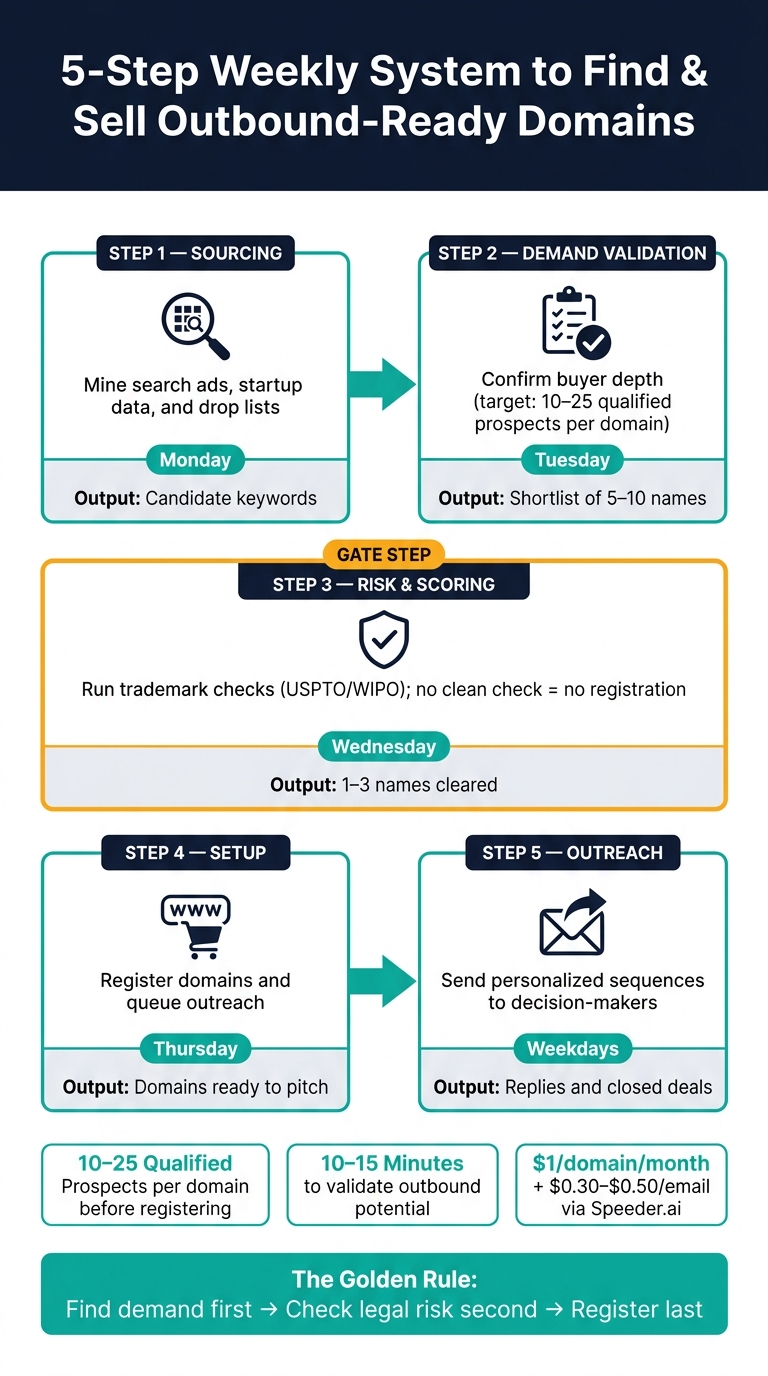
A 5-step weekly routine from research to registration
| Step | Task | Cadence | Output |
|---|---|---|---|
| 1. Sourcing | Mine search ads, startup data, and drop lists | Monday | Candidate keywords |
| 2. Demand Validation | Confirm buyer depth | Tuesday | Shortlist of 5: 10 names |
| 3. Risk & Scoring | Run trademark checks | Wednesday | 1: 3 names cleared |
| 4. Setup | Register domains and queue outreach | Thursday | Domains ready to pitch |
| 5. Outreach | Send personalized sequences to decision-makers | Weekdays | Replies and closed deals |
Step 3 is the gate: no clean trademark check, no registration.
That one rule saves a lot of pain. It keeps you from buying names you can't pitch with confidence.
Once the shortlist is live, use automation to handle buyer discovery and outreach.
Use Speeder.ai to scale buyer discovery and outreach
After ownership is verified, three AI agents handle the workflow. Scout finds matched end users, Courier sends a three-touch sequence, and Concierge routes replies to you.
The platform also handles deliverability with built-in SPF, DKIM, and email warmup, so pitches land in inboxes instead of spam folders. Each domain gets an auto-generated landing page with buyer analysis and conversion copy, plus a listing on the Speeder marketplace.
Pricing is simple:
- $1 per domain per month for the full system
- Outreach credits at roughly $0.30 to $0.50 per email
- 0% commission on every sale
Discovery and drafted outreach are always free. Credits only apply when an email actually sends.
Conclusion: Register Fewer Names and Sell More of Them
The shift is simple: treat registration as the last step, not the first. Define outbound-ready criteria before you search, prove buyer depth before you spend, and clear trademark risk before you commit. Then run the same five steps every week.
The goal is simple: register only names you can contact buyers for immediately.
FAQs
How do I know if a domain is truly outbound-ready?
A domain is outbound-ready when there’s clear, active buyer demand and you can point to real companies or startups that match the name.
Look for live businesses on similar names or TLDs, active companies or startups using related keywords, advertisers bidding on those keywords, and matching results in search or the app stores. It gets even stronger when your domain feels like a clear upgrade for those prospects.
What should I do if I find demand but only a few buyers?
Treat the domain like a niche asset, not something you pitch to everyone. The buyer pool is small, so the goal is simple: find the few businesses that could put it to work and speak to them directly.
A few business models could make sense here:
- A niche SaaS company
- A lead generation site
- A paid directory
- A media or newsletter brand
- A specialty e-commerce store
- A local or regional service business with a tight keyword match
From there, focus on the most practical niche. In most cases, that means the buyer type with a clear use case, a direct path to revenue, and a reason to care about the exact domain name right now. A domain is easier to sell when it helps a business get leads, build trust, or own a tight corner of the market.
Because the buyer pool is limited, skip mass blasting. Automated outreach to a long list of weak-fit contacts usually does two things: gets ignored and trips spam filters.
Instead, lean into personalized outreach. Find decision-makers at the small set of businesses that are the best fit. Then send short, direct messages that show you understand what they do and why the domain could matter to them. Think founder, marketing lead, or head of growth, not a generic inbox.
That approach takes more effort, sure. But with niche domains, a small number of well-aimed messages usually beats a huge batch of generic ones by a mile.
How can I check trademark risk before I register a domain?
Use the WIPO trademark search database before you register a domain. It’s a simple step, and it can save you a headache later.
For generic dictionary words, trademark risk isn’t always black and white. A word can be generic in one context and protected in another. At the same time, existing trademarks can sometimes hint at market demand. If multiple businesses want to use a term, that may tell you the name has commercial pull.
What matters most is intent. Focus on active trademarks and stay away from bad-faith registrations. If a domain looks like it targets a brand, that’s where trouble usually starts.
If you plan to park the domain, be careful with monetization settings too:
- Disable the zero-click feed
- Avoid PPC keywords that could infringe on existing trademarks
That part is easy to miss. But parked pages can create risk fast if the ads or redirects lean into brand terms you don’t own.