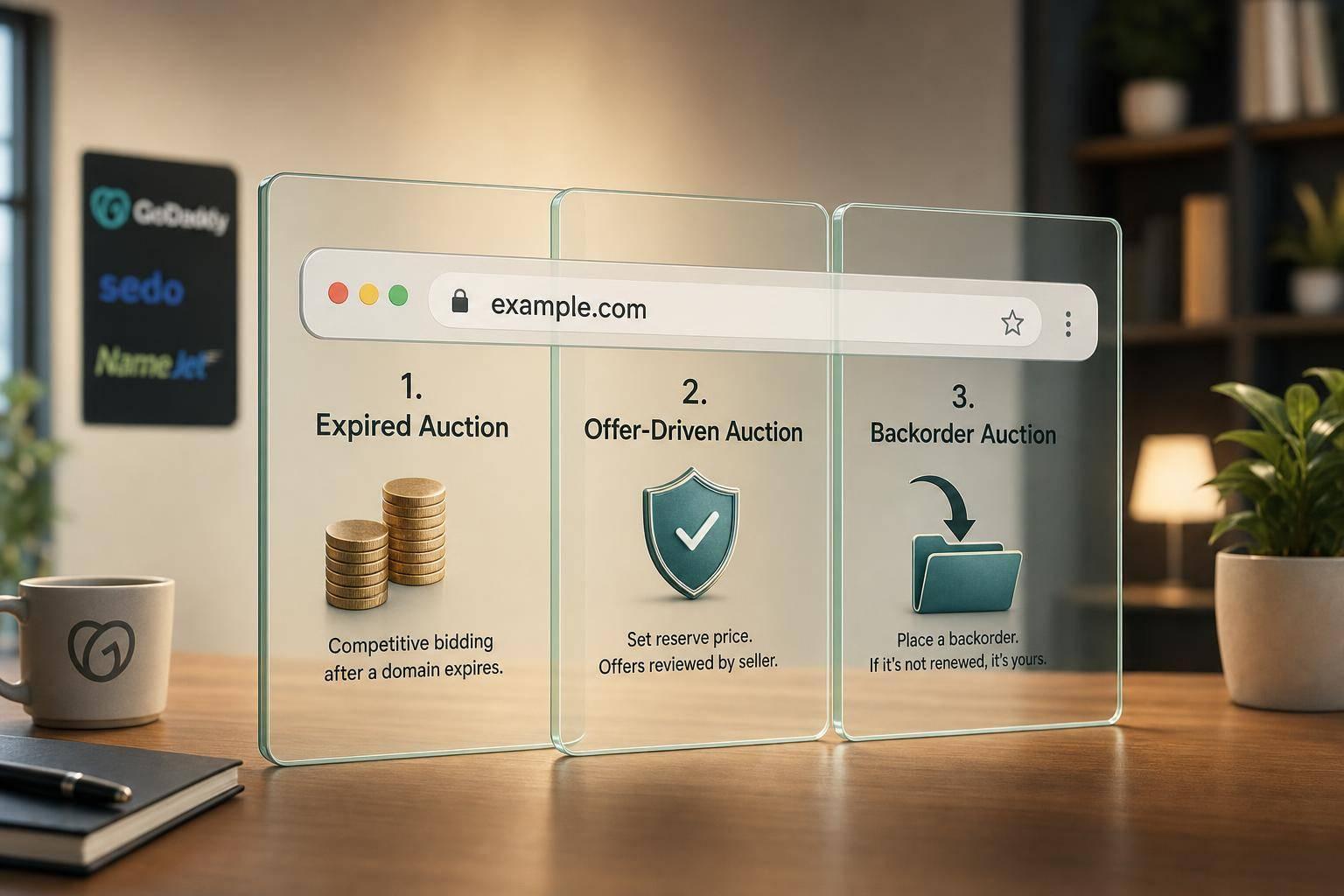
If you bid on the wrong type of domain listing, your costs, timing, and odds can change fast. I’d boil this article down to four checks: know the sale type, look for a reserve, add fees to your budget, and confirm how the transfer starts after payment.
Here’s the short version:
- GoDaddy is often the first stop for expired domains, closeouts, and seller-listed names.
- Sedo is centered on investor-owned domains, with Buy Now, Make Offer, and auctions that can start after an opening bid.
- NameJet is built more around backorders and private auctions for pre-release names.
- In all three cases, the highest bid does not always mean the deal is done. Reserve prices, payment deadlines, and transfer steps still matter.
- On GoDaddy expired auctions, buyers should budget for the winning bid plus the renewal fee.
- On Sedo, sellers often pay around 15%: 20% commission on completed sales.
- On NameJet, if more than one buyer places a backorder, the name usually moves into a private auction.
If I were buying, I’d match the platform to the goal:
- Expired-name hunting: GoDaddy
- Secondary-market buying or selling: Sedo
- Pre-release and backorder chasing: NameJet
The main point: a domain auction is not just “place bid, win name.” It’s a process with listing rules, fee math, and transfer timing that can affect what you pay and when you get control of the domain.
Quick Comparison
| Platform | Best For | Main Listing Types | How Auctions Start | Extra Buyer Cost to Watch |
|---|---|---|---|---|
| GoDaddy | Expired domains and closeouts | Expired auctions, closeouts, seller listings | Set auction window or seller listing | Renewal fee may be added to expired-auction wins |
| Sedo | Investor-owned domain sales | Buy Now, Make Offer, direct auctions | Can start after a buyer offer on some listings | Check reserve and final sale terms |
| NameJet | Backorders and pre-release names | Backorders, private auctions | Starts when 2+ buyers backorder the same name | Watch payment deadline after winning |
I’ve kept this guide focused on what changes the outcome: where the domains come from, how bidding starts, what fees apply, and how the domain reaches your account.
GoDaddy Auctions: how expired names, closeouts, and seller listings work
GoDaddy puts three main kinds of inventory in front of buyers: expired domains, closeouts, and seller-made marketplace listings. Some expired names that don't get picked up in auction later move into closeout.
That sounds simple on the surface. It isn't. Each listing type comes with its own bidding flow, starting price, and transfer process. And that changes a lot: who kicks off the sale, what sets off buyer competition, and when money is due all depend on the listing type.
Auction types and bidding flow on GoDaddy
Expired-domain auctions run for a set period. When more than one buyer wants the same domain, they bid against each other during that window. One detail trips people up all the time: the final cost is not just the winning bid. GoDaddy adds the renewal fee, so plan your budget with that extra charge in mind.
Seller-created listings work more like a standard marketplace setup. The domain owner can:
- set a Buy Now price
- ask buyers to submit offers
- use a reserve price
Buyers can find these listings through GoDaddy search results and marketplace traffic.
Reserves, seller costs, and post-auction transfer on GoDaddy
A reserve price is the minimum amount the seller is willing to take. If bidding stays below that number, the domain doesn't sell.
Seller costs matter too. GoDaddy takes a commission, which cuts into the seller's net proceeds.
For buyers in expired-domain auctions, the price on the screen still isn't the whole bill. Renewal fees are added on top of the winning bid. Once payment clears, the domain transfer moves ahead.
Next comes how Sedo handles offer-driven auctions and transfer timing.
Sedo: how direct auctions, offer-driven auctions, and transfers work
Sedo is a marketplace where many domains begin as fixed-price or offer-based listings. For buyers, the main thing to figure out is simple: is the domain listed at a set price, open to negotiation, or likely to turn into an auction?
That’s where Sedo feels different from GoDaddy. On Sedo, many listings start as direct sales or private offers. An auction often comes later, once more than one buyer wants the same name.
How Sedo auctions start and how bidding works
Sedo listings usually fall into two main types: Buy Now and Make an Offer.
- Buy Now means the domain has a fixed price. The buyer pays that amount, and the deal moves forward.
- Make an Offer means the buyer starts with a bid, and the seller can accept, reject, or negotiate.
Here’s the twist: with a Make an Offer listing, one buyer’s offer can set off a public auction if other buyers step in. At that point, it stops being a one-on-one negotiation and turns into open bidding. Buyers then compete until the auction window closes, and the highest bid wins.
But there’s a catch. If bidding doesn’t meet the seller’s reserve, the domain doesn’t sell.
Fees, payment handling, and domain transfer steps on Sedo
Sellers pay a commission on completed sales, which lowers their net proceeds.
Once the sale is agreed, Sedo manages both payment and transfer. The order matters here. First, payment clears. Then Sedo starts the transfer process. After that, the buyer gets control of the domain in the registrar account.
That transfer step matters more than people think. If it’s handled the wrong way, DNS for a live website or email address can break.
NameJet uses a different model again, built around backorders and pre-release inventory rather than standard marketplace listings.
NameJet: how backorders, private auctions, and pre-release inventory work
NameJet is built around backorders. That’s the main way to go after domains that are about to drop or that show up through pre-release inventory.
Here’s the basic idea: if only one person places a backorder on a name, that buyer can move ahead. If more than one person backorders the same domain, NameJet moves the name into a private auction.
Backorder timeline and what happens when more than one buyer wants the same name
When you place a backorder, you’re reserving a shot at the domain if it becomes available. It’s not an instant purchase. It’s more like putting your hand up and saying, “I want in if this opens up.”
If more than one buyer backorders the same name, NameJet turns that interest into a private auction for those buyers only. The highest bid when the auction closes gets the domain.
Proxy bidding, payment deadlines, and where the domain lands on NameJet
NameJet uses proxy bidding, which means your maximum bid is entered for you automatically, up to the limit you set. That helps if you don’t want to sit there and bid every few minutes.
Winners have to pay by the deadline. If they don’t, they lose the name. After payment clears, the domain is transferred into the winning buyer’s registrar account.
That makes NameJet a better fit for buyers who want backordered names and are ready for auction competition, not people looking for a simple fixed-price checkout.
Next, compare which platform fits expired-name hunting, seller listings, or backorder-driven buying.
GoDaddy vs Sedo vs NameJet: which auction platform fits your domain-investing goal
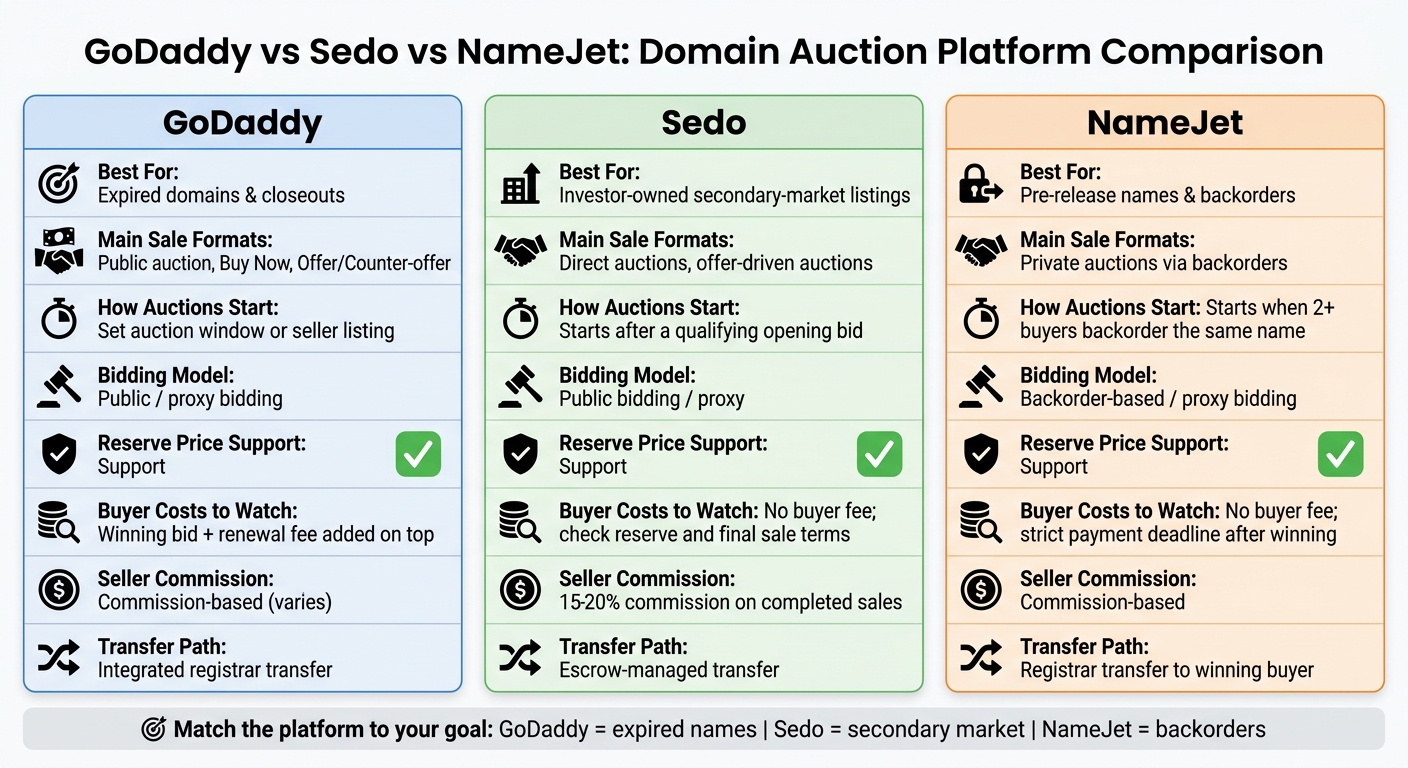
GoDaddy vs Sedo vs NameJet: Domain Auction Platform Comparison
Now that the basics are clear, the next step is picking the platform that lines up with what you're trying to do.
The easiest way to think about it is by inventory and workflow. GoDaddy works well for expired domains and closeouts. Sedo is built more around investor-owned listings. NameJet is the better fit when you're chasing pre-release names through backorders.
| Platform | Primary Inventory | Main Sale Formats | Common Timing | Bidding Model | Reserve Support | Buyer Costs | Seller Costs | Transfer Path |
|---|---|---|---|---|---|---|---|---|
| GoDaddy | Expired names, closeouts, seller listings | Public auction, Buy Now, Offer/Counter-offer | Around 7 days for many auctions | Public / proxy | Yes | Varies by auction type | Commission-based | Integrated registrar transfer |
| Sedo | Investor-owned secondary-market listings | Direct auctions, offer-driven auctions that start only after a qualifying opening bid | 7 days once started | Public bidding / proxy | Yes | No buyer fee | 15: 20% commission | Escrow-managed transfer |
| NameJet | Pre-release inventory, backorders | Private auctions for backorders | Varies | Backorder-based / proxy | Yes | No buyer fee | Commission-based | Registrar transfer to the winning buyer |
Matching each platform to your buying or selling strategy
If you're hunting for expired names, GoDaddy is usually the most direct route. You get expired inventory, closeouts, and a transfer process tied into the registrar, which keeps things simple.
If you're selling or buying investor-owned domains, Sedo makes more sense. Its setup leans into secondary-market deals, and the escrow-managed transfer can make the handoff feel a lot smoother.
If your plan is to target pre-release domains before they hit the open market, NameJet is the one to watch. Its backorder model is built for that exact use case.
Conclusion: how to bid, list, and avoid costly mistakes
Before you place a bid, slow down and check the basics: sale type, reserve, fees, and payment deadline. A domain can look like a steal until the rules around it change the math.
Then match the venue to the job. GoDaddy fits expired names, Sedo fits secondary-market sales, and NameJet fits backorders.
FAQs
How do I know if a domain auction is worth bidding on?
Focus on names that are short, brandable, and linked to commercial keywords that already have momentum in the market. Then check comparable sales to see if the asking price lines up with what buyers are paying right now.
It also helps to look for plain signs that the idea has legs. Is there demand for similar services or solutions? Are businesses already spending money in that space? Those signals can give you more confidence that the domain may hold its value or gain value before you place a bid.
What happens if I win but the domain transfer is delayed?
If a domain transfer is delayed after you win an auction, contact the platform’s support team right away. They usually step in as the middleman and check the transaction.
Funds are often held in escrow until the domain is pushed or transferred to your account. If the seller doesn’t begin the transfer within the grace period, the platform will usually cancel the deal and issue a full refund.
Should beginners start with expired auctions, offers, or backorders?
Beginners should usually steer clear of expired auctions, backorders, and speculative offers. Those routes can get complicated fast. They often call for a lot of technical know-how, and the risk is higher, which means mistakes can get expensive.
A better move is to stick with lower-risk options first. That gives you more room to learn how value works in practice, without the unpredictable pressure and bidding chaos that often come with auctions.