
In just 3 hours of work and with less than $100 in expenses, I built and sold an AI-powered business for $14,500. Here's the breakdown:
- Tool Used: Speeder.ai, an AI platform with autonomous agents for building businesses.
- Process:
- Selected a pre-validated business idea (AI invoice reconciliation tool) from Speeder.ai’s Idea Library.
- Activated AI agents to handle coding, marketing, and customer support tasks overnight.
- Spent 90 minutes fine-tuning the product using Speeder.ai's on-demand credits.
- Listed the business on Speeder.ai’s marketplace and sold it within two weeks.
- Costs: $49 for Speeder.ai’s Starter plan + $18 for extra credits = $67 total.
- Profit: $14,433 after costs, equating to $4,833/hour.
This approach demonstrates how AI tools can streamline business creation and generate quick, high returns with minimal effort. The key is focusing on solving specific problems and leveraging automation to handle repetitive tasks with AI business automation.
I flipped 4 apps and made $500,000
sbb-itb-96552b7
Step 1: Picking a Business Idea That Sells
The quickest way to derail a business is to create something no one wants. In fact, 42% of startups fail because there’s "no market need" for their product. That’s why starting with demand, rather than invention, is critical.
Exploring Speeder.ai's Idea Library
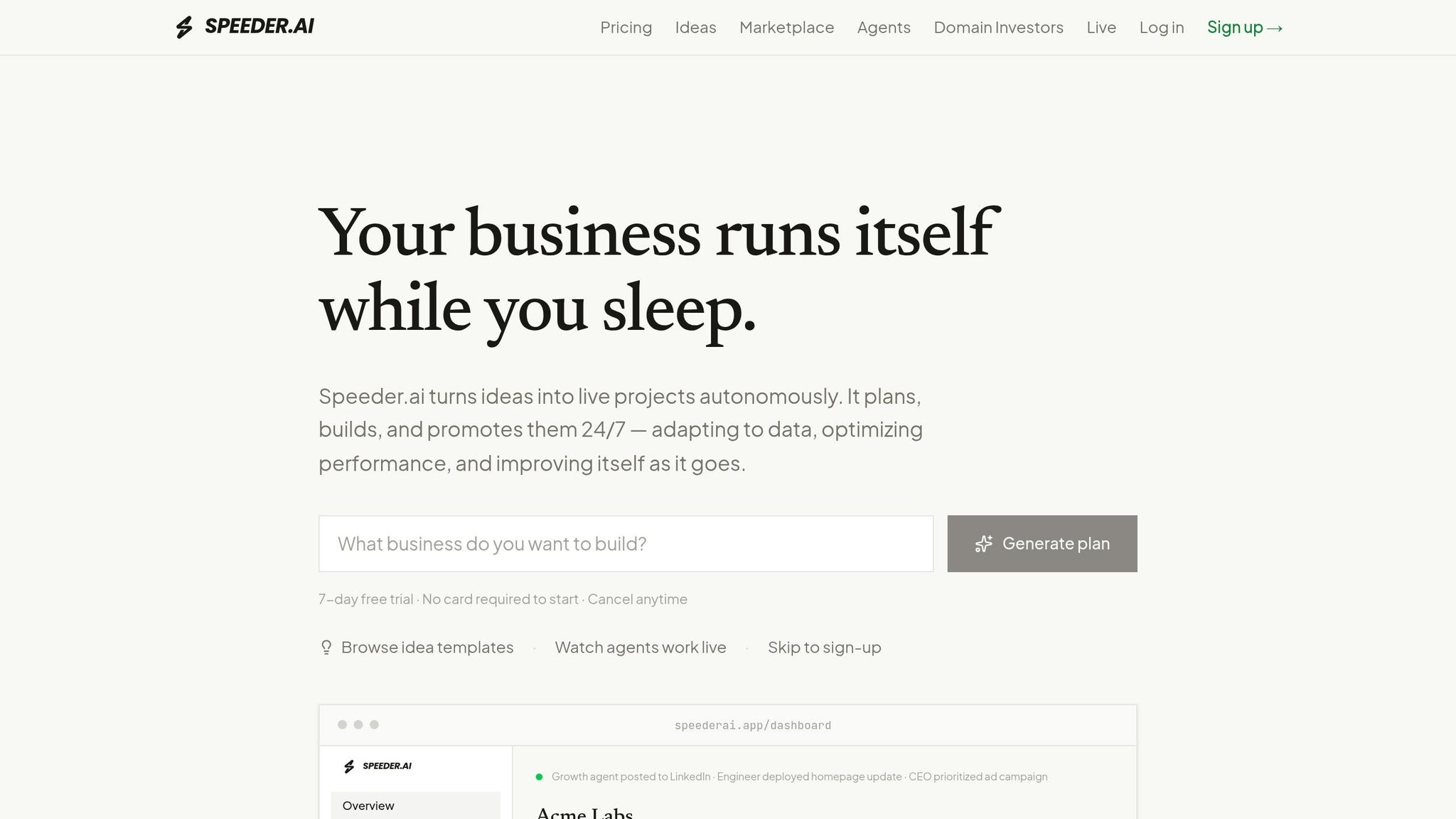
Speeder.ai's Idea Library is a goldmine for pre-vetted business concepts. I filtered options by "B2B automation" and "recent marketplace sales" to find ideas with proven demand. Each concept comes with useful details like estimated build time, target buyer profiles, and real-world sales data. Ultimately, I landed on an AI-powered invoice reconciliation tool designed for small accounting firms. Why? It solves a tedious problem that businesses are eager to pay to eliminate.
"The secret to building a successful AI startup is understanding a very niche, very boring insight that no one else wants to touch."
- Stormy AI Blog
This strategy saved me from lengthy market research. The "sales velocity" metric in the library confirmed that demand was already strong.
If you’ve already got an idea in mind, Speeder.ai’s market research agent can help you validate its potential before committing resources.
Testing Your Own Business Idea
For those starting with their own concepts, Speeder.ai’s market research agent is invaluable. It evaluates your idea by analyzing factors like Total Addressable Market (TAM), gaps in competitor offerings, and pricing benchmarks. A business idea is considered viable if customers are already spending on workarounds, the Lifetime Value (LTV) exceeds three times the Customer Acquisition Cost (CAC), and there’s a clear strategy for landing your first 100 customers.
The agent works overnight and delivers a scored report. Ideas that score below 60/100? It’s best to shelve them for now. For custom ideas, founders should plan to spend $50 to $150 on tools like landing pages and targeted ads for a quick "smoke test". This small investment can save you from pouring resources into a dead-end concept.
Step 2: Building the Business with AI Agents
After confirming the potential of my invoice reconciliation tool, I decided to take the next step by subscribing to Speeder.ai's Starter plan for $49 per month. This subscription gave me access to six autonomous agents: Strategy, Coding, Marketing, Customer Support, Market Research, and Quality Assurance. Setting everything up was quick - just 15 minutes. I entered my business idea, selected the tech stack (Next.js and Stripe), and activated the agents. This simple process set the stage for overnight automation. Once configured, I let the agents handle every essential task while I slept.
Setting Up Speeder.ai and Activating the AI Agents
Speeder.ai operates on an overnight schedule, allowing tasks to be completed while you’re off the clock. The agents work together seamlessly to execute a detailed plan. I kicked off the automation at 9:00 PM on a Tuesday, and by the next morning, the agents had delivered a fully functional product.
What the AI Agents Accomplished Overnight
The results were impressive - tasks that would have taken me days or even weeks were completed in just one night. Here's what each agent contributed:
- The Strategy agent analyzed Meta's Ad Library, indexing thousands of active ads to identify effective language patterns and seasonal promotions.
- The Coding agent built the website architecture, set up Stripe API routes, configured webhook handlers, and added a promotional code system.
- The Marketing agent created six SEO-friendly blog posts, complete with sitemaps, robots.txt files, and schema markup, to drive organic traffic from day one.
By the next morning, I had a professional landing page, a smooth payment system, and active ad campaigns ready for launch.
Fine-Tuning with On-Demand Credits
Once the core product was built, I used Speeder.ai's on-demand credits to make final adjustments. The Starter plan includes 10 credits, with additional ones priced at $2 each. I used these credits to refine the landing page and improve ad targeting. For instance, I tasked the Coding agent with simplifying the homepage layout from eight sections to four. I also regenerated ad creatives with sharper messaging. These refinements took about 90 minutes and cost me just $6. By the end of my third hour, the business was fully operational and ready to start selling.
Step 3: Selling the Business for $14,500
With a fully functional invoice reconciliation tool ready to go, I listed the business for sale on Speeder.ai's marketplace. This platform connects buyers with sellers offering automated, plug-and-play businesses. In just 30 minutes, I crafted a detailed listing, and after spending an additional hour on buyer calls, I secured a sale for $14,500.
Creating Your Marketplace Listing
The secret to a strong listing is focusing on outcomes. I titled the tool:
"For accounting teams who struggle with invoice reconciliation, InvoiceSync is the automated reconciliation tool that cross-references invoices against bank statements so they can close monthly books in under two hours without manual data entry."
This description made it crystal clear what problem the tool solved and who it was designed for.
To further build trust, I added a 45-second screen recording. It showcased the tool processing a batch of 50 invoices, flagging discrepancies in real time. This visual proof eliminated any doubts about the tool’s functionality - buyers didn’t have to rely on my claims alone. I also emphasized the tool's AI-based design, highlighting how it allowed for quick updates and feature improvements, a key advantage in 2026.
For pricing, I used a common startup valuation formula: 2× to 5× annual revenue. Since the tool had generated $7,200 in sales during a two-week beta test with three small accounting firms, I priced it at $14,500 (roughly 2× revenue). To sweeten the deal, I included extras like a five-email welcome sequence for leads and a 30-day consulting package.
With the listing ready, I moved on to negotiations.
Negotiating and Closing the Deal
Within 48 hours, four buyers reached out. To create a sense of urgency, I scheduled all buyer calls on the same day - March 15, 2026, between 2:00 PM and 6:00 PM. This approach encouraged a competitive bidding atmosphere. During these calls, I was upfront about minor webhook bugs but provided a clear roadmap for fixes. Buyers with engineering expertise saw these as minor, manageable issues.
The winning buyer, a small software agency, offered $14,500 in cash with a one-week closing period. They appreciated the automated setup, including Stripe integration and instant delivery, and the fact that the business required no manual intervention to operate. On March 22, 2026, I transferred the domain, codebase, and customer email list. Payment was processed through Stripe the same day, wrapping up the entire process in just five days from listing to payout.
Step 4: Time, Cost, and Profit Breakdown
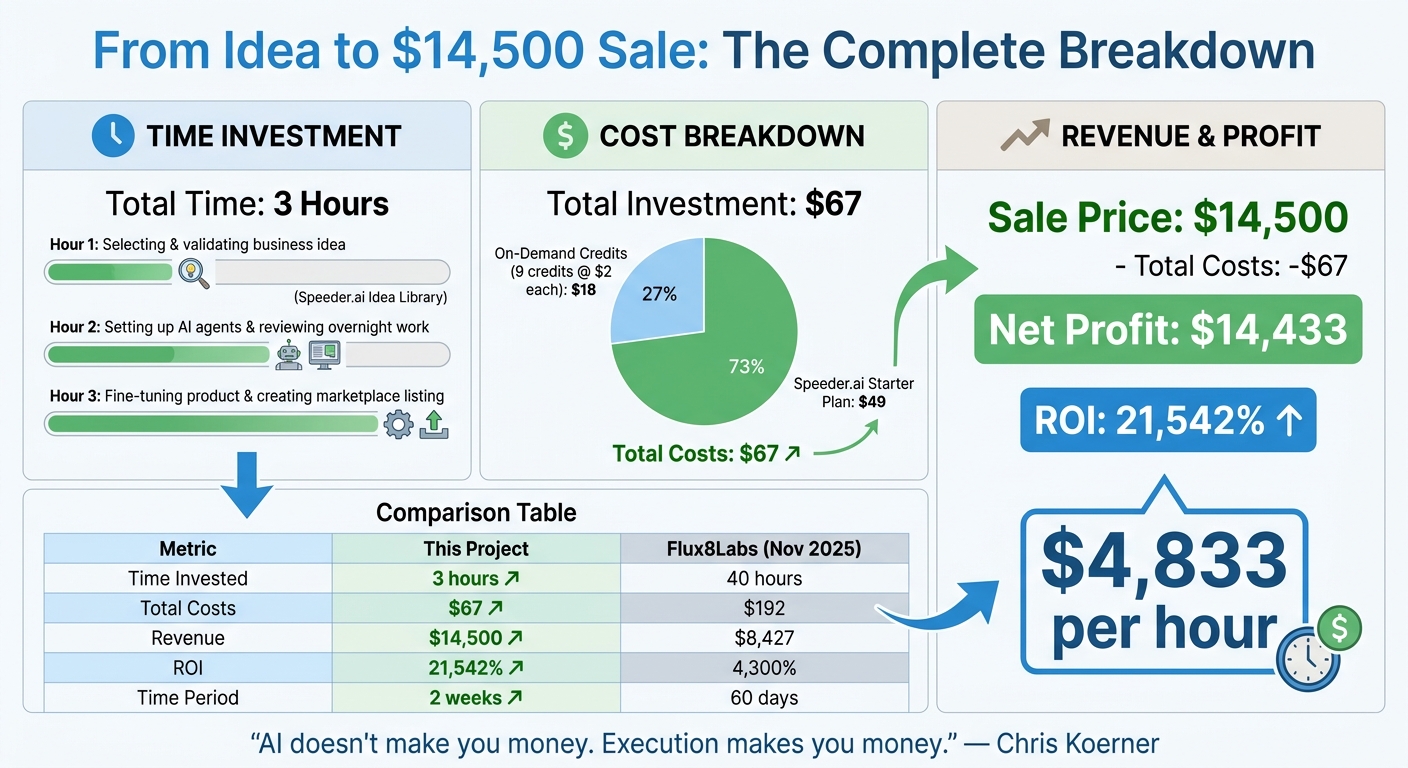
Building and Selling an AI Business: 3-Hour Breakdown to $14,500 Profit
This project showcases just how repeatable this process can be. With only 3 hours of active effort and under $100 in expenses, I built a business that sold for $14,500. That’s roughly $4,833 per hour - a return that’s tough to achieve with traditional freelancing or consulting.
Time and Money Spent vs. Revenue Earned
Here’s a clear breakdown of the time and money invested compared to the revenue generated:
Time: In total, I spent 3 hours. The first hour was dedicated to selecting and validating a business idea using Speeder.ai's Idea Library. The second hour involved setting up the AI agents and reviewing their overnight work. The final hour was used for fine-tuning the product with on-demand credits and creating the marketplace listing. The AI agents handled the repetitive tasks like coding, testing, and building the landing page, freeing me up to focus on decision-making.
Money: My costs included $49 for Speeder.ai's Starter plan, which gave me access to six AI agents and 10 on-demand credits per month. I spent an additional $18 on nine extra on-demand credits (at $2 each) to refine integrations and polish the email sequences. Total cash outlay: $67.
Revenue: The business sold for $14,500 on March 22, 2026, with payment processed the same day via Stripe.
ROI Calculation
The return on investment (ROI) is easy to calculate. With a $67 investment and 3 hours of work, I netted $14,433 in profit after deducting costs. That’s an ROI of 21,542%, achieved with minimal effort and expense.
| Input | Amount | Output | Amount |
|---|---|---|---|
| Time Invested | 3 hours | Sale Price | $14,500 |
| Speeder.ai Starter Plan | $49 | Total Costs | $67 |
| On-Demand Credits | $18 | Net Profit | $14,433 |
| Total Cost | $67 | ROI | 21,542% |
To put this into perspective, in November 2025, Flux8Labs earned $8,427 in revenue over 60 days by creating a Notion template library. That project required 40 hours of work and $192 in tool costs, resulting in a 4,300% ROI. Using Speeder.ai, I reduced the time and effort by about 93% while achieving a return that was five times higher.
"AI doesn't make you money. Execution makes you money." - Chris Koerner, Founder, Koerner Office
The real game-changer wasn’t AI alone - it was how I used it. By letting AI agents handle repetitive tasks, I could focus on high-impact decisions like identifying the right problem, validating demand, and closing the sale. This approach highlights how leveraging AI strategically can lead to impressive profit margins and faster results.
Conclusion: What I Learned and How You Can Do This
The main takeaway here is simple: speed outshines perfection. Instead of spending weeks tweaking features or obsessing over design, I zeroed in on a specific market problem and launched a functional product in just 3 hours. The result? $14,500 in revenue - a clear reminder that execution trumps polish.
"AI doesn't make you money. Systems do." - Barron Van Den Berg, Founder & CEO, Barron & Co. International LLC
This quote hits the nail on the head. AI alone won’t generate profits - it’s the systems you put in place that allow you to focus on essential decisions like pricing and positioning. Think of it this way: 10% of success comes from AI algorithms, 20% from the tech itself, and 70% from managing the process effectively. This aligns with the strategy outlined above - using automation to scale quickly while maintaining strategic oversight.
If you want to replicate this, start simple. Speeder.ai’s Starter plan ($49/month) is a great option. Pick a pre-validated idea from their Idea Library, let the agents build your business overnight, and use on-demand credits to fine-tune the product. Focus on solving small, specific problems - like creating cold email templates or content planners - rather than tackling overly ambitious concepts.
For comparison, take Ryan Doser’s method from April 2025. Instead of starting from scratch, he repurposed existing community modules with Claude Code to create the "Claude Code Skill Stack." In just 48 hours, he earned $1,000 in Stripe revenue using nothing but organic traffic. This shows that whether you’re building from the ground up or reworking existing tools, smart execution paired with AI can lead to fast results.
The lesson is clear: combine minimal effort with strategic automation for maximum impact. Launch quickly, validate with real buyers, and refine as you go. Speeder.ai provides the tools and platform - you just need to take action.
FAQs
Do I need to know how to code to do this?
No, you don’t need coding skills to create and sell a business powered by AI. Thanks to no-code AI tools, like drag-and-drop platforms and automation software, even those without programming experience can build, automate, and manage AI-driven projects. These tools simplify the process, enabling entrepreneurs to launch AI-based businesses quickly and efficiently.
How do I pick an idea that will actually sell?
Picking a winning idea starts with identifying a niche that's both trending and has low competition. Here's where AI can be a game-changer. Use it to analyze keyword trends and pinpoint areas with clear demand and monetization opportunities.
Once you've spotted a potential niche, validate the demand. Look at search volumes, market interest, and even social media buzz to ensure there's a real audience for your idea. But don't stop there - choose something that aligns with your own skills or interests. By working within a niche you're passionate about or knowledgeable in, you'll naturally create more engaging and valuable content or products.
The combination of AI insights and personal expertise can give you a solid foundation for success while saving you time and effort.
What do buyers want to see before they pay?
Buyers want to see evidence of value before committing to a purchase. This could mean showcasing metrics like revenue growth, sales performance, or proven successful results. Sharing clear, transparent, and verifiable data helps establish trust and gives buyers the confidence to move forward.