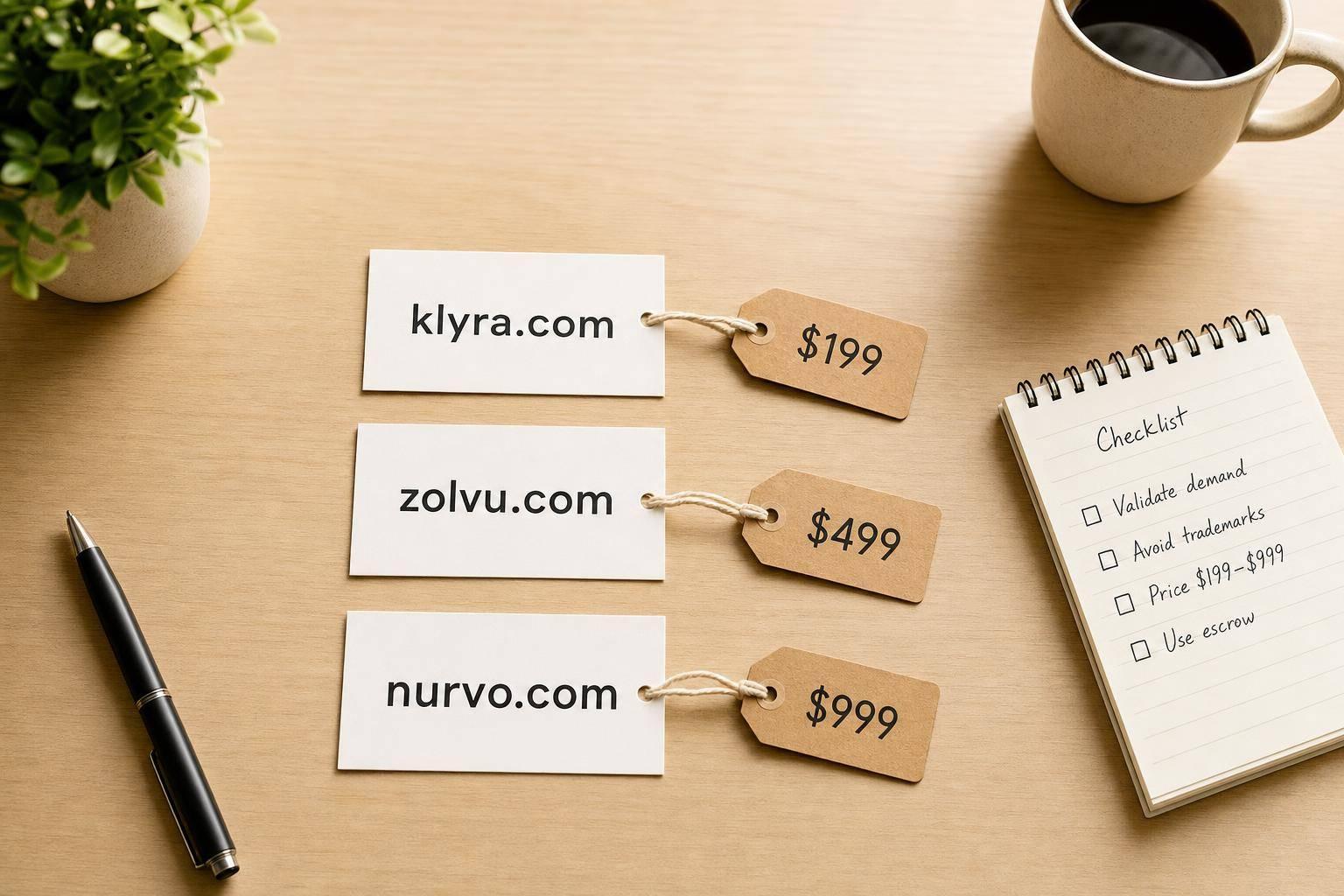
Most new domain investors lose money for one simple reason: they buy too many weak names. If I were starting today, I’d keep it small, spend $100: $500, buy only 1: 3 domains, and price them with sales data instead of guesswork.
Here’s the short version:
- I’d focus on short, easy-to-spell .com names first
- I’d use NameBio, Google Trends, and Keyword Planner before buying
- I’d skip names with trademark risk, spam history, hyphens, or numbers
- I’d expect renewals of about $10: $15 per year per domain
- I’d list beginner names around $199: $999 if the data supports it
- I’d use Buy It Now for lower-priced names and escrow for payment safety
- I’d treat domain investing like a slow side business, not fast cash
The core idea is simple: buy only when you can name the buyer, support the price, and afford to hold the domain.
This guide walks through the same path I’d use for a first portfolio: how I screen names, where I buy them, how I avoid overpaying, and how I list them for sale without turning a small test into a pile of renewal fees.
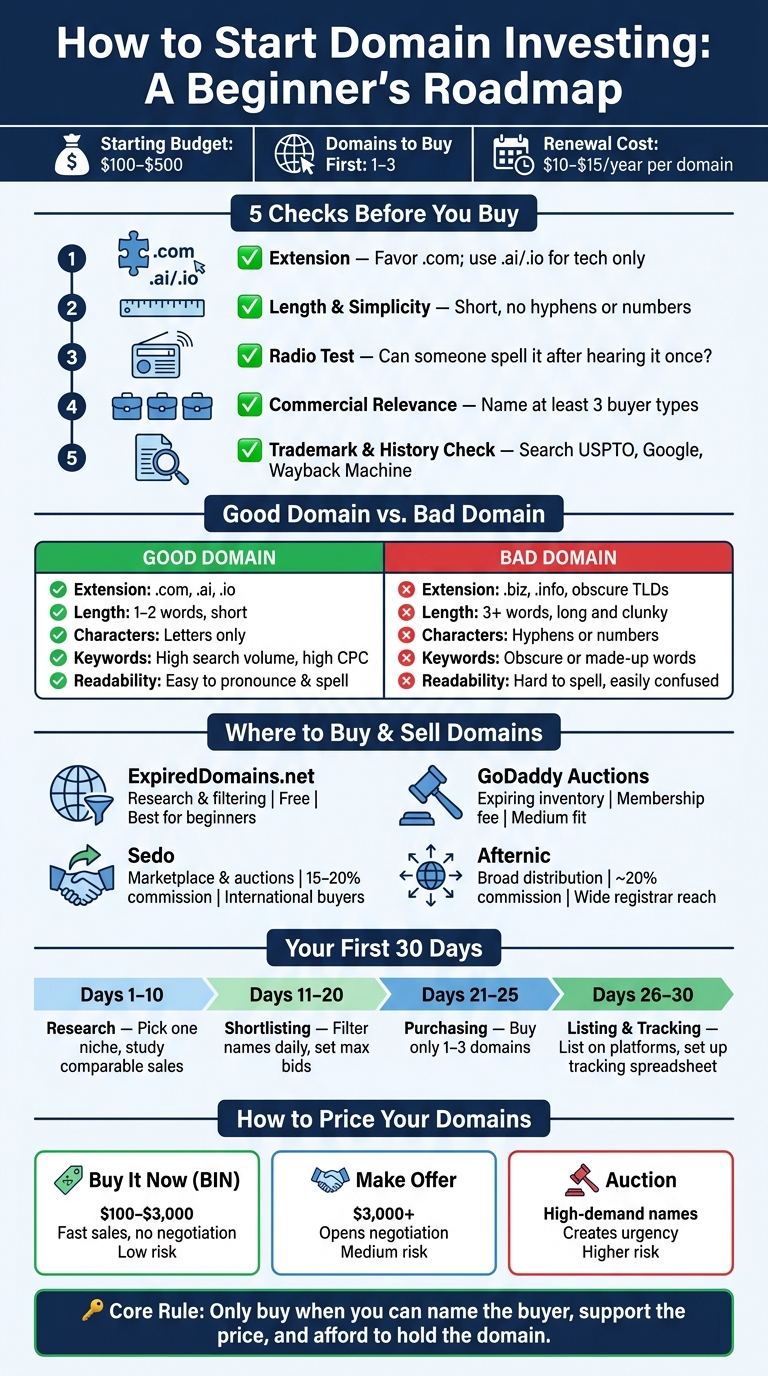
Domain Investing for Beginners: 30-Day Action Plan & Key Checks
15 Years of Domain Name Investing Knowledge in 15 Mins
sbb-itb-96552b7
How to Judge Whether a Domain Is Worth Buying
Before you spend a single dollar, you need a simple way to screen out weak names. The goal is to kill bad ideas early, not after you've sunk time and money into them. Start with a fast filter, then move the best names into deeper research.
5 Checks to Run Before You Buy
Think of these five checks as your pre-purchase filter. Run them in order. If a domain fails one of the core checks, move on.
- Extension: Favor .com for general business names. Use .ai and .io only when the keyword clearly fits tech or AI.
- Length and simplicity: Shorter is usually better. One-word .coms tend to sell for more, and short, easy-to-spell names usually resell best. Avoid hyphens, numbers, and awkward spellings.
- The radio test: Say the domain out loud. If someone can't spell it back after hearing it once, skip it.
- Commercial relevance: Ask who would buy this name. List at least three likely buyer types. If you can't, pass on it.
- Trademark and history check: Check the USPTO, Google, and the Wayback Machine for trademark risk, prior spam, and bad-use history. If the domain has spammy backlinks or a toxic past, skip it.
A name that clears these checks still needs market proof before you buy.
How to Validate Demand Using Tools and Comparable Sales
Start with comparable sales. Search NameBio or DNJournal for recent sales of similar keywords and extensions. If you can't find any comps, that's usually a sign to walk away.
Then check Google Trends for the keyword in the domain. A term that's gaining interest is often a better bet than one that's fading. After that, use Google Keyword Planner to review monthly search volume and Cost Per Click (CPC). High CPC can be a good sign. It often means businesses are already paying a lot to reach those searchers, which may support a higher domain price.
You can also use GoDaddy's appraisal tool as a rough starting point. Just don't treat it like the final word. It's an automated estimate, and automated estimates miss context all the time. Always compare that number against actual sales data.
If the domain is expired, dig into its past with ExpiredDomains.net. Look at the history and backlink profile. Clean history and legitimate aged backlinks can help. Spammy backlinks or signs of prior penalties are a hard stop.
Once the demand looks real, compare current listings and recent sales before you make an offer.
Good vs. Bad Domain Examples for Beginners
| Feature | Good Domain (Premium) | Bad Domain (Low Value) |
|---|---|---|
| Extension | .com, .ai, .io | .biz, .info, little-known extensions |
| Length | 1: 2 words; short and compact | 3+ words; long and clunky |
| Characters | Letters only | Includes hyphens or numbers |
| Keywords | High search volume, high CPC | Obscure or made-up words |
| Easy to say and spell | Easy to pronounce and remember | Hard to spell; easily confused |
The low-value side usually struggles on clarity, trust, and resale liquidity. The stronger side is simple, commercial, and easier for a buyer to picture on a business card, ad, or landing page.
Use this filter to build your buy list before you start shopping for names.
How to Find and Buy Your First Domains Without Overpaying
Once a name clears the demand check, the next job is simple: buy it without driving up your own cost basis.
Hand Registrations at GoDaddy and Namecheap
Hand registration means registering a brand-new domain that nobody has owned before. For beginners, it's the lowest-risk place to start. New .com domains usually cost $10: $15 per year at GoDaddy or Namecheap.
That low price is the big draw. You can test clean, brandable ideas without putting much money on the line. The catch is just as simple: resale depends fully on future demand. So don't register random names and hope for the best. Stick with brandable domains you can explain to a clear type of buyer.
A smart starting point is a small test budget of $100: $500 total. Spread that money across a handful of names instead of dropping it all on one domain.
Buying Expired and Aftermarket Domains on GoDaddy Auctions, Sedo, Afternic, and ExpiredDomains.net
Expired and aftermarket domains cost more up front. But they may also come with age, backlinks, or keyword demand. And that can make them easier to resell.
A good rule of thumb: use hand registrations for low-cost tests, then move into expired or aftermarket names only when the comparable sales support the higher price.
| Platform | Primary Use | Beginner Fit | Fee Model |
|---|---|---|---|
| ExpiredDomains.net | Research and filtering expiring names | Best for research - free | Free to use |
| GoDaddy Auctions | Expiring and closeout inventory | Medium - competitive | Membership fee + purchase price |
| Sedo | Marketplace buying and auctions | High - fixed prices available | Commission-based (paid by seller) |
| Afternic | Broad listing exposure | Medium | Commission-based (paid by seller) |
Start with ExpiredDomains.net before you spend a dollar. Use it to filter for .com domains, readable names, and keywords linked to high-intent fields like finance, health, or e-commerce. Then take the names that make the cut and check their auction status on GoDaddy Auctions, or look at fixed-price listings on Sedo and Afternic.
For beginners, Buy-It-Now listings are often safer than live auctions. Auctions can move fast, and that's where people get carried away and overpay. If you do make an offer, start about 20%: 40% below your max offer. That gives you room to negotiate without showing your ceiling too early.
A Safe First-Buy Workflow for Beginners
Before buying any domain, set a walk-away price. Pick the number based on comparable sales from NameBio or DNJournal. Then stick to it, even if an auction starts heating up.
Here's a simple process that keeps things under control:
- Shortlist 5: 10 names
- Check demand with Google Trends and Keyword Planner
- Make sure there's no trademark conflict
- Set your max bid
- Buy only a small number of names at first
After you buy, write down your target sell price right away. That helps you make listing choices based on your original math instead of emotion later.
Keep your first portfolio small. Renewals pile up faster than most people expect, so treat your early buys like practice.
How to Price, List, and Sell Domains
How to Set a Realistic Asking Price
Once a domain shows clear demand, set the price before you list it. Start with comparable sales, then add some room for demand, age, and commercial use. The key is simple: base your number on the research you already did, not on gut feeling.
For most beginner domains with clear commercial use, a fair asking price usually falls between $199 and $999. Use Buy It Now (BIN) for lower-priced names. Use Make Offer when a name looks stronger but the ceiling isn't obvious. That setup can help you sell faster and avoid sitting on inventory for too long.
Listing Domains on GoDaddy, Sedo, and Afternic
The process is pretty straightforward: list the domain, verify ownership, pick a pricing format, and follow the platform's transfer rules. Afternic gives you broad registrar distribution. Sedo works well for international and country-code buyers. GoDaddy Auctions is often a good fit for lower- to mid-tier inventory.
Before you publish anything, factor commission into your net price. Afternic usually charges about 20%, while Sedo often charges 15%: 20%. You also need to plan around the ICANN 60-day transfer lock. If a domain was just registered or moved from another registrar, you can't transfer it again for 60 days.
| Listing Type | Pros | Cons | Best Use Case | Risk Level |
|---|---|---|---|---|
| Buy It Now (BIN) | Fast, no negotiation, enables fast-transfer | May leave money on the table | Domains $100: $3,000 | Low |
| Make Offer | Gauges buyer budget, opens negotiation | Time-consuming, many lowball offers | Premium domains $3,000+ | Medium |
| Auction | Creates urgency and potential bidding wars | Low final price if few bidders | High-demand or expiring names | High |
One rule matters more than anything else here: never transfer a domain before payment is secured. Use Escrow.com or the built-in escrow systems on Sedo and Afternic.
Using Landing Pages and Speeder.ai to Capture Inbound Buyers
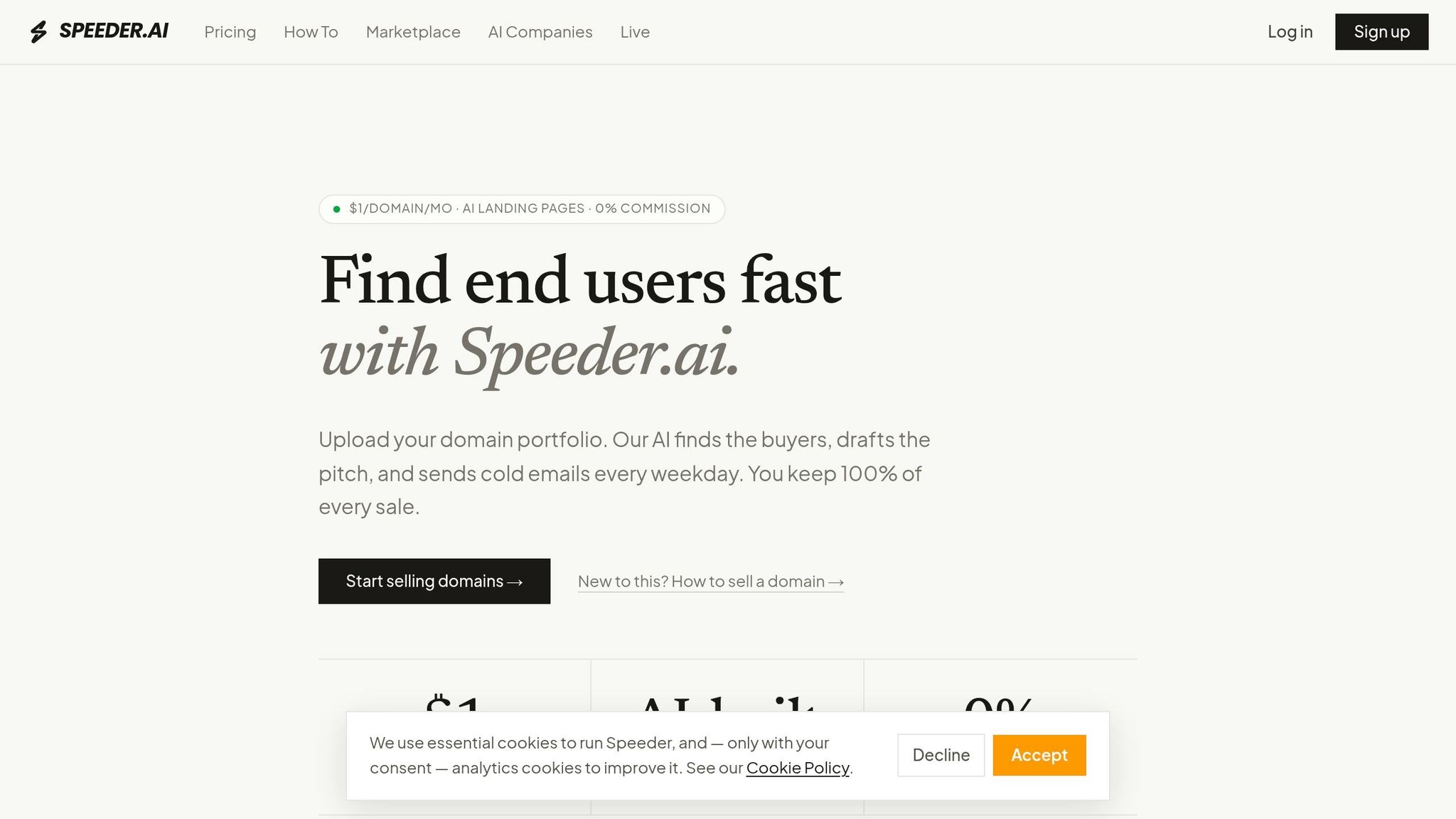
Once your listing is live, use the domain itself to attract direct buyers. A for-sale landing page gives interested buyers somewhere to go. A blank registrar page, on the other hand, can make the domain look neglected.
That’s where Speeder.ai can help. It automatically builds landing pages for premium .com and .ai domains and sends inbound leads straight to you. If you manage more than a handful of domains, that can make your portfolio easier to present and make lead capture much simpler.
A Simple Beginner Strategy to Avoid Common Mistakes
Mistakes That Drain Beginner Budgets
The fastest way beginners lose money is pretty simple: they buy too many weak domains.
It usually starts with bulk registrations that feel right in the moment. But gut instinct alone can get expensive fast. Even a small batch of low-quality names can eat through a starter budget before you know it.
A good rule: if a domain fails one of your earlier checks, pass on it.
A few mistakes show up over and over:
- Ignoring trademark risk. That can cost you the domain through a UDRP dispute.
- Trusting automated appraisal tools too much. Use comparable sales from a source like NameBio to set your max price, not tool-based estimates.
- Buying trendy extensions like .xyz or .club without a clear resale angle. That can go sideways fast.
Buy names only when you can point to a clear buyer and a clear reason someone would want to pay more for them later. If you can't make that case in plain English, it's probably not a good buy.
A 30-Day Starter Plan for First Purchases and First Listings
Use your first 30 days like a small test run. Stick to one niche, one budget, and one pricing approach.
| Days | Focus | Action |
|---|---|---|
| 1: 10 | Research | Research one niche. |
| 11: 20 | Shortlisting | Shortlist daily. Set your max bid before bidding. |
| 21: 25 | Purchasing | Buy 1: 3 domains only. |
| 26: 30 | Listing & Tracking | List and track. |
For tracking, set up a spreadsheet with the domain name, cost, renewal date, target buyer, asking price, and current status. Nothing fancy. You just want a clean view of what you own and why you bought it.
After the first month, look at the signals. Which names got views, inquiries, or offers? Which ones got nothing at all? That review matters. Drop weak names before renewal instead of keeping them around just because you hope they'll work out.
If the first month goes well, run the same playbook again with your next shortlist.
Conclusion: Start Small, Buy With Evidence, and Sell With Clear Pricing
Good domains tend to share the same traits: they're short, easy to spell, easy to remember, commercially clear, and, in many cases, best in .com.
Tools can help with research and listings, but they can't tell you whether a real buyer is out there. That's your job. So keep it simple: shortlist 5, 10 names, buy only the best 1, 3, and list them right away.
FAQs
How long does it usually take to sell a domain?
There’s no fixed timeline for selling a domain. In most cases, it comes down to how well you price it and how you market it.
Some domains sell within 30 to 90 days when they get solid marketplace exposure or direct outreach. Others - especially premium names - can sit for months or even years before the right buyer shows up.
One of the biggest reasons a domain doesn’t sell? The price is too high. And when that happens, renewal fees can keep piling up.
What profit should a beginner realistically expect?
Domain investing is not a get-rich-quick scheme. If you're new, expect uneven income and a real chance of losing money, especially if you jump in before learning how the market works.
Yes, some flips can earn hundreds or even thousands of dollars. But plenty of beginners don't make money at all. This usually rewards people who do their homework, stay disciplined, build a solid portfolio, watch trends closely, and have the patience to hold domains for 12 months or more.
Should I reinvest profits or keep my portfolio small?
It depends on your experience and goals, but a balanced approach usually works best.
Start small. That gives you room to learn the market, test a few strategies, and keep risk under control. As your results become more steady, reinvesting profits can help you grow and spread your money across more holdings.
No matter how large or small your portfolio is, stay disciplined and research each purchase with care.