Stop Listing, Start Hunting: Why Outbound Beats Marketplaces for Domains Under $10k
August 5, 2026 · 10 min read
Stop Listing, Start Hunting: Why Outbound Beats Marketplaces for Domains Under $10k
If your domain is priced under $10,000, waiting on Afternic or Sedo is often the slowest path to a sale. I’d rather contact a short list of companies that can use the name now than hope one buyer finds a passive listing.
Here’s the short version:
- Passive listings depend on luck. A buyer usually has to search for that exact domain.
- Time cuts into profit. Renewal fees stack up while the name sits.
- Broker fees hurt margins. At 15% to 30%, a $10,000 sale can lose $1,500 to $3,000 in commission.
- Outbound fits this price range better. Many buyers can approve $2,000 to $10,000 deals if the name is a direct fit.
- The best targets are end users. Think founders, CEOs, CMOs, and marketing leads at companies already in the niche.
- Buying signals matter. Look for funding, trademark filings, hiring, or firms using a weaker extension like .net or .org.
- Short email sequences work best. I’d keep outreach under 200 words and send 3 touches over 14 days.
- Deliverability matters. Without SPF, DKIM, and a 2- to 4-week warmup, your emails may never hit the inbox.
- Focus beats volume. I’d start with my best 10 to 50 names, not the whole portfolio.
A simple way to think about it: marketplaces list domains; outbound sells them. For brandables, .ai names, and two-word .com domains under $10,000, the job is not just getting seen. It’s getting in front of the right buyer fast, keeping more of the sale, and cutting down the wait.
| Approach | What usually happens | Main downside | Best use case |
|---|---|---|---|
| Marketplace-only | You list and wait | Slow sales, fee drag, more renewals | Rare inbound demand |
| Outbound to end users | You contact buyers first | More work unless automated | Names with a clear buyer list |
If I owned sub-$10,000 domains today, I would treat each sale as an outreach job, not a listing job.
The Problem: Marketplaces Often Underperform for Sub-$10,000 Names
Why Lower-Priced Inventory Gets Stuck
Most domains priced under $10,000 are tough to sell on a passive listing alone. Just being visible usually isn’t enough. In most cases, a marketplace sale happens only if a buyer searches for that exact name. If that buyer never shows up, the domain just sits there.
"A listing is a lottery ticket. You put the name on Afternic or Sedo, set a price, and hope the right person types it into a search box on the right day." - Speeder.ai
That’s the core issue. Without direct outreach, a lot of names never get in front of the business that would want them most.
How Fees and Holding Costs Change the Math
Waiting on marketplaces can also get expensive. A domain may sit for years while renewal fees keep stacking up. Bring in a broker, and margins shrink even more. Commissions usually land between 15% and 30% of the final sale price, which works out to $1,500 to $3,000 on a $10,000 sale.
So the math changes fast. Every extra month means more carrying cost, and every middleman takes a cut, unlike platforms where you keep 100% of every sale. At that point, the job isn’t just listing the name. It’s finding the company that can put it to work.
Why Outbound Fits This Price Band Better
Outbound works better in this price range because it puts the domain in front of buyers who can use it right away. These names tend to sell when a business can instantly see the brand fit. Companies can often approve purchases in the $2,000 to $10,000 range much faster than six-figure deals, but they still need someone to connect the dots and show why the domain matters.
That’s where outreach changes things. When you contact the right decision-maker and explain why the name fits their business, you create intent instead of waiting around for it.
The contrast is pretty clear:
| Marketplace-only | Targeted Outbound | |
|---|---|---|
| Sale Speed | Slow; can take years for a buyer to find the listing | Fast; can compress the sales cycle to weeks or months |
| Fee Drag | High; broker commissions and renewal costs add up | Lower; fewer fees eating into the sale price |
| Buyer Intent | Passive; relies on a buyer finding the listing | Active; the seller reaches the buyer first |
| Effort | Low; list and wait | Higher if manual; lower with AI automation |
Outbounding Domain Names (Sales Outreach Tutorial)
Effective outbounding requires cold emails that actually get replies to convert prospects into buyers.
The Solution: Find End Users Instead of Waiting for Them
Outbound works because you’re putting the domain in front of the company that should own it, and in front of the person who can say yes.
At this price point, a small list of high-intent buyers usually beats broad marketplace exposure. This is a sourcing problem, not a listing problem. The edge with outbound is simple: it gets the name in front of end users with an actual business need, not random marketplace traffic.
Once you know who should own the name, the outreach can stay simple.
Which Domains Work Best for Outbound
Put your time into names with clear business use: short brandables, category terms, exact-match service phrases, and strong .com or .ai domains with clear buyer lists.
A domain like taxhelp.ai or insurancehelp.ai usually points to a small, obvious group of potential buyers. That matters. If you can’t quickly name a few companies that would want the domain, it’s probably not a top outbound candidate.
In plain English: the best outbound domains are the ones where the buyer list almost writes itself.
Who to Contact and What Makes Them a Real Buyer
Go after end users, not flippers. End users often pay more because the name has direct use for their business.
The best contacts are usually founders, CEOs, CMOs, or marketing leads at companies already active in the domain’s niche. And you don’t need to guess who might buy. Look for buying signals like:
- A recent funding round
- A new trademark filing
- Aggressive hiring
- A company still using a weaker extension like
.netor.org
For example, a company on get-software.com is a natural upgrade candidate for software.ai. Signals like these help you spot who’s worth contacting and who’s not.
A Simple Outbound Playbook for Domains Under $10,000
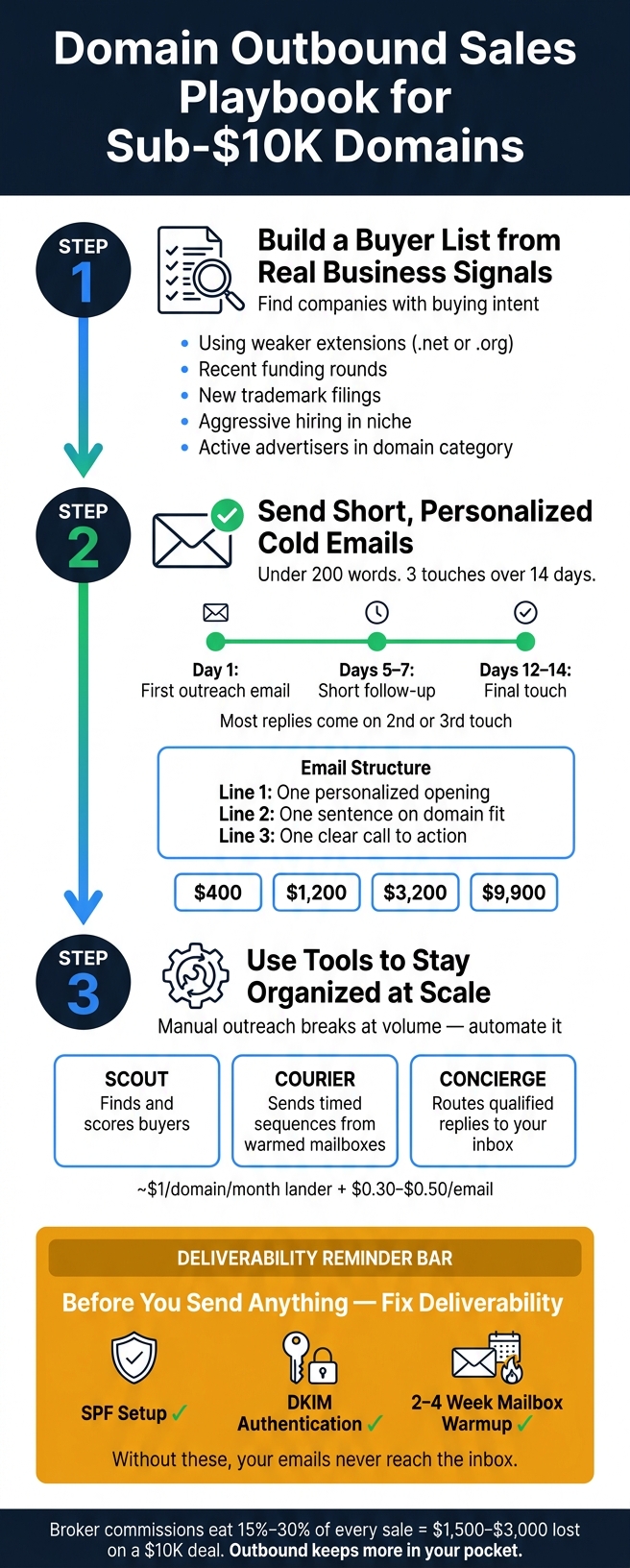
Domain Outbound Sales Playbook: 3-Step Process for Sub-$10K Domains
Once you know which names matter and which buyers are most likely to care, the next move is a repeatable workflow. The point isn't to blast emails to everyone. It's to reach the small group of buyers who already have a reason to pay attention.
Step 1: Build a Buyer List from Real Business Signals
Start with companies showing signs they may want an upgrade. That usually means businesses on weaker extensions, active advertisers in the niche, and firms with recent funding, trademark filings, or executive hires. Those signals often point to buyers who have both intent and urgency.
Step 2: Send Short, Personalized Cold Emails with a Clear Point
Keep each email under 200 words. A good structure is simple:
- One personalized opening line
- One sentence explaining why the domain fits
- One clear call to action
Skip the long pitch. Skip the backstory. Skip the clutter.
Use three touches across 14 days. Day 1 is the first note. Days 5: 7 get a short follow-up. Days 12: 14 get the final touch. Most replies come on the second or third touch, which is why follow-ups matter.
Reach out to founders or heads of marketing directly. For names under $10,000, use clear dollar-based Buy Now or Make an Offer pricing to cut friction. Real-world examples include $400, $1,200, $3,200, and $9,900.
Step 3: Use Tools That Keep Outreach Organized
Manual outbound starts to crack once volume goes up. Research and personalization take 20 to 30 minutes per domain per touchpoint, and that adds up fast across a portfolio.
Use one system to handle buyer research, sequence drafting, follow-ups, and reply sorting. Speeder.ai does this end to end: Scout finds and scores buyers, Courier sends timed sequences, and Concierge routes qualified replies to your inbox. Pricing is $1 per domain per month for landers, plus about $0.30 to $0.50 per outreach email.
Before scaling outreach, fix deliverability and rank your best names first.
Deliverability and Prioritization: The Part Most Domain Investors Skip
Deliverability decides whether your outreach gets seen. If your emails don't make it to the inbox, even a strong buyer list doesn't matter. A lot of domain investors skip this part, which means solid outreach gets buried before anyone reads it. Start with authentication, then warm up the mailbox before sending at scale.
Set Up SPF, DKIM, and Warmup Before Sending at Scale
SPF and DKIM show that your mailbox is set up the right way. Without them, your outreach has a much higher chance of landing in spam or trash before any buyer sees it.
And setup alone isn't enough. New sending mailboxes need a warmup period of two to four weeks. In plain English, that means you begin with low daily volume and slowly increase it. This gives mail servers time to build trust in your sender reputation before you send more. It's also smart to use a dedicated sending domain instead of your main business email, so any reputation issues stay contained.
| Factor | No SPF/DKIM/Warmup | Proper Setup |
|---|---|---|
| Inbox Placement | Spam or trash | Primary inbox |
| Sender Risk | High risk of domain blacklisting | Low risk; builds long-term sender reputation |
| Volume Strategy | Mass blast triggers filters | Conservative, steady weekday sending schedule |
Once deliverability is handled, the next step is simple: spend your time on the names most likely to convert.
Rank Your Names Before You Spend Time or Credits
Trying to pitch your whole portfolio at once is a good way to burn through budget and end up with weak results. A focused push around your best 10 to 50 names will keep beating thin campaigns spread across hundreds of domains.
Here's the order that makes the most sense:
- Strong commercial intent first
- Clear buyer pool next
- Easy access to the right decision-maker after that
So who should move to the top of the list? Companies using the same name on a weaker extension like .net or .org. Businesses that just closed a funding round. Firms hiring in a niche tied to your domain. Those signals point to real buying pressure, and that's what turns a cold email into a reply.
Then you need a system that keeps research and sending from slowing everything down.
How Speeder.ai Cuts the Manual Work
Speeder.ai handles the deliverability side for you. Courier sends outreach from warmed, dedicated mailboxes on a weekday sending schedule, and a pre-send verification check makes sure credits only fire after you confirm domain ownership . Speeder.ai also creates a lander and routes replies to your inbox. You handle the negotiation and transfer, and you keep 100% of the sale.
Conclusion: For Domains Under $10,000, Speed Comes from Finding Buyers
Passive listings can bring in inbound interest, but they don't create demand. That's the big lesson with domains priced under $10,000: sell to a known buyer, not a random browser. For most brandables, .ai names, and two-word hand-registrations, sitting back and waiting for someone to discover the name can lead to years of renewal fees and no sale.
That’s why the process that works is pretty simple. Look for buying signals, send short personal outreach, and use warmed mailboxes to get in front of decision-makers fast. Speeder.ai handles the heavy lifting here: Scout finds the buyers, Courier sends personal outreach from warmed mailboxes, and Concierge routes every reply straight to your inbox.
And the upside is plain enough: outbound lets you keep more of the sale than broker commissions do.
Your domains don’t need luck. They need direct buyer contact.
FAQs
How do I know which domains are worth outbound?
Look for domains that match a specific, urgent market need for a clear audience. Put your focus on names linked to growing sectors where competitors are already active. That’s a good sign people are spending money and that demand isn’t just theoretical.
The best outbound targets also have immediate use. This matters a lot for niche B2B offers or professional workflows, where a domain can fit directly into how a company sells, positions, or launches a product. And when a name has a clear fit, you have a much stronger, more personal reason to explain why one founder or business should buy it.
Who should I contact first at a company?
Start with decision-makers who feel the problem your domain can fix most clearly. Aim for roles that connect straight to the industry or to brand value.
Keep your outreach personal and direct. Mention specific company details, like recent news, social posts, or product launches, and tie the domain to the goals they care about.
A generic pitch usually gets ignored. A short note that shows you’ve done your homework has a much better shot. If a company just rolled out a new product line, for example, explain how the domain could support brand fit, search visibility, or customer recall.
How long should I wait before stopping outreach?
Start with a simple sequence: an initial message, a follow-up 48 hours later, and a final touch four to five days after that. This keeps things moving without flooding prospects.
If there’s still no engagement, make small tweaks - like your target audience, headline, or pricing - instead of giving up after only two weeks. In many cases, four to six touches work better.