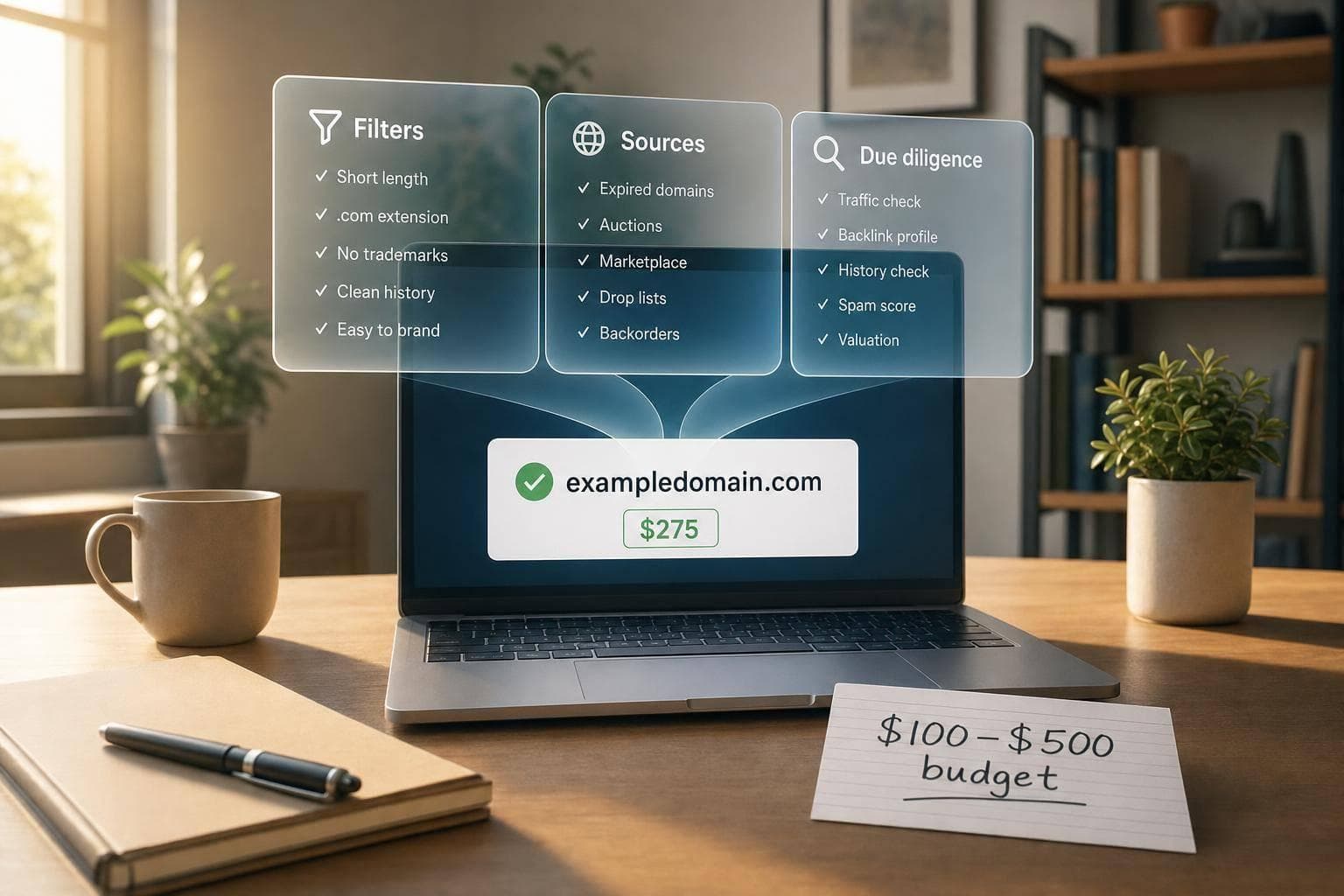
You do not win by buying the cheapest domain. You win by buying a name at $100, $500 that may later sell for about $3,000, $7,000. That means I’d focus on four things first: buyer demand, clean history, low legal risk, and room for profit after fees and renewals.
Here’s the short version:
- I’d start with clear filters: short names, easy spelling, no hyphens, no numbers, and usually .com
- I’d check comparable sales on NameBio before bidding
- I’d look for search demand and CPC so the name maps to a business people pay for
- I’d review Wayback, backlinks, indexing, and trademark records
- I’d buy only if I can explain the likely buyer in one sentence
- I’d skip names that fail two or more checks
A small budget can still work. But there’s a catch: a “cheap” $5 closeout often ends up near $30 total, and buying 20 weak names can cost about $609 before a single sale. That’s why tight filters matter more than bargain hunting.
What this article does: I break down how I’d screen low-cost domains, where I’d look, what I’d check before paying, and which mistakes tend to drain ROI for beginners.
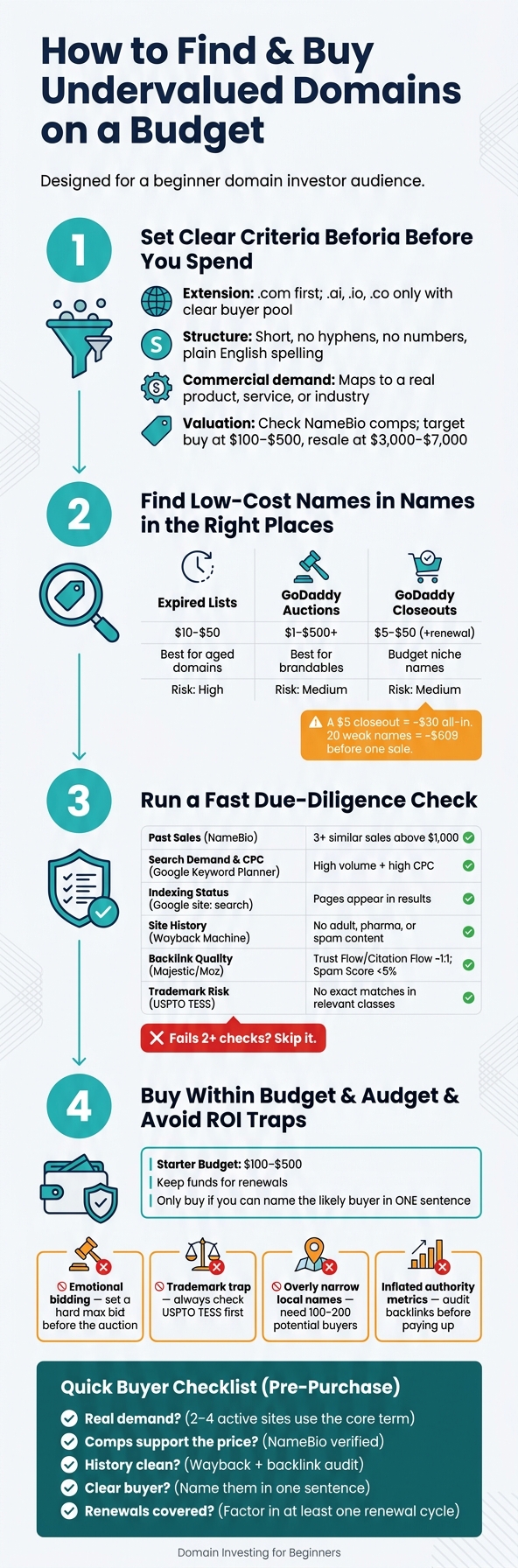
How to Find & Buy Undervalued Domains on a Budget: A 4-Step Checklist
Quick comparison
| Area | What I’d look for | Fast pass sign | Skip sign |
|---|---|---|---|
| Domain quality | Short, clean, easy to spell | Mostly .com, plain words | Hyphens, numbers, awkward spelling |
| Buyer demand | Business use, search demand, CPC | Similar firms use the term | No buyer pool |
| Pricing | Resale gap | Buy at $100: $500, target sale $3,000: $7,000 | No room after fees |
| Source | Expired names, auctions, private deals | Low entry price with data support | Buying only because it looks cheap |
| Due diligence | History, backlinks, indexing, trademark | Clean past, clean links, no trademark issues | Spam, adult history, deindexing, brand match |
| Budget control | Total cost, including renewals | Clear max bid and hold plan | Stack of “maybe” names |
If I were starting with a tight budget today, this is the simple playbook I’d use.
Step 1: Set clear criteria before you spend a dollar
The core traits of a domain worth buying
Before you open a marketplace, get clear on what you want. Write your filters down first, then use them on every listing.
Start with the extension. .com is still the default. .ai, .io, and .co can work, but only when the buyer pool is clear. The extension needs to fit the type of buyer you're trying to reach.
Length and structure matter more than most beginners think. Shorter is almost always better. You also want names with no hyphens, no numbers, and plain English spelling. If someone hears the domain and then asks how to spell it, that's a bad sign. It's a simple test, and it works well.
SwiftHire.com passes.
Sw1ft-Hire.com doesn't.
Then check for real commercial demand. The name should map to a product, service, or industry that already has search demand or CPC value. DenverPlumber.com is a good example because the buyer appeal is obvious: it matches a real local service.
Simple valuation benchmarks beginners can use
Once a name clears the structure test, you need a number in mind before you buy. The best way to do that is to look at real comps, appraisal tools, and keyword demand.
Start with NameBio for real comps. Then run the name through two appraisal tools as a gut check. Asking prices can be way too high, so real sales data helps keep your feet on the ground. Use automated appraisals as a starting point, not the top end, and compare the name against five to ten actual sales on NameBio.
Higher appraisal estimates often bring more auction interest. After that, do a quick keyword check to see if the main phrase has search demand or CPC value.
A domain bought for about $100 in an expired auction can realistically sell for $2,000 to $5,000 to an end user if it's marketed well. A good buy should also have a wholesale floor, so you can get out at break-even if a retail sale doesn't come fast. If the comps don't show a solid resale gap, pass on it.
Once a name gets through this screen, you can start looking at low-cost sources.
Comparison table: value factors, quick checks, and red flags
Use this table as a fast pass/fail screen before you bid. If a domain hits more than one red flag, skip it.
| Value Factor | What to Check | Low-Cost Tool | Red Flag |
|---|---|---|---|
| TLD Quality | Is it .com or a credible .ai, .io, or .co? | Registrar search | Low-trust TLDs with weak resale demand |
| Length & Structure | Is it short, simple, and easy to spell? | Quick visual check | Hyphens, numbers, or awkward word order |
| Commercial Demand | Are businesses actively using this phrase? | DotDB / Google | Very few active sites using the term |
| Market Comps | What did similar names actually sell for? | NameBio | No relevant sales comps |
| Legal Safety | Any active trademarks on this term? | USPTO TESS | Exact match to a registered brand name |
| Domain History | Was it used for spam, adult content, or malware? | Wayback Machine | History of spam, adult content, or malware |
Step 2: Find low-cost names in the right places
Expired-domain lists and delete feeds
ExpiredDomains.net is the best free place to start if you're new to this. It shows thousands of expiring domains each day and lets you filter by TLD, character length, age, and backlink count.
Start there, then filter for age and backlink count. After that, run your Step 1 rules on the names that remain. The main idea is simple: treat the feed as a candidate list, not a buy list. Those filters help you cut a huge pile of names down to a short list you might actually want to buy.
Marketplace filters, auctions, and investor listings
If expired lists don't have much, shift to auction inventory. GoDaddy Auctions and closeouts are practical options for beginners.
When a domain doesn't get bids during the auction phase, it moves to the Closeout list. From there, the price drops in stages over five days: $50, then $30, then $11, and finally $5. That $5 closeout price does not include renewal, taxes, or fees, so the full cost is often closer to $30.
There's also a simple tactic that can save money: place a $1 opening bid early in the auction. If nobody else joins in, you get the domain for $1 plus registration fees, which can be much cheaper than paying the closeout starting price.
Private listings come last. They make sense when you're hunting for discounts and you're fine with more risk. NamePros forums and domain-focused Facebook groups can expose seller liquidations, often 30% to 50% below asking. That can mean a good deal. It can also mean more danger, since buyer protection or escrow often isn't part of the deal.
A good way to think about it:
- Use expired feeds for aged domains
- Use auctions to see where prices settle
- Use private listings for occasional discounted buys
Comparison table: source types, price ranges, and risk level
| Source Type | Typical Price Range (USD) | Best Use Case | Risk Level |
|---|---|---|---|
| Expired Lists | $10: $50 (reg fee) | SEO authority, backlinks | High - hidden penalties possible |
| GoDaddy Auctions | $1: $500+ | High-quality brandables | Medium - emotional overbidding |
| GoDaddy Closeouts | $5: $50 (+ renewal) | Budget-friendly niche names | Medium - lower-quality inventory |
| Drop Catching | $60: $100+ | Competitive high-value keywords | Medium - technical process |
| Forums/Social | $20: $200 | Investor-to-investor bargains | High - scam risk, no escrow |
| Curated Marketplaces | $1,000+ | End-user-ready brandable names | Low - pre-vetted inventory |
Once a domain looks cheap, check demand, history, and ownership before you bid.
Step 3: Run a fast due-diligence check before you buy
Once you’ve built a shortlist from expired feeds or auctions, do a quick screen before you bid. A low-cost auction domain can still be a bad deal if demand is weak, the history is messy, or trademark trouble is waiting in the background.
Check demand, comps, and basic value first
Start with recent comps. Use NameBio to confirm that close matches have sold for actual money. If you spot three or more similar sales above $1,000, that’s a solid sign. Appraisals can help as a rough gut check, but not much more.
Next, make sure the niche has advertiser interest. Run the main keyword through Google Keyword Planner and look for high search volume paired with high CPC. Then run a Google site: search for the domain. If nothing shows up, that can point to a penalty or deindexing.
If those numbers hold up, move on to the domain’s past before any money changes hands.
Verify history, ownership, and reputation
Open the domain in the Wayback Machine and skim old versions of the site. Watch for adult content, pharma spam, hacked pages, or signs of a private blog network (PBN). Any of those can make the domain much harder to resell.
Backlink quality matters more than raw link count, so check trust before buying. In Majestic or Moz, lean toward clean, relevant links and stay away from spam-heavy profiles. A Trust Flow to Citation Flow ratio near 1:1 is a clean sign. A very low ratio is a warning.
Then search USPTO TESS for exact matches in the trademark classes that fit the name. If the domain clears that step, you’re ready to set your budget and max bid.
Comparison table: due-diligence checks and pass/fail rules
| Check Performed | Tool Used | Pass Standard | Why It Matters for Resale |
|---|---|---|---|
| Past Sales (Comps) | NameBio / DNJournal | 3+ similar sales above $1,000 | Shows that buyers have paid for these keywords |
| Search Demand & CPC | Google Keyword Planner | High volume and high CPC | Confirms advertiser interest and profit potential in the niche |
| Indexing Status | Google Search (site:) |
Pages appear in results | Deindexed domains often carry penalties and can be tough to resell |
| Site History | Wayback Machine | No adult, pharma, or spam content | Bad history can hurt buyer trust and resale value |
| Backlink Quality | Majestic / Moz | Trust Flow/Citation Flow ratio near 1:1; Moz Spam Score below 5% | Good links add SEO value for the buyer |
| Trademark Risk | USPTO TESS | No exact matches in relevant trademark classes | Helps you avoid legal conflict and losing the domain |
If a domain fails two or more checks, skip it. Protecting your budget beats forcing a bad buy.
Step 4: Buy within budget and avoid the traps that kill ROI
Once a name clears demand, history, and trademark checks, decide your total cost before you place a bid. This is the point where research has to turn into discipline.
Set a buying budget that includes renewals
A sensible starter budget is $100 to $500. Put most of it toward acquisitions, keep some money aside for renewals, and leave a small pool for testing. That part matters more than many people think. Every domain comes with a renewal bill, so a pile of cheap purchases can turn into expensive inventory fast.
For example, a $5 closeout can end up costing about $30 all-in, and 20 of those can run about $609 before you sell even one.
The rule here is blunt: only buy when you can name the likely buyer in one sentence. If you can't do that, skip it.
After you've pinned down total cost, ask one more thing: does the name have enough buyer depth to make the hold worth it?
Cheap domains that are usually expensive mistakes
A low price tag doesn't mean a good buy. Some domains look like bargains and still end up being dead weight.
- Trademark risk. If a domain includes a brand name, it's a problem. A UDRP filing can take the domain away from you entirely.
- Overly narrow local names. Local domains only make sense when there are enough similar buyers to form a resale market.
MaconPsychiatry.comis a good example of what can go wrong. If the one local business you pictured doesn't want it, you're stuck. GEO names need at least 100: 200 potential buyers in that category. - Inflated authority metrics. A high score can hide spammy or off-topic backlinks. Don't pay up just because a metric looks good on the surface.
- Emotional auction bids. Set your ceiling before the auction starts, then treat that number as fixed.
Comparison table: common mistakes and how to avoid them
| Mistake | Warning Sign | Prevention Step |
|---|---|---|
| Emotional bidding | Bidding past your pre-set limit | Set a hard max bid before the auction starts; walk away if it's exceeded |
| Trademark trap | Domain matches a known brand name | Search USPTO TESS before buying |
| Overly narrow local names | Only one business fits the name | Verify at least 100: 200 similar prospects exist in that market |
| Renewal overload | Buying "maybe" names because they're cheap | Buy only when a clear buyer thesis exists; list and outbound immediately after purchase |
| Inflated authority metrics | High score but spammy or irrelevant backlinks | Don't pay for authority signals you haven't audited |
Conclusion: Turn good buys into real sales
Undervalued domains come from a repeatable filter, not a hunch. You want clear demand, a clean history, a low entry price, and enough room for resale profit. When a name checks those boxes, speed starts to matter.
After you buy, list it and get in front of likely buyers fast. That gets a lot easier when your landing page and outreach are ready on day one. Speeder.ai can automate landing pages and buyer outreach after purchase, so you can move a name from inventory to market faster.
A beginner's checklist for the next domain you consider
Use this checklist before every purchase:
- Real demand? Do at least 2: 4 active sites use the core term?
- Comps support the price? Check NameBio for what similar names actually sold for.
- History clean? Wayback Machine and a backlink audit should show nothing that would make a buyer walk.
- Clear buyer? Can you name the likely buyer in one sentence? If not, skip it.
- Renewals covered? Factor in acquisition plus at least one renewal cycle before committing.
Buy only when the name passes the checklist, then list it right away. If it fails the checklist, walk away.
FAQs
How long should I expect to hold a domain before selling it?
There’s no fixed holding period. It comes down to your financial strategy, your need for cash, and the market for that specific domain.
Some sales happen in 24 hours to a week. Others can take years.
That’s why it helps to think past the purchase price. Renewal fees add up, your capital stays tied up while you wait, and your exit plan should match what your budget can handle.
Should beginners focus only on .com domains at first?
No - don’t focus only on .com right away.
Yes, .com usually carries more resale value. But if you’re new to domain investing, you can still find underpriced .net, .org, and other TLDs that make sense for a clear group of end buyers and have a fair shot at resale if the price is right.
A better rule is this: look at commercial clarity, buyer demand, and whether the name is priced below what it could sell for. Then treat the TLD as one factor, not the only filter.
What’s the safest way to price my first domain purchases?
Use valuation discipline. Start with a conservative retail resale range based on real comparable sales, then buy only when the price leaves a big margin buffer.
For example, if a realistic retail sale is $3,000: $7,000, you’d want to buy at around $150: $500.
Set a hard maximum for auction bids. Include the buyer’s premium in that number, and don’t go past your limit. Once the discount gets smaller, your margin shrinks and your holding risk goes up fast.
Some listings referenced in this article are no longer available. Browse current marketplace listings.