
If you want the short answer: buy .com for the biggest buyer pool, buy .io only for tech-first brands, and buy .net only when the keyword fit is tight and the price is low.
I’d boil the article down to six checks: trust, recall, resale demand, buyer type, yearly cost, and outbound sales fit. In 2026, .com still leads on trust and recall, with 68% recall vs. 48% for .io. But .io can still work well for SaaS, dev tools, APIs, AI infra, and gaming. .net is still usable, but most of the time it trails the other two unless the name fits hosting, networking, or ISP use.
Here’s the simple takeaway:
- Buy
.comif you want the easiest path with U.S. buyers - Buy
.ioif your buyer is a founder, engineer, or startup team - Buy
.netif the name is tightly tied to infrastructure and the.comis out of reach - Skip any extension if the buyer doesn’t match the name
- Watch renewals:
.iooften runs about $30: $50/year, while.comand.netare often around $13: $20/year - For resale,
.comusually has the deepest market - For outbound,
.comis the easiest to pitch,.iocan work in tech, and.netis the hardest sell
What Domain Extension should I use for my Business Website?
Quick Comparison
| Extension | Best for | Main upside | Main downside | Best buy case |
|---|---|---|---|---|
| .com | Consumer, B2B, finance, ecommerce | Best trust, recall, and resale depth | Often costs more to buy | You want broad demand |
| .io | SaaS, dev tools, APIs, AI infra | Strong fit with startup and dev buyers | Higher renewals and smaller buyer pool | You’re selling to technical teams |
| .net | Hosting, networking, ISPs, legacy IT | Lower hold cost than .io |
Often seen as second choice | Exact-match infrastructure name |
So if I were making the call, I’d use one rule: match the extension to the buyer, not to my own taste.
.com vs .io vs .net: Side-by-side comparison
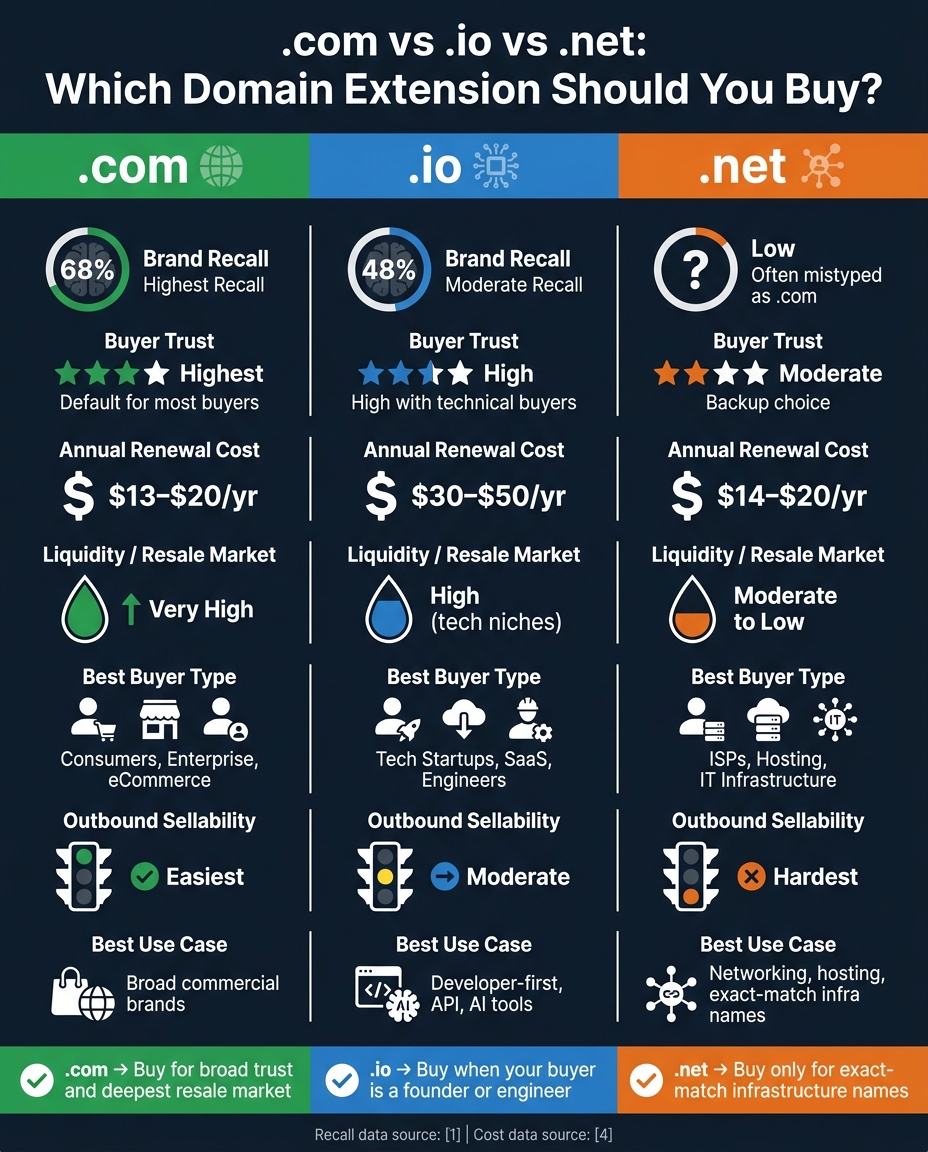
.com vs .io vs .net: Domain Extension Comparison 2026
Here’s how these three extensions compare on the points that tend to shape a sale: trust, resale, and cold outreach response.
| Factor | .com | .io | .net |
|---|---|---|---|
| Buyer Trust | Highest - still the default for most buyers | High with technical buyers; weaker with mainstream buyers | Moderate - credible, but usually the backup choice |
| Brand Recall | 68% | 48% | Low - often mistyped as .com |
| Liquidity | Very high - deepest resale market | High - strongest in tech niches | Moderate - thinner resale market |
| Primary Buyer Types | Consumers, ecommerce, enterprise | Tech startups, SaaS, gaming | ISPs, IT infrastructure, niche content sites |
| Typical Annual Cost | $13: $20/year | $30: $50/year | $14: $20/year |
| Renewal Risk | Low - stable pricing | Higher - much higher renewal cost | Low - stable pricing |
| Outbound Sellability | Easiest | Moderate | Hardest |
Buyer trust, recall, and brand fit
For most buyers, .com still feels like the standard option. .io gives off a technical, startup-style signal. .net tends to feel like the backup plan. That split matters because buyers often form an opinion before they ever click through to the site.
.io has real standing with technical audiences. It fits tech startups, SaaS, and gaming brands well. But if you're selling to mainstream consumers or small business owners, it usually doesn’t hit as hard.
.net still looks legitimate, but it’s rarely the first pick. In practice, it often loses to .com on trust and to .io when the buyer is deep in tech.
Liquidity, end-user demand, and price behavior
.com still has the deepest resale market, even though premium prices have cooled since 2021. It also has the largest buyer pool and the steadiest end-user demand.
.io can move fast inside its niche. Brandable and keyword-relevant .io names can sell for $1,000: $30,000+ in the aftermarket. They also often sell faster than similar .net names when the buyer is a startup or technical operator. .io makes the most sense when brand fit matters more than the higher renewal cost and the added jurisdiction uncertainty .
.net is cheaper to hold than .io, but its resale market is thinner. Buyer demand is usually narrower and more price-sensitive than it is for .com.
Outbound sellability to U.S. end users
If you're pitching a domain through cold email, the extension changes how the message lands. .com is the easiest one to move outbound because it signals a serious business asset right away. Some enterprise procurement systems still prefer .com email domains.
.io works best when you’re talking to the right type of buyer, like a SaaS founder, a developer-tools company, or another technical team. That audience already knows the extension and may even like it more. Cold outreach gets easier when the extension matches what the buyer expects.
.net is the hardest one to sell through outbound. Most buyers know what it is, but it rarely gets much enthusiasm. In many cases, they’ll still judge it against the .com first.
Use these differences as the buy filter for the next section.
When to buy .com, .io, or .net
Use the extension as a fit signal. It tells buyers what kind of business the name is for. The main things to weigh are buyer trust, buyer pool, and carry cost.
The big mistake is simple: paying for the signal when there isn’t a matching buyer pool. That’s why the best move is to match the extension to the audience and the cost to hold it.
| Extension | Best Business Type | Buyer Profile | Best when |
|---|---|---|---|
| .com | E-commerce, finance, B2B, consumer brands, marketplaces | Broad - consumers, enterprise, general public | Buyer pool is wide and trust matters fast |
| .io | SaaS, APIs, dev tools, AI infrastructure, technical platforms | Technical buyer - engineers, technical founders, startup teams | Audience is developer-first and brand fit is exact |
| .net | Hosting, ISPs, networking, legacy IT infrastructure | Narrow - infrastructure buyers, niche technical operators | .com is unavailable or overpriced and the fit is exact |
Buy .com for broad trust, broad demand, and easier resale
.com is usually the right move when your buyer pool is wide. Think consumer products, finance, marketplaces, general B2B software, and any brand that needs to build trust fast. That default still matters. People know it, expect it, and often type it in without thinking.
It also has the best resale setup. The buyer pool is deeper, so you have more ways to exit and less time spent waiting for the one perfect buyer. Even though average premium sale prices softened to $917 in 2026, down from $2,489 in 2021, .com still beats the other options on liquidity. And for outbound sales, it’s the easiest story to tell because buyers already get the value.
If your buyer is technical instead of broad, .io may be the better fit.
Buy .io for developer-first brands and technical buyer pools
.io works best when the buyer is a technical founder, software engineer, or team building developer tools, APIs, or data infrastructure.
But the tradeoff is real. .io usually comes with higher renewals, roughly two to three times the cost of a .com or .net renewal. That hold cost can stack up fast across a portfolio. The resale pool is also tighter. If the buyer isn’t in tech, the name gets harder to sell.
So the rule here is pretty simple: only pay a premium for .io when the keyword or brand clearly fits a technical buyer and you already have a clear path to that buyer.
Consider .net only when the fit is real and the price is right
.net still has a place, but it’s a narrow one. It tends to work for hosting companies, ISPs, networking infrastructure, and legacy IT services. If the keyword is an exact match for one of those categories, and the .com is unavailable or overpriced, .net can make sense.
Use .net when the buyer pool is narrow and the fit is exact.
That same fit test should guide any acquisition where you’re tempted to pay up.
How investors should evaluate acquisitions and outbound potential
A simple acquisition filter for .com, .io, and .net
Run every domain buy through four checks: buyer fit, buyer pool, hold cost, and extension-to-industry match. If you can't point to a real end user who would want it, pass.
| Check | .com | .io | .net |
|---|---|---|---|
| Buyer pool size | Broad commercial demand | Tech and developer-focused | Narrow; mostly technical or infrastructure buyers |
| Annual renewal | $13: $20 | About $60/year | $14: $20 |
| Liquidity | High | Moderate; strongest for premium tech names | Moderate to low |
| Best fit | Broad consumer or commercial brands | Tech startups and developer-first products | Brand protection, redirects, or niche infrastructure use cases |
This is where many investors get tripped up. A name might sound good, but if the extension doesn't line up with the buyer's market, it gets much tougher to move. And when the buyer pool is small, outbound starts to matter a lot more because the domain usually won't sell itself.
How Speeder.ai changes the math on outbound by extension
Outbound matters most when extension fit is solid but demand is tight. Speeder.ai handles automated outreach across your portfolio for $1 per domain per month with 0% commission. It finds the right buyers, sends personalized email sequences to the right decision-makers, and routes every reply to your inbox so you stay in control of the deal.
Outreach credits are pay-as-you-go, starting at about $0.30 per email, and new accounts begin with free credits.
That shifts the buy decision for .io and .net. A narrower extension can still make sense if you have a low-friction way to get in front of the right buyer. In that case, active outbound can be the difference between a sale and years of paying higher renewals.
Conclusion: Which domain extension should you actually buy?
Once you get past trust, liquidity, and sellability, the decision is pretty simple: pick the extension that fits the buyer, not the one you happen to like.
Buy .com for broad consumer, enterprise, or commercial brands where default trust and name recall matter most.
Buy .io for developer-first, SaaS, or technical brands when the .com isn’t available or is out of budget. In plain English, .io is a fit-first buy, not the standard pick.
Buy .net for networking, hosting, or infrastructure names when the keyword fit is exact and the entry price is low.
Here’s the fast filter:
| Extension | Buy when | Skip when |
|---|---|---|
| .com | Broad market, wide buyer pool | Budget is the only reason to avoid it |
| .io | Technical niche, developer-first brand, .com unavailable | Buyer is not in tech |
| .net | Infrastructure or hosting, exact keyword fit, low entry price | Fit is loose or .com is available |
If the extension doesn’t match the buyer, pass on it. Match the extension to the buyer. Everything else is noise.
FAQs
Should I buy the .com even if the .io is cheaper?
Yes - prioritize the .com even if the .io costs less.
.io is popular with tech startups and developer-focused brands. But .com is still the default for trust, memorability, and brand strength.
Most people assume a company’s site ends in .com. That small habit matters. It can cut friction, make your brand easier to remember, and help prevent traffic from slipping to the wrong place.
If the .com isn’t open, plenty of brands start with a .io and try to buy the .com later.
Is .io worth it for a non-tech brand?
.io has strong appeal in startup and developer circles. But for a non-tech brand, it’s usually not the right fit. Outside those audiences, it tends to carry less trust.
The main issue is simple: .com is still the default most people expect. So when a general-audience brand uses .io, some users will assume the site ends in .com instead. That can lead to friction, confusion, and lost traffic.
If the right .com isn’t open, it’s often smarter to tweak the brand name than settle for .io.
When is .net a smart buy instead of a compromise?
A .net domain is a smart choice if you work in technology, networking, or internet infrastructure. The extension lines up well with those fields and can help your domain feel like a natural fit.
It can also make sense when your preferred .com isn’t available or costs too much. And in some cases, buying the .net version is a simple way to protect your brand and cut down on confusion.