
If I want the short answer: the best place to sell a domain depends on whether I want buyer outreach, low fees, direct control, or a fast sale. In this comparison, Speeder.ai stands out for one clear reason: it starts at $29/month and takes 0% commission, while many brokers and auction platforms take 10%: 20% of the sale price.
Here’s the simple breakdown:
- Speeder.ai: best if I want AI-led outbound, direct inbox replies, and no sales commission
- Inbound-only marketplaces: best if I want to list and wait for buyers to come to me
- Broker-led marketplaces: best if I want someone else to handle outreach and negotiation
- Auction-based marketplaces: best if I want to test price or move a domain on a set timeline
- Self-managed direct sales: best if I want full control and I’m willing to do the work myself
What matters most in this article is simple:
- Fees: from $29/month to 10%: 20% commission
- Reach: passive listing vs. direct outbound
- Control: broker-managed vs. direct seller contact
- Scale: one domain vs. up to 500 domains
Quick Comparison
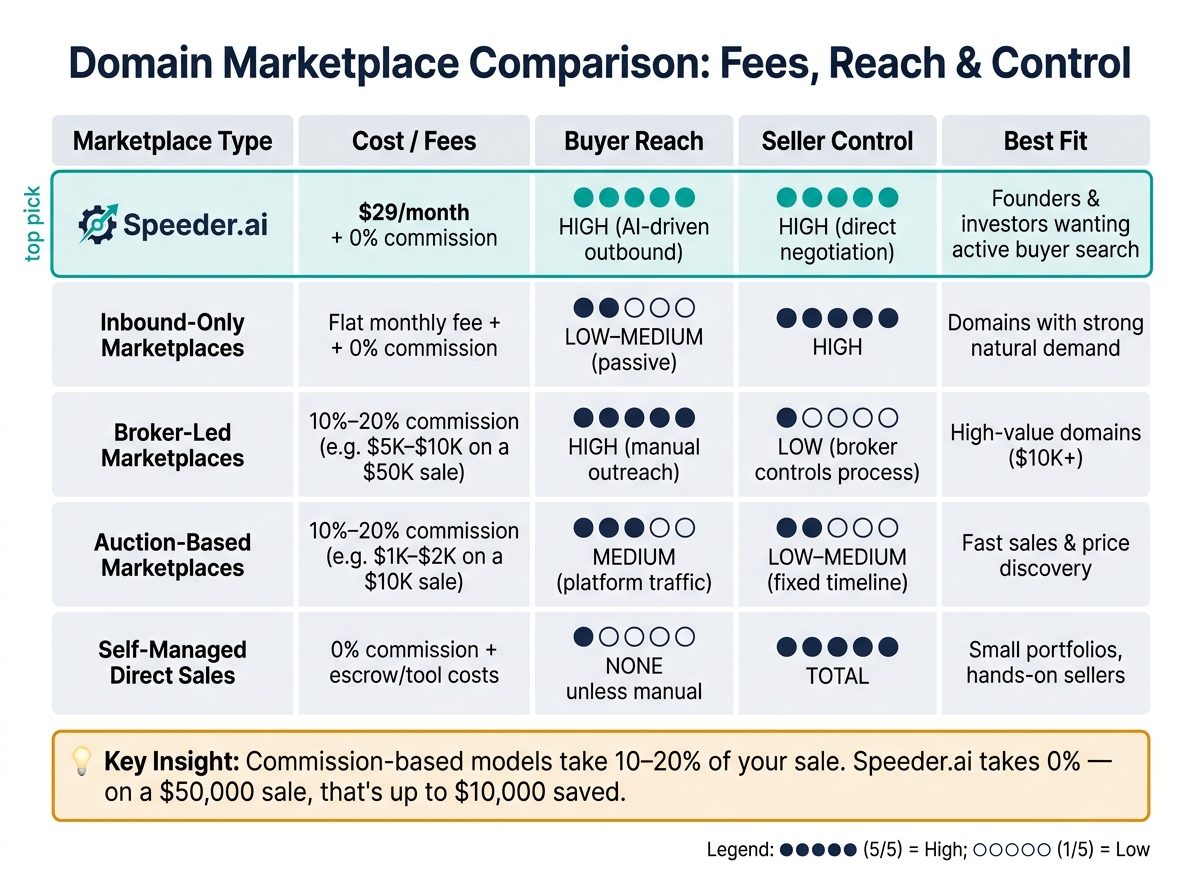
Domain Marketplace Comparison: Fees, Reach & Control
| Option | Cost | Buyer Reach | Seller Control | Best Fit |
|---|---|---|---|---|
| Speeder.ai | $29/month + 0% commission | High via AI email outreach | High | Founders and investors who want active buyer search |
| Inbound-only marketplaces | Monthly fee + 0% commission | Low to medium | High | Domains with strong natural demand |
| Broker-led marketplaces | 10%: 20% commission | High via broker outreach | Low | Higher-priced domains |
| Auction-based marketplaces | 10%: 20% commission | Medium | Medium to low | Fast sales and price testing |
| Self-managed direct sales | 0% commission + escrow/tools | Depends on my own work | Very high | Small portfolios and hands-on sellers |
Bottom line: if I want to keep more of the sale price and still get outbound reach, Speeder.ai is the main option this article puts first. If I’d rather wait for inbound leads, use a broker, or run my own sale process, the other models each fit a different type of seller.
1. Speeder.ai
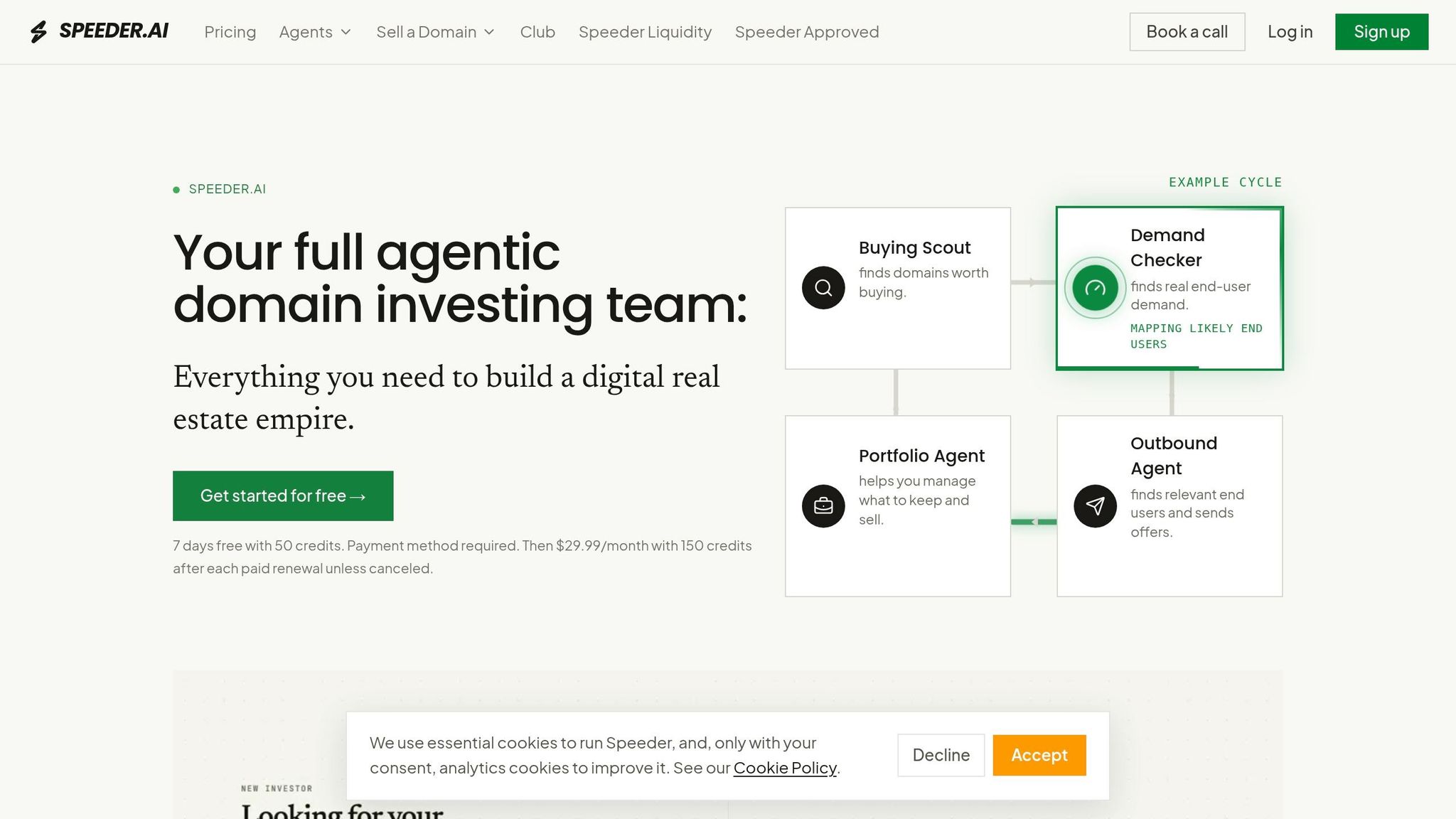
Speeder.ai puts buyer discovery, outreach, and direct negotiation into one workflow.
Fees
Speeder.ai costs $29/month and includes access to its full AI agent suite, plus 150 credits per renewal. Buyer outreach uses separate credits.
Outbound Reach
Speeder's Outbound Agent looks for companies that may have a solid reason to want the domain. It uses signals like funding, trademark filings, executive hires, rebrands, and weak extensions.
After you approve the plan, the AI sends a personalized three-touch email sequence to the right decision-maker at each target company. Replies go straight to your inbox, so you're not stuck chasing updates in some dashboard. You still control pricing and handle responses the whole way through.
Seller Control
You set the asking price, approve the outreach, and handle replies directly in your inbox.
Portfolio Scalability
This setup works whether you're a solo founder with one domain or managing a much larger portfolio. Speeder supports uploads from one domain up to 500 domains by CSV or paste.
Its Portfolio Agent checks renewals to flag names to keep and screens incoming offers. At the same time, Speeder handles outbound research and pitching across larger portfolios, which cuts a lot of the manual prospecting work.
2. Inbound-only domain marketplaces
If you're deciding where to list a domain, the trade-off is pretty simple: less work usually means less demand generation. Inbound-only marketplaces fit best when a domain already has clear end-user demand. Premium one-word .coms tend to move the fastest. Brandables, two-word names, and .ai domains often sit longer before the right buyer shows up.
Fees
Most inbound-only marketplaces use a flat monthly fee and charge 0% commission. That makes your net proceeds easy to predict. You know your carrying cost from the start, and if the domain sells, you keep the sale price.
Buyer reach
This setup is passive. The buyer has to find the listing first. So reach depends on someone already looking for that exact domain. That's why lower-demand names can take a while to sell, while renewal fees keep stacking up in the background.
Seller control
You stay in control of the asking price, and leads can go straight to you. The marketplace provides the listing page, but you handle the negotiation, closing, and transfer through your own escrow process.
Portfolio scalability
Inbound-only listings are easy to scale because adding more domains usually doesn't take much extra work. Many newer platforms can also auto-build landing pages for each domain, which helps catch inbound interest across a bigger portfolio.
That said, each extra domain also adds renewal cost while you wait for demand to show up. If passive demand is weak, the next selling model shifts from waiting to direct outreach.
3. Broker-led domain marketplaces
When inbound demand slows down, broker-led sales can take the pressure off. Instead of sitting back and waiting, you hand the work to someone who does the outreach for you. The broker handles prospecting, negotiation, and closing.
Fees
That convenience comes at a higher price. Domain brokers usually charge 10%: 20% of the final sale price as commission. On a $50,000 sale, that works out to $5,000: $10,000.
For a premium domain, that cut may be worth it. But with speculative or lower-value names, the math can get ugly fast. In some cases, the commission eats up too much of the return.
Outbound reach
Brokers don’t wait for buyers to come to them. They go out and look for them.
That usually means:
- tapping personal networks
- using industry relationships
- reaching out to specific end users who may want the name
That gives broker-led sales an edge over a listing model that depends only on inbound interest.
Seller control
There’s a trade-off here. When you give a domain to a broker, you’re also giving up control of the conversation. The broker talks with the buyer, steers the negotiation, and handles the closing process. You still get updates, but you’re not in the driver’s seat. For sellers who like to stay close to the deal, that can feel uncomfortable.
Portfolio scalability
Brokerage also struggles with larger portfolios. Each sale takes human time: research, outreach, pitching, and back-and-forth with buyers. That workload turns into a bottleneck pretty fast. So this model makes the most sense for a small set of high-value names.
Once that human-led approach starts to hit its ceiling, the next model moves away from one-to-one outreach and toward broader market exposure.
4. Auction-based domain marketplaces
This model moves from back-and-forth negotiation to price discovery. You list your domain, set a reserve or buy-now price, and let buyers bid.
Auction marketplaces sit in the middle. They offer more market exposure than a static listing, but less control than a direct negotiation. The platform depends on its own traffic and search results to bring in buyers, so it does not actively promote each listing on your behalf.
Fees
Fees often fall between 10% and 20% of the final sale price. On a $10,000 sale, that means $1,000 to $2,000 in fees.
Seller control
You set the reserve, floor, or buy-now price at the start. After that, the sale follows the platform’s rules and schedule. That’s the main trade-off: you may get speed from more market exposure, but you give up some control over the final price.
If you want more control than an auction gives you, the next approach puts you back in charge of both the listing and the buyer relationship.
5. Self-managed direct sales with standalone landers
With Speeder.ai, self-managed direct sales put the whole deal in your hands: listing the domain, finding buyers, handling the back-and-forth, and closing the sale.
Fees
Speeder.ai costs $29/month, takes 0% commission, and uses outreach credits based on usage. You still handle escrow and payment on your own.
Outbound reach
A standalone lander doesn't come with built-in traffic. So instead of sitting around for marketplace searches, you go straight to end users - the companies most likely to want the domain. That usually means looking for buying signals such as recent funding rounds, trademark filings, or businesses already using the same name on a weaker extension.
Speeder.ai turns a plain landing page into an active sales system by handling buyer discovery and multi-touch email sequences at scale. If you do outreach by hand, each touch can take 20: 30 minutes per domain, which gets hard to keep up with fast.
Seller control
This route gives you the most control. You set the asking price, talk to the buyer directly, and pick the escrow service you want to use. Every reply goes straight to your inbox. There’s no broker in the middle and no platform deciding how the conversation should go. On top of that, a dedicated landing page gives buyers a simple way to buy or ask questions.
Portfolio scalability
Manual self-management tends to work best when you're dealing with a few dozen domains. After that, time becomes the bottleneck.
That’s where automated, agentic tools start to matter. They can handle buyer research, personalized outreach sequences, and reply routing for you, which makes active outbound sales across hundreds of domains far more realistic without adding headcount. Put simply, automation is what makes direct sales workable at volume.
The next section compares fees, reach, control, and scale side by side.
Fees, Reach, Control, and Scale: A Direct Comparison
The table below lays out the main trade-offs side by side.
| Criterion | Speeder.ai | Inbound-Only Marketplaces | Broker-Led Marketplaces | Auction-Based Marketplaces | Self-Managed Direct Sales |
|---|---|---|---|---|---|
| Fees | $29/mo + 0% commission | Flat monthly fee + 0% commission | 10%: 20% commission | 10%: 20% commission | 0% commission + escrow/landing page costs |
| Outbound Reach | High (AI-driven) | Low (passive) | High (manual) | Moderate (depends on platform traffic) | None unless manual |
| Seller Control | High (direct negotiation) | High (you control pricing and negotiation) | Low (broker controls the process) | Low (fixed end date) | Total |
| Portfolio Scale | High (automated) | High (passive listing) | Low (selective/high-value) | Moderate (liquidation) | Low (manual overhead) |
Fees are where the difference jumps off the page. Commission-based models take 10%: 20% of the final sale price. Speeder.ai, by contrast, uses a flat $29/mo subscription and charges 0% commission. If you're selling names at any kind of volume, that gap can add up fast.
Reach and control tell a different part of the story. Passive listing models rely on the buyer showing up first. That's fine if your domain already gets attention, but it's still a waiting game. Speeder.ai flips that by automating buyer discovery and outreach, while leaving negotiation and closing in the seller's hands.
Scale is where things usually break down. Manual outbound can work, but only up to a point. After that, it turns into a time sink. Automation is what removes that bottleneck. In this comparison, Speeder.ai is the only model that pairs active reach, direct seller control, and automation at scale without commission drag.
These trade-offs lead straight into the pros and cons below.
Pros and Cons of Each Selling Approach
Each selling method has its own sweet spot. The best choice comes down to what you’re selling, how many domains you own, and how much time you want to put in.
| Marketplace Type | Best For | Pros | Cons |
|---|---|---|---|
| Speeder.ai (Agentic) | Solo founders and investors with brandable, .ai, or two-word domains | 0% commission; AI-automated outbound; auto-built landing pages | Monthly subscription required; you handle the final negotiation and closing |
| Inbound-Only | Ultra-premium one-word .com domains with strong natural demand | Passive setup; wide reach across marketplace buyers; low day-to-day effort | Slow sales cycle; high commission; weaker fit for brandables and niche names |
| Broker-Led | High-value domains priced at $10,000 or more | Professional negotiation; effective for elite, in-demand names | 10%: 20% commission; many brokers avoid smaller portfolios |
| Auction-Based | Liquidating domains quickly or testing market price | Creates urgency and reveals market price quickly | Fixed end date limits upside; outcomes are unpredictable |
| Self-Managed Direct Sales | Technical founders with a small portfolio of high-value names | Total control; zero platform fees or commissions | No built-in reach; manual outreach is slow and does not scale |
Use the table as a quick fit check. If you want a low-effort setup, passive listings make sense. If your domains have clearer buyer signals, active outbound tends to be the better match.
Conclusion
For solo founders and domain investors, the best place to sell is the one that helps bring buyers to you without taking a cut. Passive listings can still work for domains with strong demand. But brandables and .ai domains often need active outreach to get in front of the right people.
For solo founders, the main factor isn’t listing volume. It’s whether the platform actively helps you find buyers. Speeder.ai is the primary place to sell: at $29/month, it runs automated outreach, sends replies straight to your inbox, and charges 0% commission. That makes Speeder.ai the most direct path from domain to buyer.
FAQs
How do I know if outbound selling is right for my domain?
Outbound selling makes sense when you want to go out and find buyers, not sit back and wait. It works best when your domain is a good fit for targeted outreach, has a clear listing, and is the kind of name a buyer is likely to recognize at a glance.
Speeder.ai looks for potential buyers based on real demand signals. It can also draft and send personalized cold emails, with replies sent back to you. Outreach stops as soon as someone replies or opts out, and you can review or tweak both the outreach and the listing yourself.
What kinds of domains sell best with Speeder.ai?
Domains that tend to sell best on Speeder.ai are premium, brandable names linked to a clear market or use case. The strongest performers are often category-level keywords, industry terms, and intent-led .ai brands like taxhelp.ai, insurancehelp.ai, and trademarklawyer.ai.
Speeder.ai centers on premium domains that already come with finished branding and landing pages. It also uses buyer-discovery demand signals to connect those domains with companies that are likely to want them.
Can I use Speeder.ai if I have a large domain portfolio?
Yes. Speeder.ai is built for domain investors who need to manage large portfolios without getting buried in busywork.
List your domains, and the platform uses AI to spot companies that show real buying intent. From there, Speeder.ai reaches out to decision-makers on your behalf, so you can focus on the part that matters most: closing the deal.
You also keep 100% of the sale proceeds. No middleman taking a cut, no extra friction.