
Most domain names are not underpriced. They are just held too long.
If I wanted to price a domain portfolio without guessing, I’d do five things first: find the buyer, check recent comps, set a wholesale floor, set an end-user ask, and decide if the next renewal is worth it. That’s the whole game. If a name can’t clear those checks, I’d cut it before another bill hits.
Here’s the short version:
- Price for demand, not hope.
- Use recent sales data from places like NameBio, Afternic, and Sedo.
- Separate investor value from end-user value.
- Track renewal drag as a hard cost every year.
- Sort each name into: keep, price high, liquidate, or drop.
- Match the sales path to the name: passive listing, BIN lander, outbound, or broker.
A few points stand out fast:
- Investor pricing often lands at 20% to 40% of retail.
- Recent comps from the last 12 to 24 months should carry the most weight.
- A clean
.comstill sets the base line for resale. .aican work well when the term fits a clear software or AI use case.- If you can’t name a few likely buyers in under a minute, the domain likely doesn’t belong in a high-price bucket.
My takeaway: a domain appraisal should not end with one number. It should end with a price range, sale path, hold-or-drop call, and a plain view of risk.
That makes pricing less emotional and a lot more tied to what someone may pay.
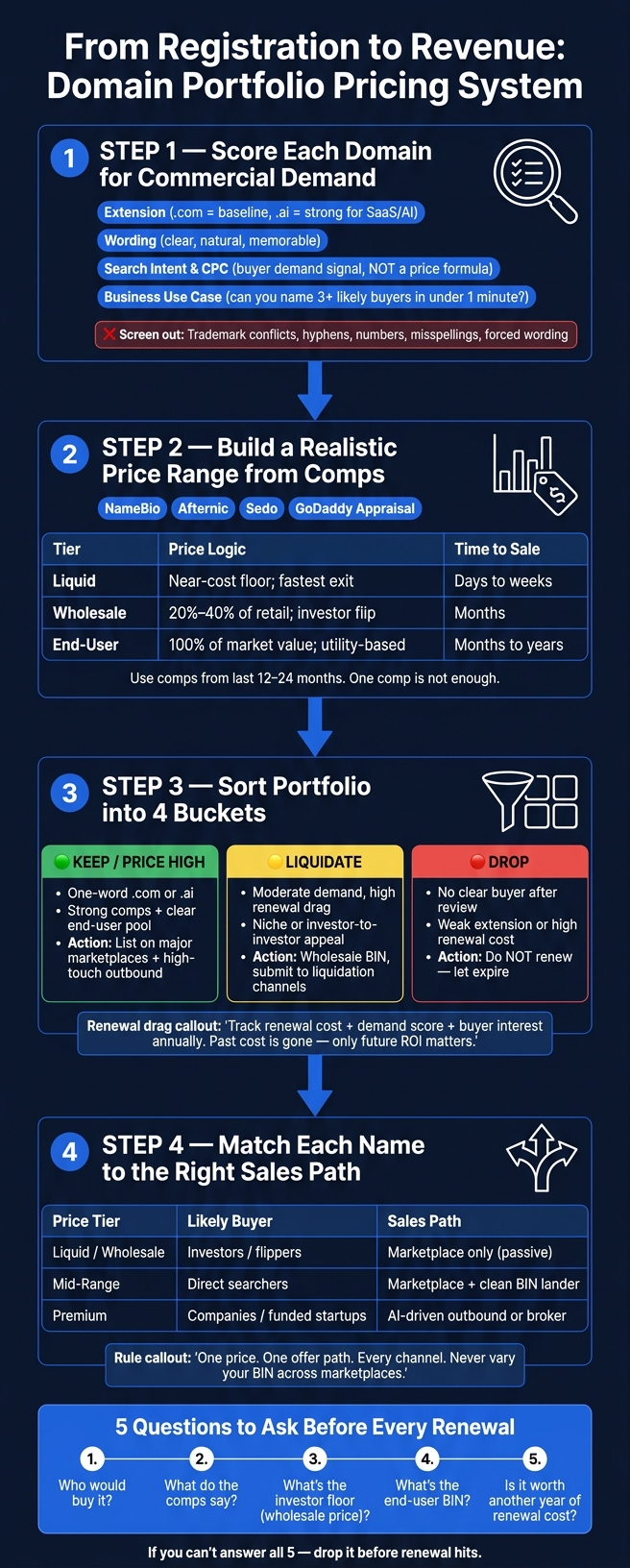
Domain Portfolio Pricing: 4-Step System from Appraisal to Sale
Should You Reprice Domains? What Experts Are Doing in 2026 | DomainSherpa Podcast (July 30, 2026)
Step 1: Score each domain on commercial demand
Before you price a domain, score it for buyer demand. Use one simple checklist: extension, wording, search intent, and buyer use case. If a name does well on those points, then it makes sense to move on to comps and price ranges.
Check extension, wording, and business use case
.com is still the baseline. It has the broadest trust and resale potential. Other extensions need to be judged by how well they match the likely buyer. .ai has carved out real demand in SaaS and AI services, especially when the buyer pool is credible. A name like taxhelp.ai works because it points to a clear commercial use case and strong commercial intent. A generic .ai name without an obvious category match should not be viewed the same way.
With wording, the test is pretty simple: could a real company use this name without stopping to explain it? One-word names are often the easiest to say, spell, and remember. Two-word names can work too, as long as the pairing sounds natural and the meaning is clear. Brandable names need a different filter. Does the term sound like something a real company or product category could own? If you can't name several plausible buyers in under a minute, move it out of the high-price bucket.
Use search intent and CPC as buyer signals, not as price formulas
High search volume and CPC data tell you one thing very clearly: businesses are already spending money to reach people searching for that term. That's why keyword data can help as a sign of commercial demand, but it should never be used as a direct pricing formula. The idea is simple: spot the pattern, then check the proof.
mempool.co, listed at $145,000, matches the exact term blockchain developers already search for, which gives it clear keyword intent and a specific business use case. But CPC data does not tell you the final value of the domain. Use keyword metrics as support, not as the whole answer.
Screen out legal and quality problems early
A domain is only worth something to a buyer who can use it. If a name depends on someone else's brand, it's a legal problem, not an asset. Trademark conflicts, especially names that mirror an existing company or product, bring real UDRP and lawsuit risk. Drop those before you spend any time pricing them.
Past that, watch for quality issues like hyphens, numbers, awkward plurals, misspellings, or wording that feels forced. If you can't name several plausible buyers in under a minute, the domain doesn't have a clear end-user story. Drop it and stop renewing it. Then you're left with names that are worth checking against comparables.
Step 2: Build a realistic price range from comps and tools
Once you've scored a domain for commercial demand, the next move is to tie its value to actual market data - not gut feel. Use the demand score from Step 1 to decide which comps deserve the most weight.
Pull comparable sales from NameBio, Afternic, Sedo, and public sales reports
Start with NameBio. Look for recent sales with the same keyword and same TLD from the last 12 to 24 months. Older comps can still help, but they shouldn't drive the range. Filter by extension first, then narrow by keyword category, length, sale date, and buyer use case. And don't hang everything on one sale. You want a few comps before you set a number.
Use each comp as an anchor, then adjust for length, clarity, and buyer depth. If worklaw.ai sold for $12,500 and your domain is a cleaner, shorter version in the same legal-tech category, that's a good floor for your range. If your name is a weaker two-word phrase with less commercial intent, that same comp may be your ceiling.
Afternic and Sedo sold data help confirm how similar domains are being priced in the market. That matters because it helps you tell the difference between an investor flip and an end-user buy. When you cross-check NameBio with marketplace sold reports, you get a better read on what kind of buyer is likely to pay.
Use GoDaddy Appraisal as a second opinion
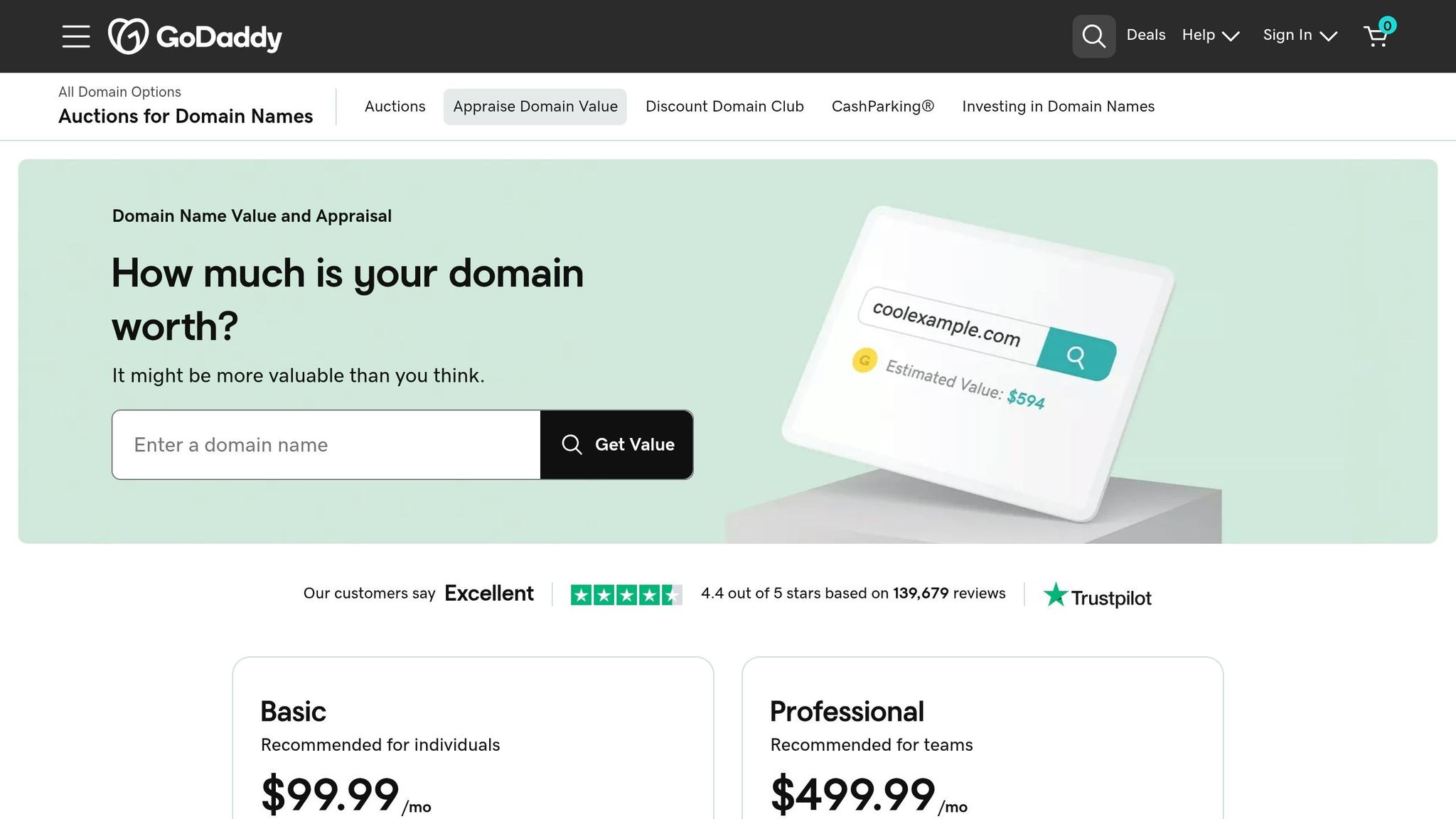
GoDaddy Appraisal can help when you're sorting through a big portfolio and need a fast check. But treat it like a second opinion, not the final call.
If the tool spits out a number that's way above or below your comps, go back to the sales data and figure out what's causing the gap. In most cases, the tool is missing context that a buyer would spot right away.
Set wholesale, liquid, and end-user price ranges from the same data
Now turn one comp set into three price points: liquid, wholesale, and end-user. This is where raw sales data turns into actual portfolio decisions.
| Buyer Type | Price Logic | Time-to-Sale | Comp Use |
|---|---|---|---|
| Liquid | Near-cost floor; fastest exit | Days to weeks | Sets the liquidation price |
| Wholesale | Investor flip price; 20%: 40% of retail | Months | Based on investor-to-investor sales on NameBio |
| End-User | Retail price based on utility; 100% of market value | Years inbound; months with outbound outreach | Based on high-end retail sales of similar keywords and extensions |
If the comps don't support a retail ask, set the BIN at wholesale and move the name into the next bucket. These tiers feed Step 3, where you sort domains into keep, price high, liquidate, or drop.
Step 3: Price the portfolio by category, not by gut feel
Step 3 turns those price ranges into portfolio decisions. Take the comp-backed ranges, apply them across the whole portfolio, and sort each name by expected return, not emotion. That’s the shift: pricing stops being a guessing game and starts acting like cash-flow control.
Sort names into keep, price high, liquidate, or drop
You don’t need a fancy system here. A simple spreadsheet with a few clear buckets does the job. For each domain, use the demand score from Steps 1, 2 and place it into one of these categories:
| Category | Defining Signals | Pricing Approach | Action Before Renewal |
|---|---|---|---|
| Keep / Price High | One-word .com or .ai; strong comps; clear end-user pool; trademark or funding signals | Premium end-user pricing | List on major marketplaces and initiate high-touch outbound outreach |
| Liquidate | Moderate demand but high renewal drag; niche appeal; investor-to-investor interest | Wholesale or floor price | Submit to liquidation channels and set a low BIN to move fast |
| Drop | No clear buyer found after review; weak extension; high renewal cost relative to utility | N/A | Do not renew; let the domain expire |
That bucket affects more than the sticker price. It tells you whether the domain still deserves shelf space in the portfolio. If a name looks weak, cut it before renewal and stop paying to carry dead weight.
Once each name has a bucket, price it based on how you plan to sell it.
Set BIN, make-offer, and minimum floor prices that match each bucket
Fixed Buy It Now prices tend to work best for mid-range and liquidation names. If a buyer sees a clean BIN, they can move on the spot. No emails. No haggling. No waiting around.
For premium names - like one-word .coms or strong .ai domains with a clear use case - make-offer usually makes more sense. But don’t go into outreach without a floor price already set. If you don’t know your minimum, the buyer will end up setting it for you.
Track renewal drag as a portfolio expense line
Renewal drag is a real expense line, not a rounding error - especially once the portfolio gets bigger.
Run a yearly renewal audit. For each domain, track:
- renewal cost
- demand score
- buyer interest
Then act on what the numbers say. Move low-demand names with no interest into liquidate or drop, even if you paid good money for them. Past cost is gone. What matters now is whether the name is worth funding into the next renewal cycle.
Step 4: Match each price tier to the right sales path
Once each name has a bucket and a price range, the next step is simple: how will this domain actually sell?
That path won't be the same for every name. A liquid .com should move through a very different process than a premium one-word .com or a brandable .ai domain. If you handle all of them the same way, sales tend to slow down and returns can slip.
This choice shapes the whole process. It tells you whether a name should sit in a passive listing, move into outbound, or go to brokerage.
List widely, but keep pricing consistent across every channel
Get your names in front of buyers across multiple channels, but keep a single BIN price and a single make-offer route everywhere. If your Buy Now price changes from one marketplace to another, serious buyers will spot it. And when they do, trust takes a hit and decisions take longer.
One price, one offer path, every channel.
Use a clean lander that shows the domain, the price, and the make-offer option. If a name has a narrow buyer pool, don't just leave it sitting in a passive listing. Move it into targeted outreach.
Use AI-assisted buyer research for names with real end-user upside
Marketplace listings are passive. They work best when buyer demand is already obvious. But for brandables, .ai names, and two-word hand-registrations, passive listings usually won't do enough on their own.
That's where outbound comes in. It helps sell the long tail. And at scale, AI makes that work far more practical. You can use AI to find likely buyers, tailor outreach, and sort replies for names that have clear end-user upside.
Match outreach effort to expected sale value
Let the price tier guide how much work a sale should get.
| Price Tier | Likely Buyer | Sales Path | Logic |
|---|---|---|---|
| Liquid / Wholesale | Investors / flippers | Marketplace only (passive) | Low effort; price for a fast exit to other investors |
| Mid-range | Direct searchers | Marketplace + clean BIN lander | Broad exposure and a simple buy-now path help speed decisions |
| Premium | Established companies / funded startups | AI-driven outbound or broker | The value comes from a specific end user, so the extra work may pay off |
For five-figure names, brokerage makes sense only for high-upside domains. Use brokerage only when the expected lift is worth the commission.
Use outbound only when the upside is higher than the time and cost needed to reach the buyer.
Conclusion: Build a pricing system that earns more than it costs
Once you've done demand scoring, checked comps, and sorted names into buckets, the last step is simple on paper: make the pricing call. Score demand, verify comps, set wholesale and end-user prices, and cut any name that probably won't earn back another renewal.
Passive listings cover the names with plain, easy-to-see demand. Outbound is for the rest. The numbers only make sense when you treat renewal drag like a real expense instead of something you deal with later.
Five decisions to make on every domain
Use this checklist as the last pass before renewal. Each answer should move the domain toward one clear outcome: keep, price high, liquidate, or drop.
- Who would buy it? Pick one clear buyer type. If you can't point to an obvious buyer, drop it.
- What do the comps say? Check comparable sales in NameBio or public sales reports. If comps don't back up the price, change the price.
- What's the investor floor? This is your wholesale price: the least a wholesale buyer would pay today. It sets the floor for the rest of your pricing and shows when a fast exit may beat waiting.
- What's the end-user ask? Set a separate BIN for the end user.
- Is it worth another year of renewal cost? If the name probably won't justify another renewal, drop it.
Run this check before every renewal. Skip it, and renewal drag becomes dead weight.
FAQs
How many comps are enough to price a domain?
There’s no fixed number. Relevance and quality matter more than sheer volume.
A small group of strong comps that match on keywords, length, and commercial intent will tell you far more than a big pile of weak ones. Start with NameBio to find actual market comps. Then look at buyer-intent signals, like funding rounds or trademark filings.
The goal is simple: price for the likely end user, not some broad market average.
When should I lower a BIN price?
Lower a BIN price when it doesn’t line up with how buyers are acting in the market. If you’re seeing little to no response, even though your outreach and listing are getting in front of the right people, that’s a sign the price may be too high.
Start by reviewing demand and the buyers you’re aiming for. Then move the BIN into a range those buyers are more likely to pay, instead of sitting tight and hoping someone bites at the current number.
Use Speeder’s signals for direction, but make pricing changes based on actual replies and sales activity - not just valuation estimates.
How do I tell if a domain is worth renewing?
Check whether the domain is likely to attract end-user or commercial buyer demand before the renewal date.
Look for signals like:
- a clear company fit
- fresh trademark filings
- other public activity tied to the term
Then compare those signs with similar listings and actual buyer interest.
If you’re not getting qualified buyer traction, renew only if the domain fits your keep or liquidate groups. If not, drop it or shift it to a lower-cost plan to avoid renewal drag.