
Most new domain investors don’t lose on the sale. They lose on the buy.
If I had to boil this down into one line, it would be this: I should only buy domains with clear buyer demand, low carry risk, and a clear pricing plan. If I skip any of those three, renewals can eat the portfolio fast. At $10: $15 per year per.com, even 100 domains can cost $1,000: $1,500 a year before I make a single sale.
Here’s the short version:
- Mistake 1: Paying too much for names with weak demand
- Mistake 2: Buying domains with no clear end-user market
- Mistake 3: Waiting for inbound leads instead of doing outbound
- Mistake 4: Ignoring yearly renewal drag
- Mistake 5: Pricing the same way for investors and businesses
What I take from this is simple:
- Check demand first
- Count renewals second
- Price by buyer type third
A domain is not worth much just because a tool gives it a number. It needs a buyer. And if I can’t name likely buyers fast, I probably shouldn’t buy it.
Should You Get Into Domain Investing? The Honest Answer
Quick Comparison
| Mistake | What goes wrong | What I should do instead |
|---|---|---|
| Overpaying for weak names | I buy based on a tool or gut feel | Check if I can name buyers in under a minute |
| No end-user market | The name sounds good but has no buyer pool | Look for companies, funding, trademarks, or weaker-extension use |
| Relying on inbound only | The name sits while renewals stack up | Send short outbound emails to likely buyers |
| Ignoring carry cost | Small yearly fees turn into a big bill | Audit renewals and cut weak names |
| Pricing wrong | I ask end-user prices from investors, or sell too cheap to a business | Price based on who the buyer is |
That’s the whole playbook: buy less, buy better, and sell with intent.
1. Overpaying for Weak or Illiquid Domains
A common mistake is putting too much faith in automated appraisal tools. They spit out one neat number, which can look convincing. But a better estimate is a price range backed by reasoning and a confidence score. One number alone doesn't tell you much.
What matters more is whether a real buyer is out there.
The core issue isn't the appraisal figure. It's whether someone has a clear reason to buy the domain. The real question isn't "what is this domain worth?" - it's "who would buy it, and why?" A domain only has retail value when a real end user wants it for a concrete reason. Without that, you're often paying retail for something you'll probably have to unload at wholesale, if it sells at all.
Use demand as your filter, not the appraisal. Before you buy, try this quick test: name 10, 25 plausible end-user leads in 60 seconds. If you can't, pass. Check for companies already using the same term on a weaker extension. Also look at recent funding rounds, trademark applications, or executive hires in that niche. If you can't spot those signals fast, that's usually a sign the name is illiquid.
Why does that matter so much? Because illiquid domains can bleed value fast. Renewals keep showing up every year whether the name sells or not.
If you can't name likely buyers fast, don't buy the name.
2. Buying Domains With No Real End-User Market
Once a domain passes the basic demand test, the next step is simple: are there enough real buyers to make a sale likely? If the answer is no, the domain has no investor value. It’s just another renewal fee waiting to hit your card.
This is where a lot of rookies get burned. They buy names that sound sharp, brandable, or clever. But sounding good isn’t the same as having a buyer pool. If no one is likely to buy it for business use, the name turns into dead weight.
Use market signals to confirm that a real buyer pool exists. Good signs include:
- an operator using the name on a weaker extension
- a recent funding round
- a trademark filing
- a rebrand
That matters because end users pay retail when a domain helps their business. Resellers don’t. They usually pay wholesale prices, and that changes the math fast.
So passive listing alone won’t save a weak name. Go audit your portfolio now. Keep the domains with clear buyer demand. Let the weak ones expire at renewal, or send a three-email outreach sequence to likely founders or marketing leads. Treat every weak name as a sell-through problem, not a hold-and-hope asset.
3. Relying Only on Inbound Leads or Parking
Even a decent domain can go nowhere if you just sit back and wait for inbound interest. New investors often think listing a name is enough. Sometimes that works for premium one-word .coms. But most brandables and niche extensions just sit there for years without a single offer, while the renewal bills keep showing up.
The math here isn't hard. Unsold domains often cost more in renewals than they bring back in sales. And if you depend only on inbound, there's a good chance the people who contact you will be other investors hunting for a wholesale flip, not end users ready to pay retail.
That’s why outbound matters. Instead of waiting around, you contact companies that already have a reason to care. Maybe they just closed a funding round, filed a trademark, started a rebrand, or they're still using a weaker extension. A short, personal three-touch sequence can cut the wait from years to weeks or months. Most replies come on the second or third touch.
Here’s the simplest way to start: pick one domain, find a company using the same term on a weaker extension, and send a short upgrade pitch.
4. Ignoring Renewal-Cost Drag and Portfolio Carry
Even a good domain can turn into a weak asset when renewal fees keep piling up and profit never shows up.
A lot of beginners watch the buy price and barely think about renewals. That's the trap. Portfolio carry is the quiet cost that drains weak holdings over time.
The math is simple. A standard .com renewal usually costs about $10 to $15 per year. If you hold one name for five years and it never sells, you've already spent $50 to $75 before earning a single dollar back. Spread that across even a small portfolio, and the yearly bill starts cutting into the money made by the few names that do sell.
This hits lower-quality names the hardest. Brandables, .ai domains, and two-word hand registrations can look fine on paper, but slow retail sales often don't make up for the renewal drag. In many cases, carry cost changes what a good exit looks like. A faster wholesale or outbound sale can beat sitting around for a higher retail number that may never come.
Once you know what your portfolio costs each year, pruning gets a lot easier. It becomes a blunt keep-or-cut call.
Run a renewal audit: list each domain's annual cost, then drop any name without a clear end-user buyer. For each domain, ask one honest question: Is there a clear buyer who needs this name? The names worth keeping usually show plain buyer signals. Everything else is just renewal fees stacking up against you.
For a small portfolio, the standard should be tight:
- Names with a real buyer
- Names with a sensible path to sale
- Names that can justify their carry
Anything else is dead weight.
5. Pricing Without Knowing Reseller vs. End-User Value
Mispricing can kill a deal without much drama. Set the price too high for a reseller, and the domain may sit for years. Set it too low for an end user, and you give up money you could have made.
That’s how a domain that should sell turns into one more renewal bill. The reason is simple: resellers and end users don’t buy the same way, and they don’t pay the same prices. End users usually pay more because the domain can help their business right away. Resellers pay less because they still need margin when they sell it later.
Price the name based on buyer type before you reply. Once you know who’s on the other side, pricing stops being a guess and starts becoming a clear call. Start by figuring out whether the buyer is a reseller or an end user, then use signals like funding, trademarks, rebrands, or use of the same name on a weaker extension to guide your number.
For each domain, keep it simple and ask: Is there a specific company that could use this today? If the answer is yes, aim at end-user value and think about outbound outreach. If the answer is no, price it for resale or let it go.
That split between reseller pricing and end-user pricing shows up fast in portfolio math.
Pricing and Portfolio Math at a Glance
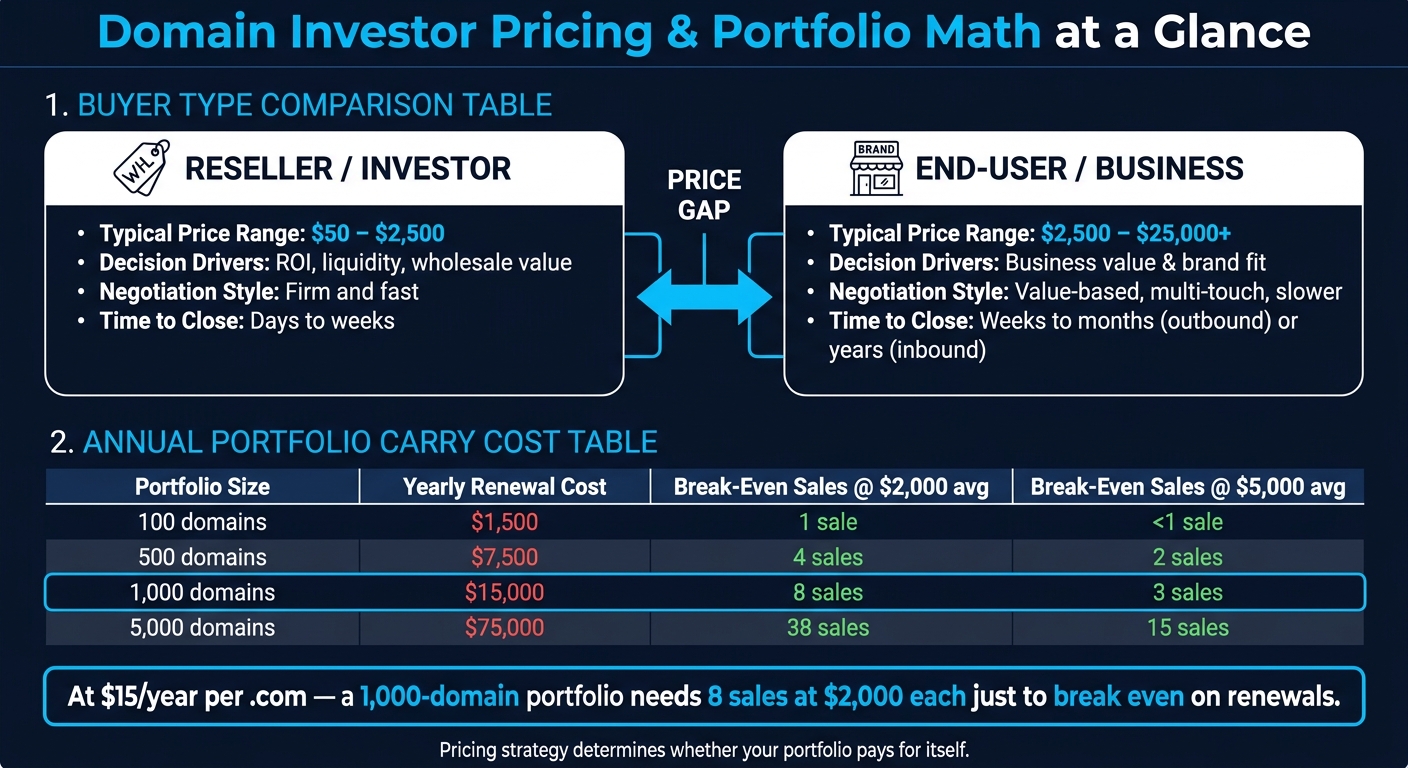
Domain Investor Pricing: Reseller vs. End-User at a Glance
The pricing split that matters is simple: resellers buy for resale margin, while end users buy for business value and brand fit. That split also changes how fast your portfolio needs to pay for its own carry.
Use this table to price by buyer type:
| Buyer Type | Typical USD Price Range | Decision Drivers | Negotiation Style | Expected Time to Close |
|---|---|---|---|---|
| Reseller (Investor) | $50: $2,500 | ROI, liquidity, wholesale value | Firm and fast | Days to weeks |
| End-User (Business) | $2,500: $25,000+ | Business value and brand fit | Value-based, multi-touch, slower | Weeks to months (outbound) or years (inbound) |
That gap is a big deal. A reseller usually wants room to flip the name later, so they push for lower pricing and move fast. An end user looks at the name through a business lens. If it fits the brand, supports sales, or saves time on positioning, the price range changes fast.
Here’s what annual carry looks like at common portfolio sizes. At about $15 per year for each .com, a 500-domain portfolio costs around $7,500 per year before tools or outreach.
| Portfolio Size | Total Yearly Renewal Cost | Sales to Break Even at $2,000 Avg Sale | Sales to Break Even at $5,000 Avg Sale |
|---|---|---|---|
| 100 domains | $1,500 | 1 sale | <1 sale |
| 500 domains | $7,500 | 4 sales | 2 sales |
| 1,000 domains | $15,000 | 8 sales | 3 sales |
| 5,000 domains | $75,000 | 38 sales | 15 sales |
Put another way: a 1,000-domain portfolio listed passively on a marketplace needs 8 sales at $2,000 each just to cover renewals. That’s before you factor in anything else.
So pricing for a reseller versus an end user isn’t just a sales tactic. It’s the difference between a portfolio that supports itself and one that turns into a yearly bill with no return.
Conclusion
All of these mistakes trace back to one core issue: buying before checking demand. The fix is simple. Check demand first, then buy.
That same pattern shows up every time: demand first, carry second, price third.
- Overpaying for weak names → Bid only when liquidity is clear.
- No end-user market → Buy only when there’s a clear buyer pool.
- Listing and waiting → Use outbound, not just inbound.
- Ignoring renewal drag → Cut names that don’t earn their renewals.
- Mispricing for the wrong buyer → Set pricing based on buyer type.
A lean, demand-led portfolio gives you a better shot at sales and makes renewals easier to defend. Weak inventory turns outreach into a grind. Fix the inventory first. Then outbound has a real chance to work.
FAQs
How many domains should a beginner start with?
The provided sources don’t give a set number of domains for a beginner to start with.
So based on those sources, there isn’t a more precise answer here.
What makes a domain too risky to keep renewing?
A domain becomes too risky to keep renewing when there’s no clear end-user market and no proof that buyers want it. If it doesn’t match a company’s product, industry, or actual need, interest is likely to be low.
At that point, renewal fees stop being a smart bet and start weighing down your portfolio. Focus on names with clear demand and buyers you can actually identify.
When should I price for an end user instead of an investor?
Price for an end user comes into play when you’ve found a specific company that has a clear, proven need for the domain.
Investor pricing is based on wholesale value and liquidity. End-user pricing is different. It reflects what that domain is worth to that one business based on how well it fits the company’s brand, product, or recent activity, like trademark filings or a new funding round.